Endometriosis in Perimenopause: What Changes and What Doesn’t
Changing periods can blur the picture, but the type and timing of symptoms still offer useful clues.
Perimenopause can make periods less predictable, heavier or lighter, while endometriosis may still cause pelvic pain or pain during sex. Some endometriosis symptoms ease as menopause approaches, but that isn’t guaranteed. Look at pain and bleeding as separate changes, rather than assuming one diagnosis explains both. Heavier bleeding than before, or any bleeding after 12 months without a period, warrants a check. 158
Two changes can happen at once
If you’ve lived with endometriosis for years, a changing period may raise a fair question: is this perimenopause, endometriosis, or both? Perimenopause often changes how frequently you bleed and how heavy or light your periods are. Endometriosis can also be associated with heavy bleeding and pain. The overlap means a changed period alone cannot tell you which is responsible. 58
Pain adds another part of the picture. Endometriosis can cause pain during or after sex, and it may involve areas around the uterus, ovaries, bowel or bladder. Perimenopause can bring symptoms of its own, including hot flashes. Having a hot flash doesn’t explain new pelvic pain; having endometriosis doesn’t mean every new symptom comes from it. 127
What might change as menopause approaches?
Endometriosis symptoms often improve after menopause, but they can continue. In one study of women ages 39 to 55 with endometriosis, heavy bleeding and pain tended to fade among those who also had menopausal symptoms. That describes a group trend, not a timetable for any one woman. It also doesn’t mean you should wait for menopause to address pain that is affecting your life. 15
An irregular cycle can make an old pattern harder to recognize. For example, if pain used to arrive with a predictable period, you may now have longer gaps between periods or bleed unexpectedly. It helps to describe the pain on its own terms: where it is, whether sex brings it on, and whether it has changed along with the bleeding. Those details are more useful than trying to label every symptom ‘endo’ or ‘perimenopause’ before it has been assessed. Endometriosis symptoms can resemble those of other conditions, and diagnostic guidance calls for considering other causes of symptoms too. 168
Bleeding deserves its own attention
Periods may become irregular, lighter or heavier during perimenopause. Even so, if you’re still having periods and are bleeding more than you used to, bring that change to a clinician rather than writing it off as the transition. If you’ve gone 12 months without a period and then have any vaginal bleeding, it needs to be checked, even if it’s only a small amount. These are bleeding questions, whether or not you have an endometriosis diagnosis. 8
Hormonal treatment can further blur the timeline. Hormonal contraception can alter bleeding, making it harder to tell where you are in the menopause transition. Menopause guidance also notes that hormonal treatment for heavy bleeding can complicate identification of menopause. If your bleeding pattern changes while you’re using a hormone treatment, its name and when you started or changed it are relevant parts of the story. 78
Treatment depends on which symptom needs help
There isn’t one treatment decision called ‘treating endometriosis in perimenopause.’ Endometriosis care may focus on managing pain, with medicines or, in some circumstances, surgery. Menopause treatment may instead focus on bothersome hot flashes. Menopause hormone therapy is the most effective treatment for those vasomotor symptoms, and nonhormonal options with supporting evidence also exist. A treatment aimed at hot flashes should not be assumed to treat endometriosis pain. 1236
This distinction matters if you’re considering a change in hormone treatment. The benefits and risks of menopause hormone therapy vary with the treatment and the person using it; if you have endometriosis, your pelvic pain and treatment goals matter alongside your menopause symptoms. A useful starting point is to name the problem you most want to improve: pelvic pain, bleeding, hot flashes, or more than one. That keeps a change intended to help one symptom from obscuring another that needs attention. 128
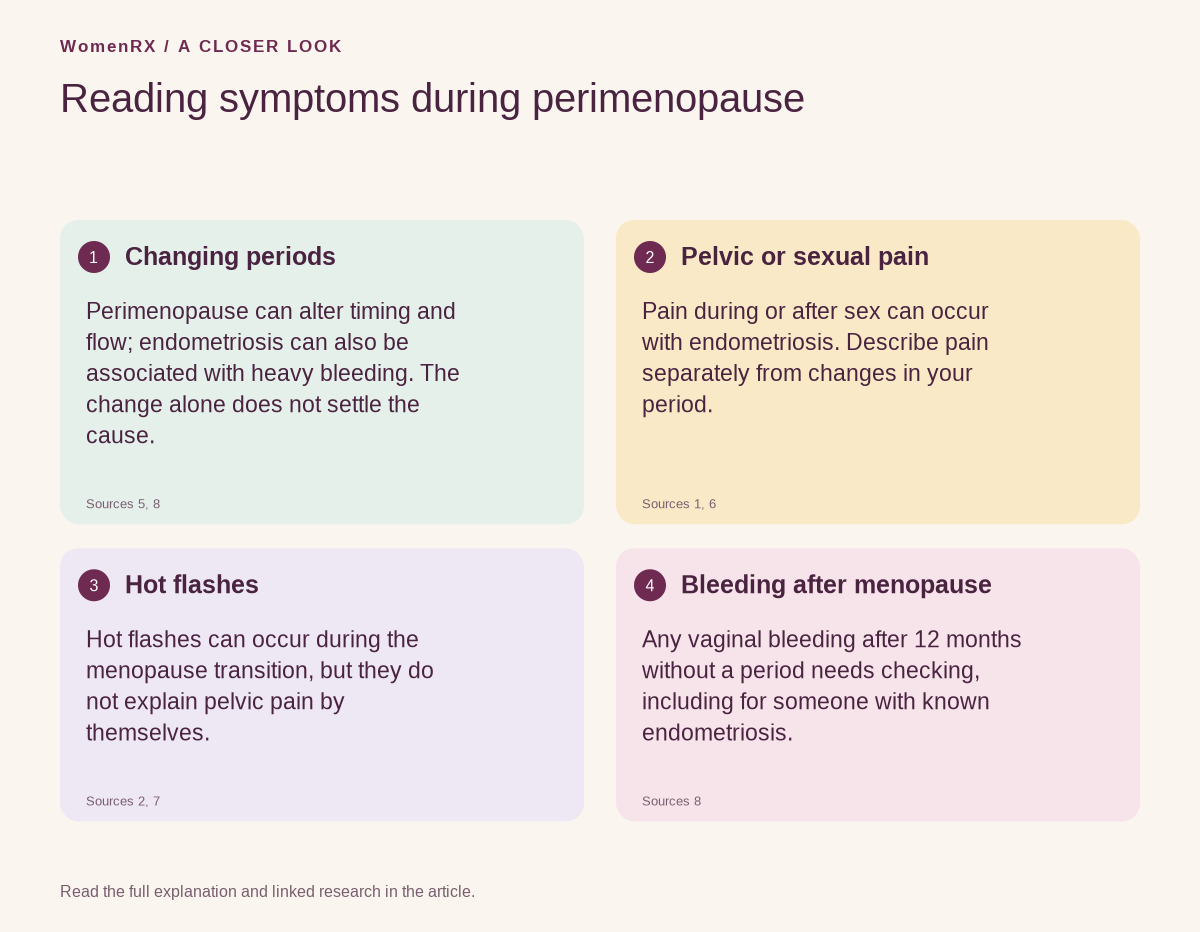
Reading symptoms during perimenopause
Changing periods: Perimenopause can alter timing and flow; endometriosis can also be associated with heavy bleeding. The change alone does not settle the cause.58
Pelvic or sexual pain: Pain during or after sex can occur with endometriosis. Describe pain separately from changes in your period.16
Hot flashes: Hot flashes can occur during the menopause transition, but they do not explain pelvic pain by themselves.27
Bleeding after menopause: Any vaginal bleeding after 12 months without a period needs checking, including for someone with known endometriosis.8
Read the figure as text
These patterns can overlap. The comparison shows what each change may suggest and where a familiar explanation is not enough.- Changing periods: Perimenopause can alter timing and flow; endometriosis can also be associated with heavy bleeding. The change alone does not settle the cause.58
- Pelvic or sexual pain: Pain during or after sex can occur with endometriosis. Describe pain separately from changes in your period.16
- Hot flashes: Hot flashes can occur during the menopause transition, but they do not explain pelvic pain by themselves.27
- Bleeding after menopause: Any vaginal bleeding after 12 months without a period needs checking, including for someone with known endometriosis.8
More questions, answered
Does endometriosis always go away after menopause?
No. Symptoms usually stop after menopause, but symptoms after menopause are possible. A new episode of vaginal bleeding after 12 months without a period needs checking rather than being attributed to endometriosis. 18
Can endometriosis treatment cause menopause-like symptoms?
It can. In a small trial of women treated with a gonadotropin-releasing hormone agonist after surgery for advanced endometriosis, both treatment groups reported menopause-like symptoms. Those treatment-related symptoms are not, by themselves, proof of natural menopause. 4
Sources you can check
- Endometriosis - NHSAccessed 2026-09-25Return to first citation
- The 2022 hormone therapy position statement of The North American Menopause Society.“The 2022 Hormone Therapy Position Statement of The North American Menopause Society” Advisory Panel. · Menopause (New York, N.Y.) · 2022Return to first citation
- The 2023 nonhormone therapy position statement of The North American Menopause Society.Menopause (New York, N.Y.) · 2023Return to first citation
- Curative effect of 1.88-mg and 3.75-mg gonadotrophin-releasing hormone agonist on stage III-IV endometriosis: Randomized controlled study.Tang H, Wu R, Li X, Zhou Y, Liu Z, Wang C, Chen Y, Zhang F. · The journal of obstetrics and gynaecology research · 2017Return to first citation
- [CLINICAL FEATURES OF ENDOMETRIOSIS IN WOMEN IN PERIMENOPAUSE].Zakharenko N, Kovalenko N, Manoliak I. · Georgian medical news · 2018Return to first citation
- Recommendations | Endometriosis: diagnosis and management | Guidance | NICEAccessed 2026-09-25Return to first citation
- Recommendations | Menopause: identification and management | Guidance | NICEAccessed 2026-09-25Return to first citation
- Symptoms of menopause and perimenopause - NHSAccessed 2026-09-25Return to first citation