Vitamin D After 40: What Changes, and What Doesn’t?
Your birthday or menopause alone doesn’t settle whether you need a vitamin D supplement; bone health, intake, and personal risk matter more.
Vitamin D helps your body absorb calcium and maintain bone, but the guidance summarized here doesn’t single out age 40 or menopause as an automatic reason to start a supplement. Adult recommended intake varies by age, while testing and supplementation are better considered in light of individual risk. Correcting a deficiency has a clearer skeletal rationale than taking extra vitamin D without one. 1 3
Vitamin D matters to bone health at every adult age: it helps the body absorb calcium and supports normal bone mineralization. But turning 40, entering perimenopause, or reaching menopause doesn’t by itself tell you whether you need a supplement or a blood test. The useful distinction is between meeting routine intake needs and correcting a deficiency or another specific risk. 1
Age and menopause aren’t the same as a new requirement
The adult recommended intake summarized by the National Institutes of Health’s Office of Dietary Supplements ranges from 600 to 800 IU a day, depending on age. It is a target for total intake, not an instruction to take that amount as a pill. The guidance is framed by age, not by perimenopause or menopause, and it doesn’t name age 40 as a turning point. 1
Menopause still makes bone health a reasonable topic to revisit. Vitamin D is part of the system that supports bone, but that doesn’t mean every woman needs extra vitamin D to prevent bone loss. A 2026 systematic review of complementary therapies for menopause reported moderate-certainty evidence for vitamin D and fracture risk, while noting that evidence for many complementary approaches was limited. That finding doesn’t establish that every woman in midlife benefits from a supplement, or identify a menopause-specific dose or testing schedule. 5
When supplementation has a clearer purpose
The strongest practical case is correcting a known deficiency or addressing circumstances that raise the chance of low vitamin D. A 2026 review concluded that meaningful skeletal benefits are mainly seen in people with deficiency. That makes targeted correction a different decision from taking extra vitamin D for general bone protection when there’s no known deficiency. 3
Risk depends on more than age. Limited sun exposure, difficulty absorbing nutrients from the digestive tract, some diets with few vitamin D sources, and problems converting vitamin D in the kidneys can be relevant. The NIH also notes that deficiency is more common among people who are lactose intolerant, have a milk allergy, or follow an ovo-vegetarian or vegan diet. These factors don’t prove that someone is deficient, but they can make an individualized assessment more useful. 1
Food can contribute: in the United States, many people get dietary vitamin D from fortified foods such as milk, cereal, and yogurt; saltwater fish and egg yolks are among the foods that naturally contain it. Check what you already get from food and any multivitamin before assuming you need another product. 2
Testing is useful when the result can guide a decision
A blood test commonly used to assess vitamin D status measures 25-hydroxyvitamin D, or 25(OH)D. Routine testing isn’t recommended for every healthy adult in the 2024 guidance summarized in a recent clinical review. Testing is more useful when a clinician has a reason to suspect deficiency and the result would affect what happens next. 1 3
That distinction can help you make sense of a test suggestion: ask what risk or symptom it’s meant to assess, and how the result would change the plan. A number alone can be difficult to interpret because an optimal 25(OH)D level for bone and general health hasn’t been established for every person or life stage. 1
What menopause studies can, and can’t, tell you
Some menopause research combines vitamin D with other products, which makes it hard to tell what vitamin D itself did. For example, a small retrospective study followed symptomatic women taking a combination of pollen extract, vitamin D, and vitamin K2. It cannot show that vitamin D alone improves menopause symptoms or prevents fractures. 4
So the practical takeaway is not “take vitamin D because you’re over 40,” or “skip it because you’re healthy.” Keep meeting your overall intake needs, and consider testing or supplementation when your personal risk or a specific clinical concern makes the result useful. That’s a more grounded approach than treating a birthday or menopause as a stand-alone prescription.
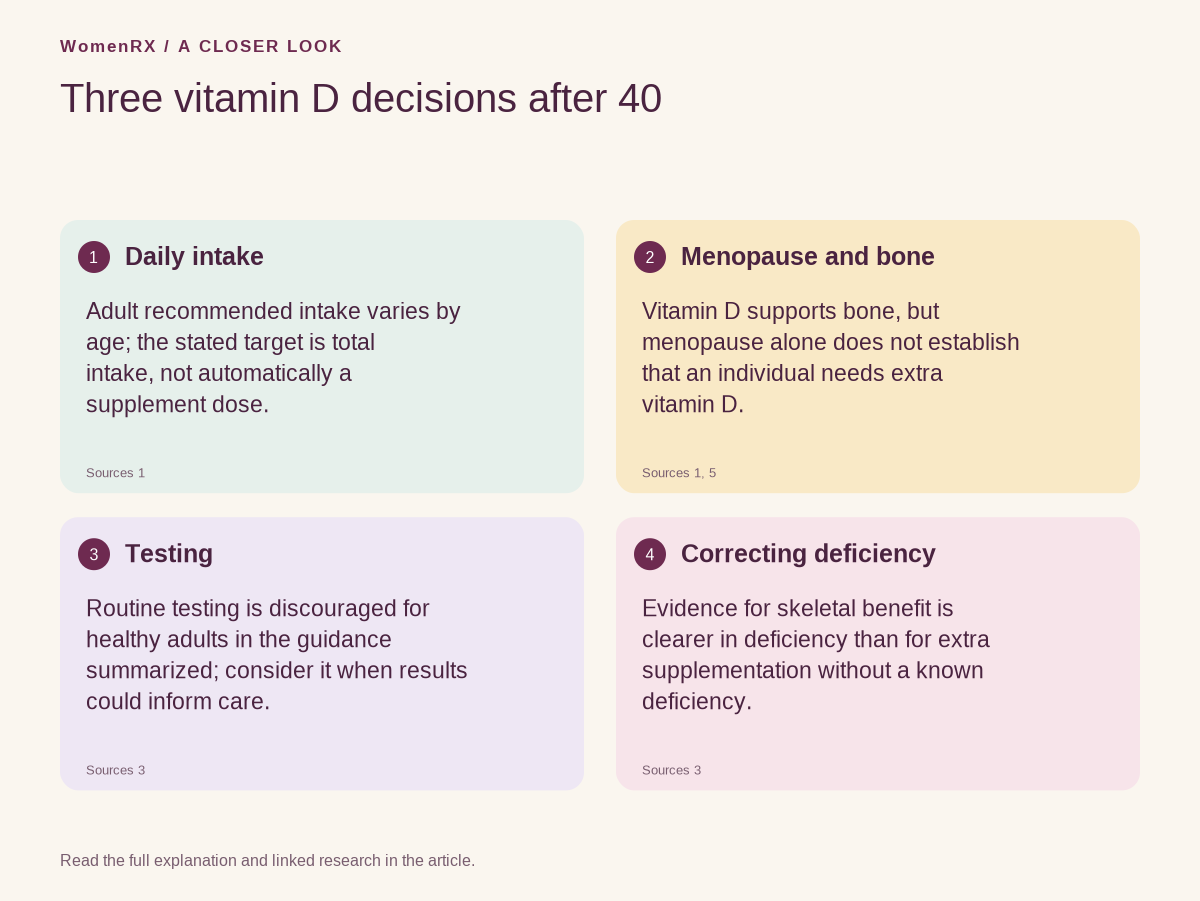
Three vitamin D decisions after 40
Daily intake: Adult recommended intake varies by age; the stated target is total intake, not automatically a supplement dose.1
Menopause and bone: Vitamin D supports bone, but menopause alone does not establish that an individual needs extra vitamin D.15
Testing: Routine testing is discouraged for healthy adults in the guidance summarized; consider it when results could inform care.3
Correcting deficiency: Evidence for skeletal benefit is clearer in deficiency than for extra supplementation without a known deficiency.3
Read the figure as text
Age and menopause provide context, but intake, testing, and deficiency correction answer different questions.- Daily intake: Adult recommended intake varies by age; the stated target is total intake, not automatically a supplement dose.1
- Menopause and bone: Vitamin D supports bone, but menopause alone does not establish that an individual needs extra vitamin D.15
- Testing: Routine testing is discouraged for healthy adults in the guidance summarized; consider it when results could inform care.3
- Correcting deficiency: Evidence for skeletal benefit is clearer in deficiency than for extra supplementation without a known deficiency.3
More questions, answered
Does menopause automatically mean I need a vitamin D test?
No. The clinical review summarizing current guidance discourages routine testing in healthy adults. A test makes more sense when an individual risk or concern means the result could guide care. 3
Is vitamin D a proven treatment for hot flashes?
The evidence doesn’t establish vitamin D alone as a hot-flash treatment. A small retrospective menopause study used vitamin D alongside pollen extract and vitamin K2, so its results can’t isolate vitamin D’s effects. 4
Sources you can check
- Vitamin D - Health Professional Fact SheetAccessed 2026-09-25Return to first citation
- Vitamin D: MedlinePlusAccessed 2026-09-25Return to first citation
- From the Vitamin D Paradox to Precision Nutrition: Targeted Supplementation, Assay Pitfalls, and Clinical Decision-Making.Dalamaga M, Tsilingiris D, Petropoulou D, Emfietzoglou R, Kypraiou M, Kounatidis DC, Vallianou NG, Karras S, Magkos F, Karampela I. · Current nutrition reports · 2026Return to first citation
- Beneficial Effects of Purified Cytoplasm of Pollen Associated with Vitamin D and Vitamin K2 on Menopausal Symptoms and Bone Health.Capozzi A, Fagotti A, Sacco D, Pasi A, Mellino R, Lello S. · Nutrients · 2026Return to first citation
- Complementary therapies for management of menopausal symptoms: a systematic review to inform the update of the International Menopause Society recommendations on women's midlife health.Maunder A, Mardon AK, Rao V, Torkel S, Metri NJ, Liu J, Yang G, Giese N, Mantzioris E, Abdul Jafar NK, Rodrigues de Souza GE, Al-Kanini I, Romero L, Panay N, Pedder H, Ee C. · Climacteric : the journal of the International Menopause Society · 2026Return to first citation