Does Vitamin D Need to Be Taken With a Meal?
A meal or snack with some fat may help vitamin D absorption, but you don’t need a special high-fat meal.
If you take an oral vitamin D supplement, a meal or snack with some fat is a sensible choice: vitamin D is fat-soluble, and it may be absorbed better that way. That doesn’t mean a dose taken without food is ineffective. Pick a time you can remember, and check whether your specific product gives food instructions. 2
What food changes, and what it doesn’t
Vitamin D is fat-soluble. MedlinePlus says you can absorb a vitamin D supplement better when you take it with a meal or snack that includes some fat. It doesn’t call for a large meal or a particular amount of fat. If breakfast is when you’ll remember your supplement, for example, breakfast or a snack containing some fat fits that guidance. 2
Better absorption with food is not the same as no absorption without food. NIH’s Office of Dietary Supplements describes both vitamin D2 and D3 as well absorbed in the gut, but that statement doesn’t tell us how much the same dose would differ if taken with a meal rather than on an empty stomach. You don’t need to treat a dose taken without food as wasted. 12
There’s also a difference between getting vitamin D from food and taking a supplement alongside food. Fortified milk, some fortified plant milks, and some cereals contain vitamin D; the amount depends on the food and its label. Those foods can contribute to your intake. Their vitamin D content, though, doesn’t tell you whether your particular supplement has a food requirement. 1
Make the choice fit your actual day
Start with the directions on the product you use, whether it’s a stand-alone vitamin D supplement or a multivitamin containing vitamin D. If it specifies how to take it with food, use those directions. General absorption advice can’t account for every product.
If the label doesn’t settle the question, pairing it with a meal or snack containing some fat is an easy way to follow the general guidance. Choose one you regularly have rather than trying to create a special meal around a supplement. For example, if lunch is predictable but breakfast often isn’t, lunch may make a simpler routine. The meal guidance is about food, not a proven best hour of the day. 2
You may see vitamin D2, also called ergocalciferol, or vitamin D3, also called cholecalciferol, on a label. Both forms raise blood vitamin D levels. D3 generally raises those levels more and maintains them longer than D2, according to NIH. That comparison is about the forms of vitamin D; it doesn’t establish a different meal-timing rule for each one. 1
If you have a condition that limits fat absorption, an ordinary food-timing tip may not answer your bigger question about vitamin D intake. MedlinePlus lists conditions such as Crohn’s disease and celiac disease among reasons some people may need extra vitamin D. In that situation, the useful conversation is about your condition and supplement needs, not simply whether breakfast contains fat. 2
Keep timing separate from how much you need
Taking vitamin D with food won’t tell you whether you need a supplement or what amount is appropriate. Vitamin D can come from food and supplements, and it’s also included in many multivitamins. Look at what you’re already taking before treating a meal-timing decision as a reason to add another product. 12
That distinction matters if you’re pregnant, breastfeeding, or thinking about bone health after menopause. The 2024 Endocrine Society guideline suggests vitamin D supplementation during pregnancy for potential benefits, while saying the optimal supplemental dose remains unclear. That’s a recommendation about supplementation, not a special instruction to take it at a certain meal. 3
Breastfeeding and postmenopause likewise don’t create a different food-timing rule in the guidance cited here. Your reason for taking vitamin D may differ, but the practical meal question stays modest: check your product, and, when it fits your routine, take it with a meal or snack containing some fat. 12
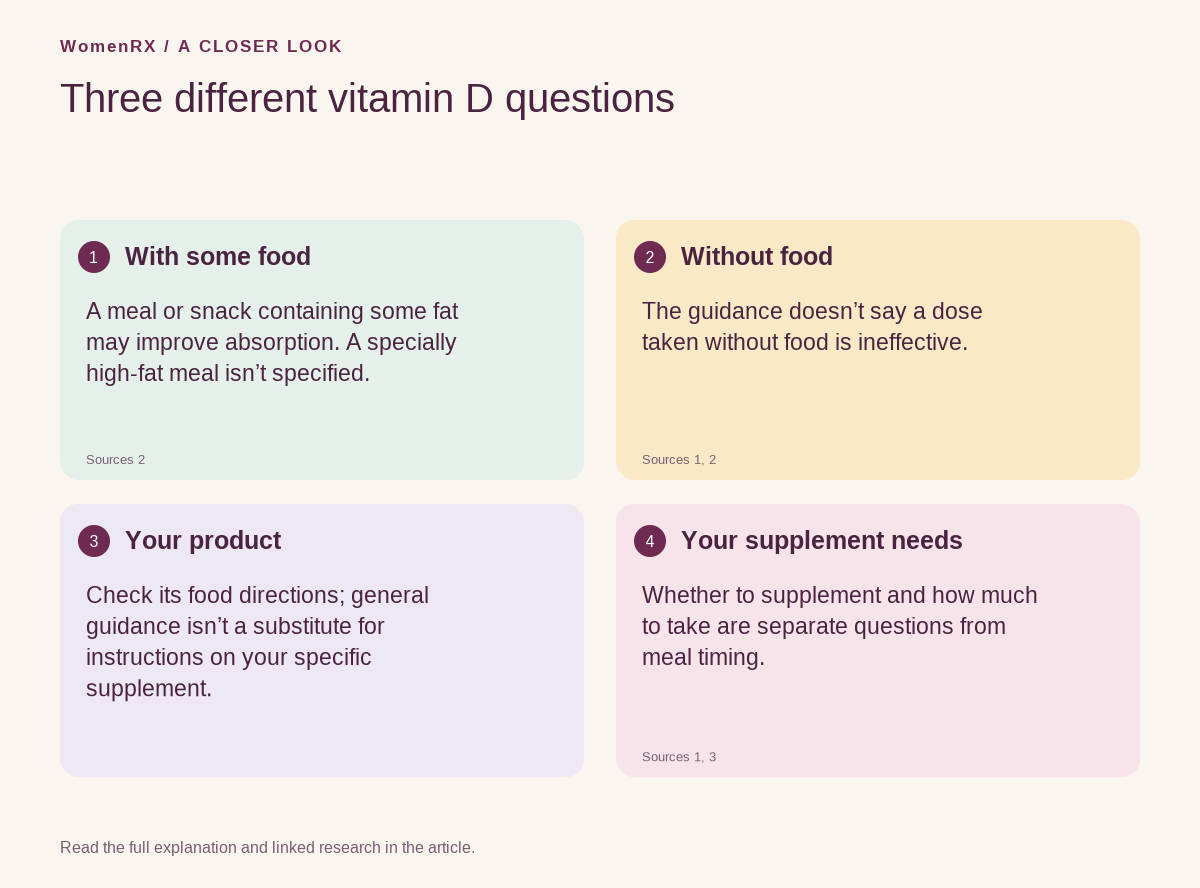
Three different vitamin D questions
With some food: A meal or snack containing some fat may improve absorption. A specially high-fat meal isn’t specified.2
Without food: The guidance doesn’t say a dose taken without food is ineffective.12
Your product: Check its food directions; general guidance isn’t a substitute for instructions on your specific supplement.
Your supplement needs: Whether to supplement and how much to take are separate questions from meal timing.13
Read the figure as text
Use this comparison to keep absorption advice separate from product instructions and supplement decisions.- With some food: A meal or snack containing some fat may improve absorption. A specially high-fat meal isn’t specified.2
- Without food: The guidance doesn’t say a dose taken without food is ineffective.12
- Your product: Check its food directions; general guidance isn’t a substitute for instructions on your specific supplement.
- Your supplement needs: Whether to supplement and how much to take are separate questions from meal timing.13
More questions, answered
Does a vitamin D supplement require a high-fat meal?
No special high-fat meal is specified in MedlinePlus guidance. It says a meal or snack that includes some fat may improve absorption. 2
Is there a best time of day to take vitamin D?
The food guidance addresses taking vitamin D with a meal or snack containing some fat, not choosing a particular hour. A time that works with your product’s directions and your regular routine is a practical choice. 2
Sources you can check
- Vitamin D - Health Professional Fact SheetAccessed 2026-09-25Return to first citation
- Vitamin D: MedlinePlusAccessed 2026-09-25Return to first citation
- Vitamin D for the Prevention of Disease: An Endocrine Society Clinical Practice Guideline.Demay MB, Pittas AG, Bikle DD, Diab DL, Kiely ME, Lazaretti-Castro M, Lips P, Mitchell DM, Murad MH, Powers S, Rao SD, Scragg R, Tayek JA, Valent AM, Walsh JME, McCartney CR. · The Journal of clinical endocrinology and metabolism · 2024Return to first citation