Menopause Mood Changes: Causes and Support That Can Help
Mood changes can overlap with menopause, but sleep, life circumstances, and depression itself may also be part of the picture.
Mood changes during perimenopause may have more than one contributor. Sleep problems are associated with depression and anxiety in studies of postmenopausal women, but that association doesn’t prove that disrupted sleep causes a mood disorder. Hormone therapy is an established option for bothersome hot flashes, not a proven stand-alone treatment for depression. If low mood persists or disrupts daily life, mental-health care is a reasonable next step. 3 5 2
Mood changes can show up during perimenopause, but they don’t point to one cause by themselves. Hot flashes, disrupted sleep, stress, a past mental-health condition, medication effects, and depression are different possibilities to consider. The useful question isn’t only “Is this menopause?” It’s also “What’s changing, how much is it affecting me, and what kind of support fits?”
Separate the pattern from the explanation
A large Australian study followed women who were 45 to 50 at the start. Among the nearly 6,000 women with complete data, researchers found different patterns of depressive symptoms over 15 years: most had low, stable scores, while about 9% had increasing symptoms and 8.5% had decreasing symptoms. These were symptom patterns, not diagnoses, and the results show why a mood change during the transition shouldn’t automatically be attributed to menopause alone. 4
Sleep is one possible piece of the picture. A systematic review of studies in postmenopausal women found that sleep disturbances were associated with depression, anxiety, and poorer quality of life. They were also reported in women without vasomotor symptoms such as hot flashes. The findings show a connection, not that one problem necessarily causes another. 3
It may help to notice whether mood shifts seem to track with poor sleep, hot flashes, stressful events, or a broader loss of interest and energy. Past depression or anxiety is relevant context to share, as is a history of severe premenstrual mood symptoms. That history doesn’t establish what’s causing a current change, but it can help a clinician understand your pattern.
Choose support for the problem you’re having
When low mood is the main concern: Depression can affect daily activities and may involve persistent low mood or loss of interest. A depression diagnosis generally involves symptoms lasting at least two weeks, but you don’t need to wait that long to seek help if you’re struggling. A medical or mental-health provider can assess what’s going on; medicines and psychotherapy are common treatment approaches. Some medicines and medical conditions, including thyroid disorders, can cause symptoms that resemble depression. 2
When hot flashes are disrupting sleep or daily life: Hormone therapy is the most effective treatment for vasomotor symptoms, according to the North American Menopause Society’s position statement. Whether it’s appropriate depends on individual factors, and the statement recommends weighing benefits and risks together. This is a treatment route for bothersome menopause symptoms such as hot flashes, not evidence that hormone therapy alone treats depression. 5
If you prefer not to use hormone therapy, or it isn’t suitable for you, the Society’s nonhormone statement lists evidence-supported options for vasomotor symptoms, including cognitive behavioral therapy and clinical hypnosis, as well as certain prescription treatments. These recommendations concern hot flashes and related symptoms. They aren’t a substitute for assessing persistent depression on its own. 6
When sleep or several symptoms overlap: It can be useful to describe the whole pattern in a routine appointment: what changed, how long it has been happening, how sleep and hot flashes fit in, and whether work, relationships, or everyday tasks are getting harder. This helps keep the conversation open to more than one explanation rather than treating every mood change as a hormone problem.
Know when to get help promptly
If low mood is ongoing or making ordinary activities difficult, reach out to a medical or mental-health provider. Depression can affect sleep, eating, work, and other parts of daily life, and treatment is available. 2
If you’re thinking about suicide or might harm yourself, get help right away: call or text 988 in the United States. If there’s an immediate emergency, call 911. 1
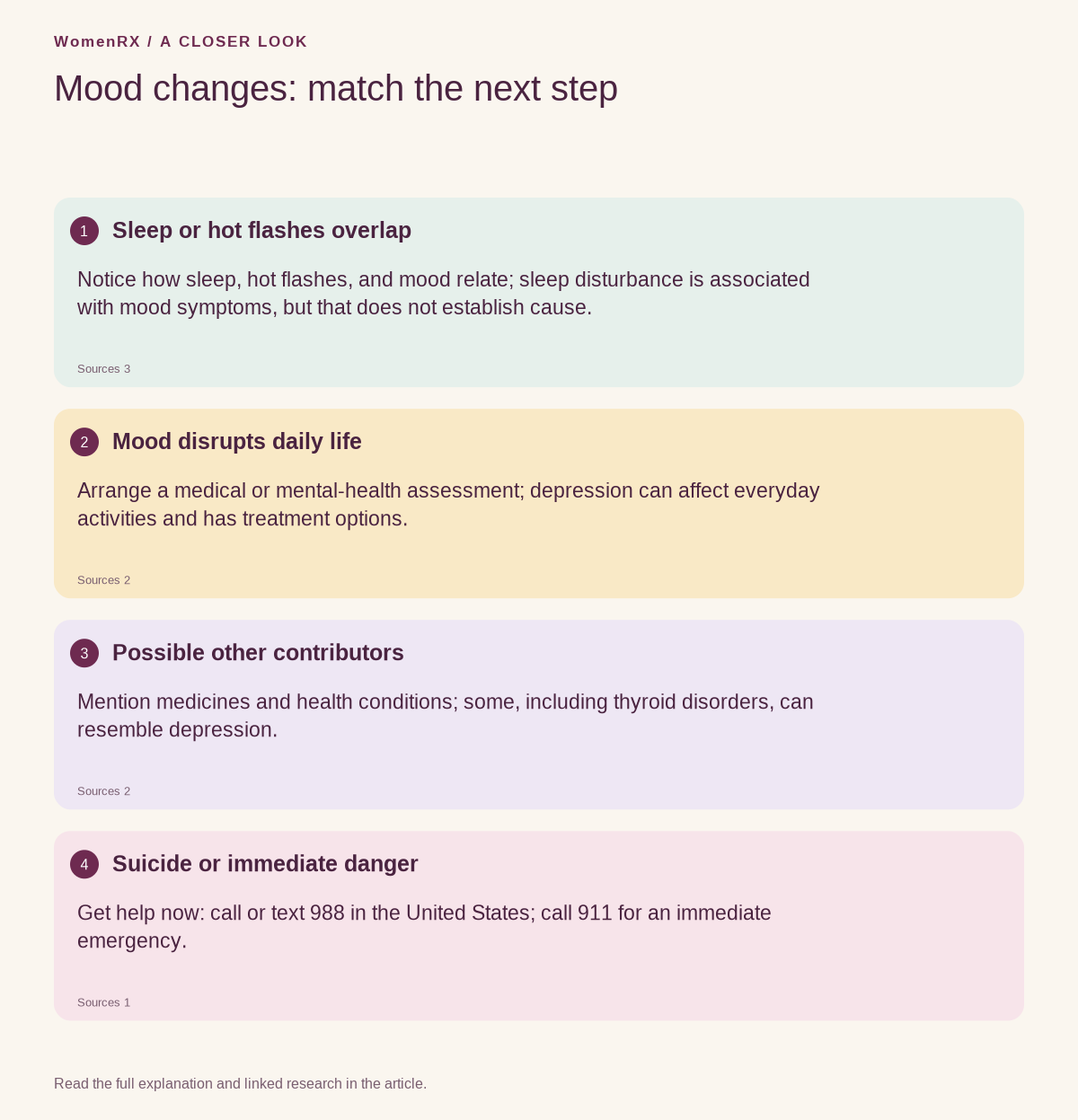
Mood changes: match the next step
Sleep or hot flashes overlap: Notice how sleep, hot flashes, and mood relate; sleep disturbance is associated with mood symptoms, but that does not establish cause.3
Mood disrupts daily life: Arrange a medical or mental-health assessment; depression can affect everyday activities and has treatment options.2
Possible other contributors: Mention medicines and health conditions; some, including thyroid disorders, can resemble depression.2
Suicide or immediate danger: Get help now: call or text 988 in the United States; call 911 for an immediate emergency.1
Read the figure as text
Different patterns call for different kinds of support. A mood change can have more than one contributor, so use the route that fits the concern rather than assuming a single cause.- Sleep or hot flashes overlap: Notice how sleep, hot flashes, and mood relate; sleep disturbance is associated with mood symptoms, but that does not establish cause.3
- Mood disrupts daily life: Arrange a medical or mental-health assessment; depression can affect everyday activities and has treatment options.2
- Possible other contributors: Mention medicines and health conditions; some, including thyroid disorders, can resemble depression.2
- Suicide or immediate danger: Get help now: call or text 988 in the United States; call 911 for an immediate emergency.1
More questions, answered
Can hormone therapy treat depression during menopause?
Hormone therapy is recognized as the most effective treatment for bothersome hot flashes, but that doesn’t establish it as a stand-alone treatment for depression. If low mood is persistent or affecting daily life, ask for a separate assessment and discuss options such as psychotherapy or medication. 5 2
Sources you can check
- Suicide: MedlinePlusAccessed 2026-09-25Return to first citation
- Depression: MedlinePlusAccessed 2026-09-25Return to first citation
- Impact of sleep disturbances on health-related quality of life in postmenopausal women: a systematic review.Soares CN, Bajbouj M, Schoof N, Kishore A, Caetano C. · Menopause (New York, N.Y.) · 2026Return to first citation
- Depressive symptoms across the menopause transition: findings from a large population-based cohort study.Hickey M, Schoenaker DA, Joffe H, Mishra GD. · Menopause (New York, N.Y.) · 2016Return to first citation
- The 2022 hormone therapy position statement of The North American Menopause Society.“The 2022 Hormone Therapy Position Statement of The North American Menopause Society” Advisory Panel. · Menopause (New York, N.Y.) · 2022Return to first citation
- The 2023 nonhormone therapy position statement of The North American Menopause Society.Menopause (New York, N.Y.) · 2023Return to first citation