Weight Changes Around Menopause: Causes and Next Steps
Menopause can change where your body stores fat, but it may not be the reason the number on the scale has changed.
Weight gain around menopause can have overlapping causes. During the transition and early menopause, body fat tends to shift toward the abdomen as lean mass declines, but whether those changes themselves cause weight gain remains debated. Age-related changes matter too. Start by looking at when the gain began and what else changed. Don’t assume sudden or unexplained gain is menopause-related. 2 3 4 1
A changing shape isn’t the same as a changing weight
During the menopausal transition and early menopause, women tend to gain body fat, particularly around the abdomen, and lose lean mass. That can change how your body feels or how clothes fit. The scale can’t show those shifts on its own: body weight includes fat, muscle, bone, and water. 3 1
It’s less clear how much menopause itself contributes to a higher number on the scale. Whether menopause-related changes in body composition cause weight gain remains debated. A review of midlife weight gain describes age-related metabolic changes as a primary driver, while menopause contributes to changes in body composition and abdominal fat. Diet, family history, and genetics can also play a role. These influences can overlap, so a gain that begins in perimenopause isn’t necessarily caused by menopause alone. 2 4 1
The body-composition findings are most directly about the menopausal transition and early menopause. If you’re further past menopause, or the change feels sudden, it’s worth looking at the pattern rather than giving it a menopause label. 3 1
Match what you notice to a next step
| What you notice | What could be going on | A useful next step |
|---|---|---|
| Weight or waist size has changed gradually | Age-related changes and menopause-related shifts in body composition may overlap. The scale alone can’t tell you which tissues have changed. 2 3 4 1 | Note the trend and whether your body shape has changed, too. That gives you more context than one weigh-in. 1 |
| The change happened alongside a shift in routine | Diet and other everyday factors can affect weight; there may be more than one contributor. 1 4 | Identify what changed around the same time. If you want to work on weight or body composition, combining dietary and physical-activity changes has shown benefits in menopause research, particularly during the transition. 3 |
| Gain began around a medication change | Some medicines have weight-gain side effects, though timing alone can’t establish the cause. 5 | Note when the medicine and weight changes began. Ask the prescriber whether the medicine could be contributing before changing it. 5 |
| The gain is sudden or you can’t explain it | An unexpected weight change can be a sign of a medical problem. Weight can reflect changes in water as well as fat or muscle. 1 | Contact a healthcare provider about the change rather than assuming it’s part of menopause. 1 |
Choose a first step that fits the pattern
For a gradual change, a short, neutral record may help: when you first noticed it, whether it has continued, and any changes in routine, health, or medicines around the same time. You don’t need to prove what caused the gain before raising a concern. If it was sudden or happened without an apparent reason, make that the reason to seek care rather than waiting to build a longer record. 1 5
Waist circumference can add context because carrying more fat around the abdomen is associated with higher risk of heart disease and type 2 diabetes. It won’t tell you why your weight changed. A clinician can consider your health history alongside measurements when helping you decide what matters for your health. 1
If the change has been gradual and you want to address it, combined diet and physical-activity approaches have shown improvements in weight, body composition, and metabolic risk factors during the menopause transition. That’s a starting direction, not a reason to ignore an unexpected change or treat every midlife body the same way. 3 1
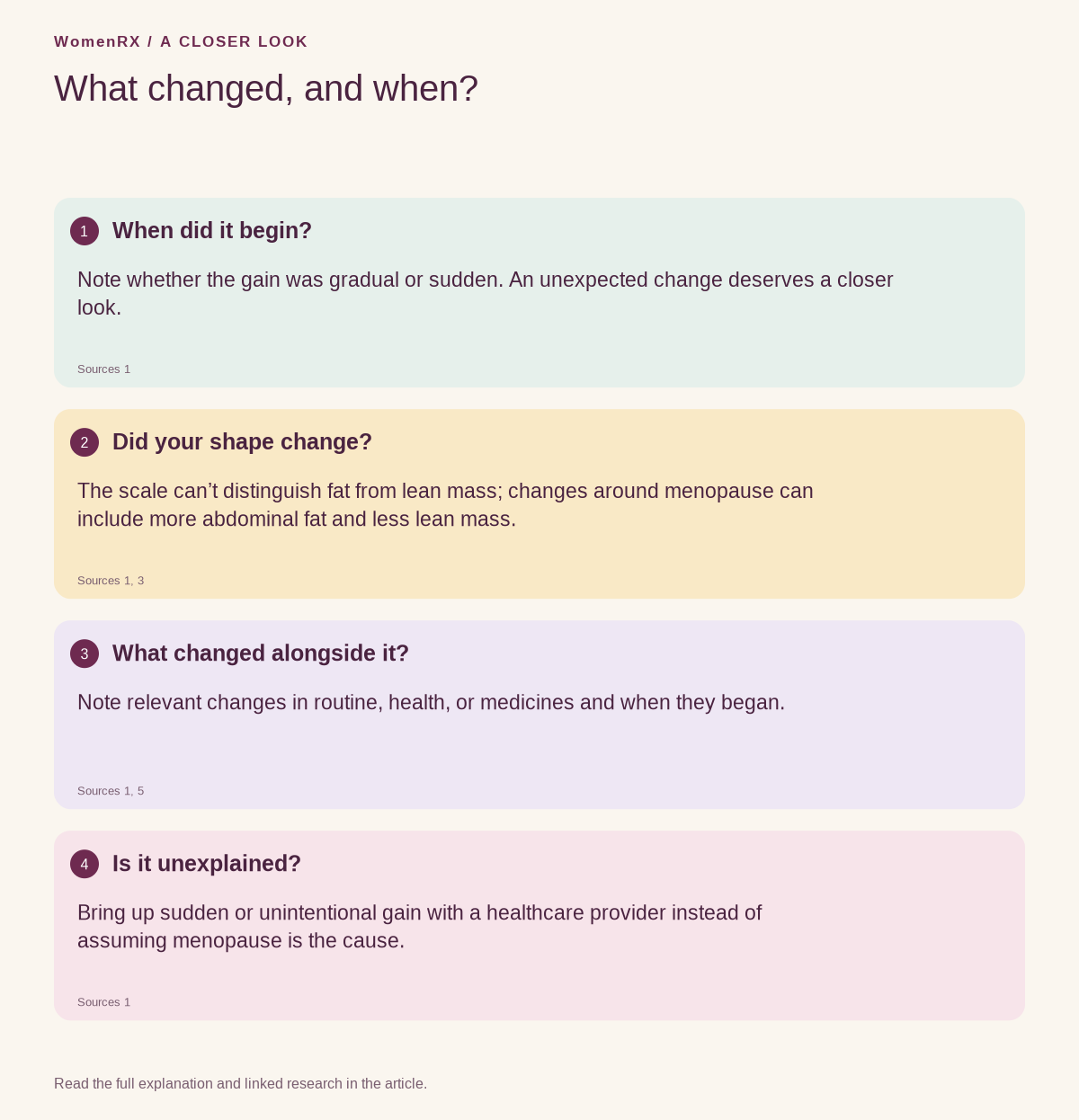
What changed, and when?
When did it begin?: Note whether the gain was gradual or sudden. An unexpected change deserves a closer look.1
Did your shape change?: The scale can’t distinguish fat from lean mass; changes around menopause can include more abdominal fat and less lean mass.13
What changed alongside it?: Note relevant changes in routine, health, or medicines and when they began.15
Is it unexplained?: Bring up sudden or unintentional gain with a healthcare provider instead of assuming menopause is the cause.1
Read the figure as text
Use these prompts to describe the pattern without trying to diagnose its cause.- When did it begin?: Note whether the gain was gradual or sudden. An unexpected change deserves a closer look.1
- Did your shape change?: The scale can’t distinguish fat from lean mass; changes around menopause can include more abdominal fat and less lean mass.13
- What changed alongside it?: Note relevant changes in routine, health, or medicines and when they began.15
- Is it unexplained?: Bring up sudden or unintentional gain with a healthcare provider instead of assuming menopause is the cause.1
More questions, answered
Can my body shape change even if my weight barely changes?
Yes. Changes around menopause can include more abdominal fat and less lean mass, while the scale combines fat, muscle, bone, and water into one number. A stable weight doesn’t necessarily mean your body composition has stayed the same. 3 1
Sources you can check
- Body Weight: MedlinePlusAccessed 2026-09-25Return to first citation
- [Weight gain during menopause: physiology and practical implications].Correia JC, Mavromati M, Pataky Z. · Revue medicale suisse · 2024Return to first citation
- Weight Management in Menopause: Diet, Physical Activity, Medication, and Surgery.Lu V, Tayachew B, Chevtsov A, Nicklas JM. · Obstetrics and gynecology clinics of North America · 2026Return to first citation
- Midlife weight gain: challenges and solutions.Hung S, Adams KE. · Current opinion in obstetrics & gynecology · 2026Return to first citation
- Prevention and harm reduction of obesity (clinical prevention).Bayat Z, Lubbe J, Conradie-Smit M, May W. · South African medical journal = Suid-Afrikaanse tydskrif vir geneeskunde · 2025Return to first citation