Midlife Weight Changes: When to Check for Other Causes
A gradual shift in shape can happen around midlife, but a sudden, unexplained change deserves a closer look.
During the menopause transition, some women gain fat around the middle and lose lean mass, even when the scale tells only part of the story. Aging and day-to-day factors also contribute, so menopause isn’t the only explanation. If your weight changes suddenly or without a clear reason, arrange a clinical review and bring a timeline of the change, health changes, and medication updates. 1 2 4
The scale can miss the change that matters
Weight is made up of fat, muscle, bone, and water. A scale can’t show which part has changed, and it can’t tell you where body fat is stored. Waist size and the broader health picture may add useful context. 1
Around the menopause transition, body composition can shift toward more fat and less lean mass, with fat more likely to collect around the abdomen. That shift does not mean menopause inevitably causes substantial weight gain: how much the scale changes is a separate question, and the contribution of hormonal changes to weight gain remains debated. Aging and other physiological and psychosocial factors also matter. 2 4
That distinction can make a gradual change easier to interpret. Your weight may be fairly stable while your waist or the way clothes fit changes. Or the scale may move for reasons that have little to do with fat. Neither pattern, by itself, identifies a cause.
A gradual shift or a sudden change?
A slow change over time can reflect several influences together, including aging, eating and activity patterns, sleep, mood, and changes in body composition. Research reviews describe midlife weight change as an interplay of aging, hormonal changes, and lifestyle, rather than a single menopause effect. 3 4 5
A sudden gain, or a change you can’t explain, is different. MedlinePlus advises discussing unexpected weight gain or loss with a health care provider because it can signal a medical problem; it lists heart failure as one possible cause of sudden weight gain. That doesn’t mean a gain points to heart failure, but it is a reason not to automatically chalk a rapid change up to menopause. 1
There isn’t a single weight-change threshold in this guidance that separates normal from concerning. The pace, whether the change is continuing, and what else has changed are useful context for deciding to seek a review.
What to bring into the conversation
You don’t need a perfect record. A few notes can help make the change easier to assess:
- Timing: When you first noticed it, whether it has been gradual or sudden, and whether it is continuing.
- What you’re seeing: Scale trend if you already track it, changes in waist or clothing fit, and any other body changes.
- Recent context: Changes in eating, activity, sleep, stress, or general health. These are relevant parts of the midlife picture, not evidence that the change is your fault. 1 3
- Medication timeline: Bring a current medication list and note any recent starts, stops, or changes. This provides context for a clinician’s review; it does not establish that a medicine caused the gain.
- Menopause context: Where you are in the transition and any other changes you’ve noticed. This can help distinguish a longer-term body-composition shift from a new, unexplained change.
A clinician can consider the pattern alongside your health history and decide whether further assessment is appropriate. One number on the scale cannot make that decision on its own. 1
Keep the focus broader than weight
A change in weight or shape can be worth discussing without treating it as a personal failure or assuming the goal must be weight loss. Body weight is only one part of health, and waist distribution and health history can add important context. 1
The useful distinction is not “menopause or something else” as if only one can be involved. Midlife body-composition changes may be part of the picture, while a sudden or unexplained shift still deserves an individual look. Naming both gives you a clearer next step than blaming menopause alone.
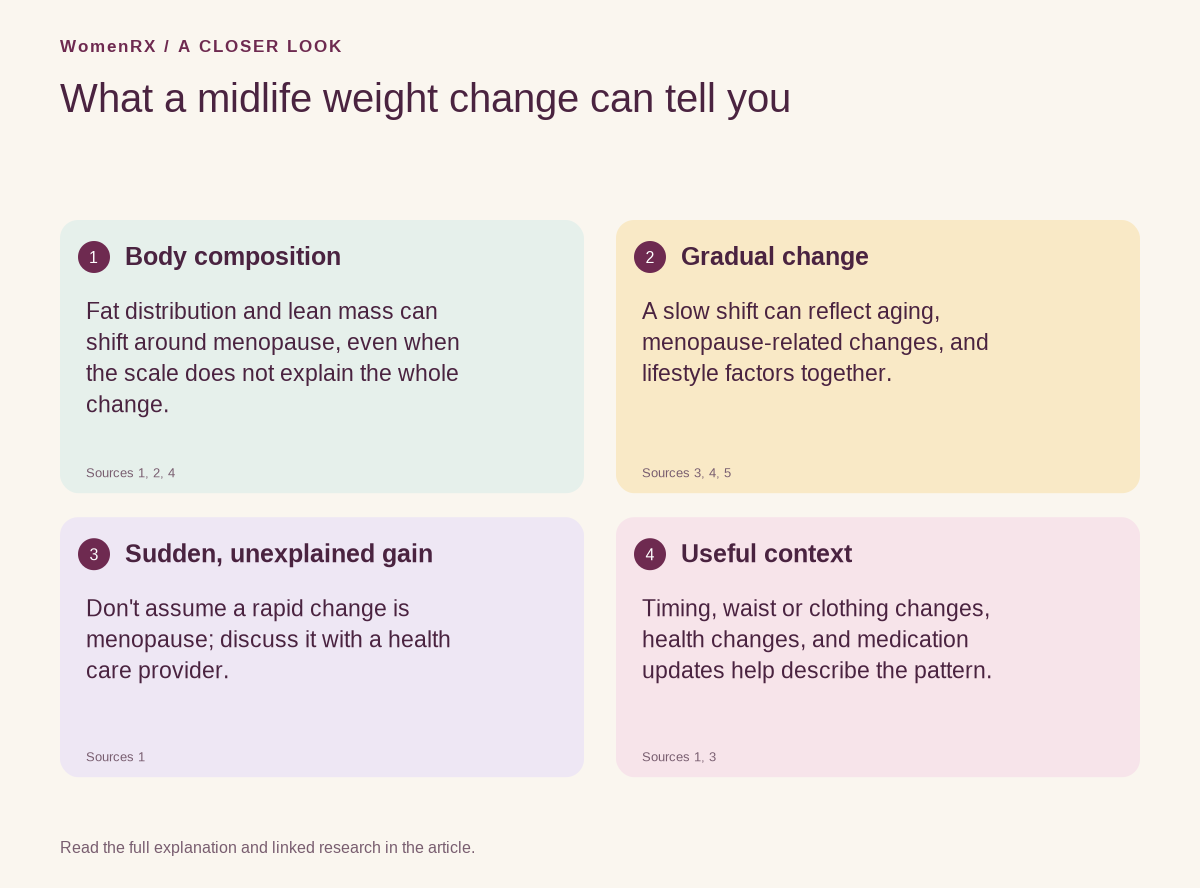
What a midlife weight change can tell you
Body composition: Fat distribution and lean mass can shift around menopause, even when the scale does not explain the whole change.124
Gradual change: A slow shift can reflect aging, menopause-related changes, and lifestyle factors together.345
Sudden, unexplained gain: Don't assume a rapid change is menopause; discuss it with a health care provider.1
Useful context: Timing, waist or clothing changes, health changes, and medication updates help describe the pattern.13
Read the figure as text
A quick comparison of common midlife patterns and the kinds of changes worth reviewing more broadly.- Body composition: Fat distribution and lean mass can shift around menopause, even when the scale does not explain the whole change.124
- Gradual change: A slow shift can reflect aging, menopause-related changes, and lifestyle factors together.345
- Sudden, unexplained gain: Don't assume a rapid change is menopause; discuss it with a health care provider.1
- Useful context: Timing, waist or clothing changes, health changes, and medication updates help describe the pattern.13
Sources you can check
- Body Weight: MedlinePlusAccessed 2026-09-25Return to first citation
- [Weight gain during menopause: physiology and practical implications].Correia JC, Mavromati M, Pataky Z. · Revue medicale suisse · 2024Return to first citation
- Mechanisms of improved body composition among perimenopausal women practicing Meditative Movement: a proposed biobehavioral model.James DL, Larkey LK, Evans B, Sebren A, Goldsmith K, Ahlich E, Hawley NA, Kechter A, Sears DD. · Menopause (New York, N.Y.) · 2023Return to first citation
- Fat mass, weight and body shape changes at menopause - causes and consequences: a narrative review.Fenton A, Smart C, Goldschmidt L, Price V, Scott J. · Climacteric : the journal of the International Menopause Society · 2023Return to first citation
- Midlife weight gain: challenges and solutions.Hung S, Adams KE. · Current opinion in obstetrics & gynecology · 2026Return to first citation