Can Hormone Changes Contribute to Midlife Bloating?
Bloating may shift during the menopause transition, but a hormone link is only one possible part of the picture.
Yes. Some women notice bloating around menstrual changes, and a longitudinal study found bloating severity associated with menopause-transition stages. Those findings suggest a possible connection, not proof that hormones directly cause bloating. Digestive factors can contribute too. If bloating is frequent, very uncomfortable, or doesn’t go away, get it assessed rather than assuming it’s menopause. 2 4 1
A pattern can be a clue, not a diagnosis
If bloating comes and goes alongside changes in your periods, reproductive changes could be part of the picture. A review of research on gastrointestinal symptoms reported that some women experience more gut discomfort, including bloating, around menstruation. The authors considered changing ovarian hormone levels a possible contributor, while also noting the need for more confirmatory research. That makes a cycle connection plausible, but it doesn’t show that a particular hormone change causes bloating in an individual woman. 4
A longitudinal study followed 291 women through reproductive-aging stages using health diaries. Bloating severity was associated with early and late menopause-transition stages in the study’s multivariable analysis. Tension was also associated with greater severity. Urine hormone measurements were available for only 131 participants, and the findings do not establish that hormones caused the symptom. 2
Research on gut-brain interaction disorders offers another piece of context. These include conditions such as irritable bowel syndrome and functional bloating, where gut sensations and symptoms can be part of the condition. In an analysis of a global survey, symptom patterns differed by sex and menopausal group, but varied by condition and symptom. That analysis doesn’t show that menopause hormones alone explain bloating. 3
Perimenopause and after periods stop
During perimenopause, periods may become less predictable, so you may still be able to notice whether bloating recurs around bleeding or cycle changes. A repeated pattern can be useful information, but it can’t identify the cause by itself. Bloating that overlaps with cycle changes may also have a digestive explanation.
After periods have stopped, there’s no monthly cycle to compare symptoms with. That doesn’t rule out a role for reproductive changes, but it makes a recurring menstrual pattern less useful as an explanation. The survey analysis found differences in some gut symptoms between premenopausal and postmenopausal groups, but these varied by condition and weren’t a simple finding that postmenopause causes bloating. 3
A 2025 scoping review mapped 122 studies of gastrointestinal symptoms in natural perimenopause and postmenopause. It found gaps in how studies defined menopause stages and measured symptoms, which limits how confidently the findings can explain bloating after periods stop. The practical takeaway is to keep hormonal changes in mind without treating them as the default cause. 5
Other explanations deserve a place
Bloating can accompany constipation or diarrhea. Swallowing air while eating, food triggers, and food intolerance are other possibilities to consider. These factors can overlap with cycle-related changes, so a period connection doesn’t rule them out. 1
For example, you might notice bloating after a particular meal, during constipation, or at a recurring point in your cycle. Comparing those patterns can help you describe what’s happening, but it isn’t a test that determines the cause. Regular movement and avoiding foods you know you don’t tolerate may help ease bloating for some people. 1
When to get bloating checked
If you feel bloated often, feel very bloated, or the symptom doesn’t go away, arrange an evaluation. It’s especially worth getting checked if bloating comes with unintentional weight loss or blood in your stool. Sudden severe abdominal pain, vomiting blood, or being unable to pass stool or gas are reasons to seek urgent care. 1
A cycle-linked pattern may be one useful clue during perimenopause. Persistent or changing bloating, especially after periods have stopped, still deserves attention on its own terms.
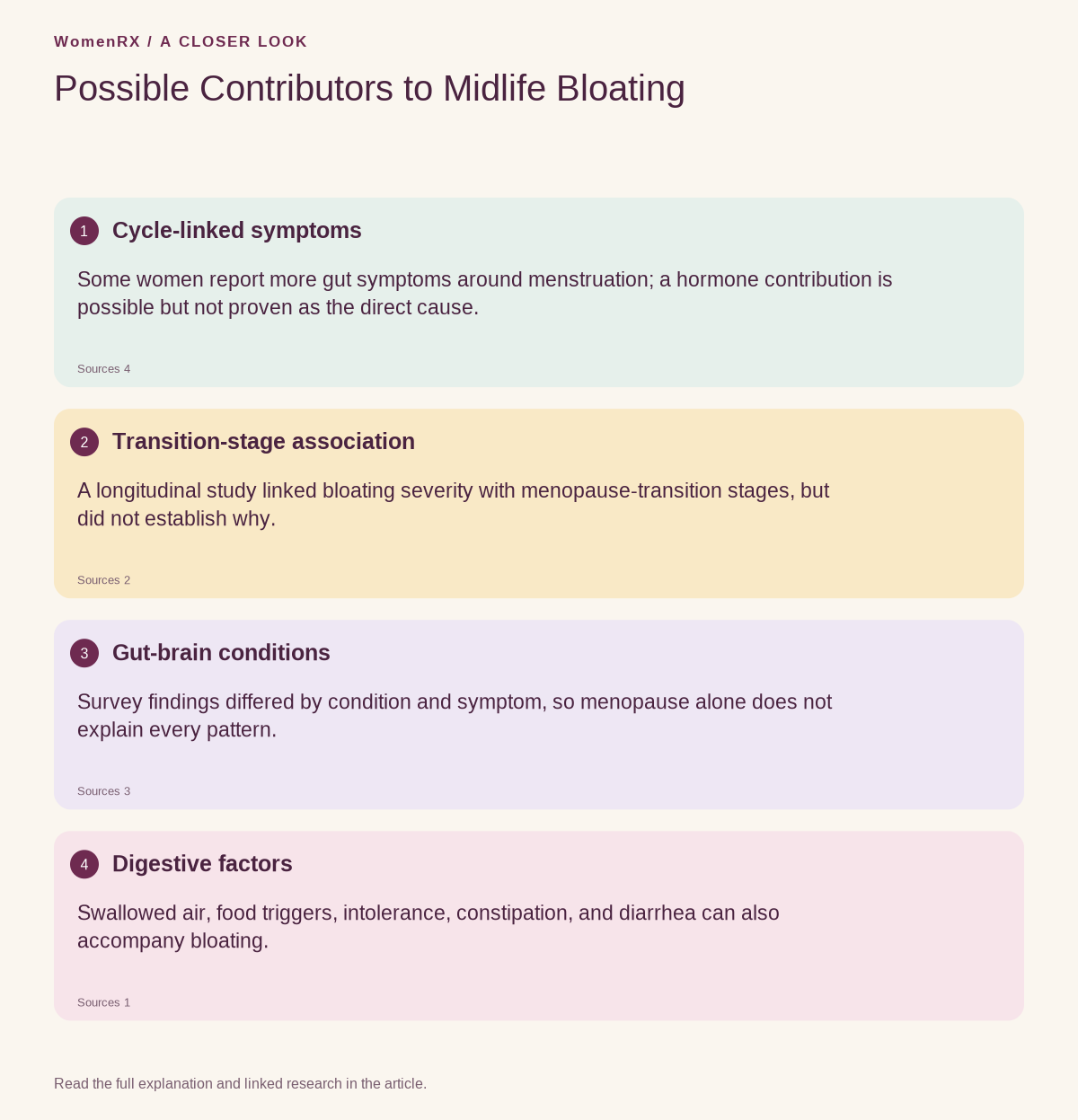
Possible Contributors to Midlife Bloating
Cycle-linked symptoms: Some women report more gut symptoms around menstruation; a hormone contribution is possible but not proven as the direct cause.4
Transition-stage association: A longitudinal study linked bloating severity with menopause-transition stages, but did not establish why.2
Gut-brain conditions: Survey findings differed by condition and symptom, so menopause alone does not explain every pattern.3
Digestive factors: Swallowed air, food triggers, intolerance, constipation, and diarrhea can also accompany bloating.1
Read the figure as text
Bloating can have overlapping explanations. A cycle pattern may make reproductive changes relevant, but it cannot identify the cause by itself.- Cycle-linked symptoms: Some women report more gut symptoms around menstruation; a hormone contribution is possible but not proven as the direct cause.4
- Transition-stage association: A longitudinal study linked bloating severity with menopause-transition stages, but did not establish why.2
- Gut-brain conditions: Survey findings differed by condition and symptom, so menopause alone does not explain every pattern.3
- Digestive factors: Swallowed air, food triggers, intolerance, constipation, and diarrhea can also accompany bloating.1
More questions, answered
Does bloating mean my hormones are out of balance?
No. Bloating has several possible explanations, and research linking it with menstrual or menopause-transition patterns doesn’t show that it proves a hormone imbalance or identifies which hormone is involved. 2 4
Can bloating happen around a period?
Some women report more gut symptoms, including bloating, around menstruation. A recurring pattern may be worth noticing, but it doesn’t confirm the cause. 4
Sources you can check
- Bloating - NHSAccessed 2026-09-25Return to first citation
- Bloating During the Menopause Transition: Observations from the Seattle Midlife Women's Health Study.Kamp KJ, Callan NGL, Mitchell ES, Heitkemper MM, Woods NF. · Journal of women's health (2002) · 2026Return to first citation
- Sex Differences, Menses-Related Symptoms and Menopause in Disorders of Gut-Brain Interaction.Sarnoff RP, Hreinsson JP, Kim J, Sperber AD, Palsson OS, Bangdiwala SI, Chang L. · Neurogastroenterology and motility · 2025Return to first citation
- Do fluctuations in ovarian hormones affect gastrointestinal symptoms in women with irritable bowel syndrome?Heitkemper MM, Chang L. · Gender medicine · 2009Return to first citation
- The volume and characteristics of research on gastrointestinal symptoms in 'natural' peri- and postmenopause: A scoping review.Shaw N, Abbott R, Pettinger C. · Women's health (London, England) · 2025Return to first citation