Menopause, Weight, and What Hormone Therapy Can Do
Hormone therapy can help with certain menopause symptoms, but it isn’t a weight-loss treatment.
Menopause hormone therapy (MHT) is used for reasons such as bothersome hot flashes and prevention of bone loss, not to lose weight. It may help preserve a favorable body-fat distribution, but the evidence doesn’t support expecting meaningful weight loss from it. Weight management is a separate decision, with options that can include nutrition and activity changes, behavioral support, and medical treatment when appropriate. 3 4
Two concerns, two treatment goals
If your weight is changing during menopause, it’s reasonable to wonder whether hormone therapy could help. The clearest way to think about the choice is to separate two goals: treating menopause symptoms and managing weight. They can matter at the same time, but one treatment shouldn’t be assumed to do both.
The menopause transition can bring changes in body composition, including more fat around the middle and less lean mass. Those shifts may not show up clearly on the scale. 4 A weight number alone also can’t distinguish fat, muscle, bone, and water; waist measurement and health history can add context. 1
What hormone therapy may, and may not, change
MHT is the most effective treatment for hot flashes and other vasomotor symptoms, and it helps prevent bone loss. Whether it’s a good option depends on your symptoms, health history, age, timing, and individual risks. The Menopause Society says the benefit-risk balance is generally more favorable for healthy women younger than 60 or within 10 years of menopause onset who have no contraindications, and less favorable when therapy starts later. 3
Weight is not a reason to start MHT, and weight concerns alone aren’t a reason to rule it out. A clinical review of the evidence describes possible benefits for central fat accumulation and body composition, but concludes that MHT isn’t a primary weight-loss or obesity treatment. 4 In other words, it may affect where fat is stored without reliably making the scale go down. A review of individual trials also found no greater weight gain than placebo in one large trial and a small weight difference in another; those results don’t establish MHT as a weight-loss strategy. 4
If symptoms are disrupting sleep or making everyday activity harder, say so when discussing treatment. The point is to choose symptom care for symptom relief, while making a separate plan if weight management is also a goal.
Weight-management choices are a separate conversation
A comprehensive approach can include nutrition, physical activity, and behavioral support. Depending on your health and circumstances, it may also include an FDA-approved weight-management medicine or metabolic and bariatric surgery. These are options to assess individually, not automatic next steps for everyone. 4
Food-pattern evidence specific to menopause is useful, but it has limits. In a 12-year prospective study of 38,283 women followed around menopause, dietary patterns higher in foods such as nuts, legumes, fruits, vegetables, and whole grains were associated with more favorable weight outcomes. Because this was an observational study, it can’t prove that a particular diet will cause weight loss for you or identify one best plan for every woman. 5 It does offer a reasonable starting point for discussing a sustainable way of eating rather than chasing a menopause-specific “fat-burning” diet.
The goal doesn’t have to be a particular scale number. Weight, waist size, strength, and relevant health risks each offer different information. BMI, for example, doesn’t distinguish muscle from fat, and can be less informative for some older adults who have lost muscle. 1 Ask what measures make sense for your health and what kind of progress would be useful to track.
Be cautious about weight-loss supplements promising a quick fix. Evidence for many ingredients is limited or inconsistent, products may combine ingredients in ways that haven’t been well studied, and supplement formulas can vary. 2
Questions that make the decision clearer
You might ask: “What’s the main reason to consider MHT in my situation, and what change should I expect from it?” “Could my symptoms be affecting sleep or activity in ways that complicate weight management?” “What weight-management options fit my health history and preferences?” These questions help keep symptom treatment and weight treatment connected, without treating them as substitutes.
If you’re considering MHT, discuss its likely benefits and risks for you and revisit the decision over time. If weight is your main concern, ask about a weight-management plan directly rather than relying on hormones to do that work. 3 4
Symptom care and weight care
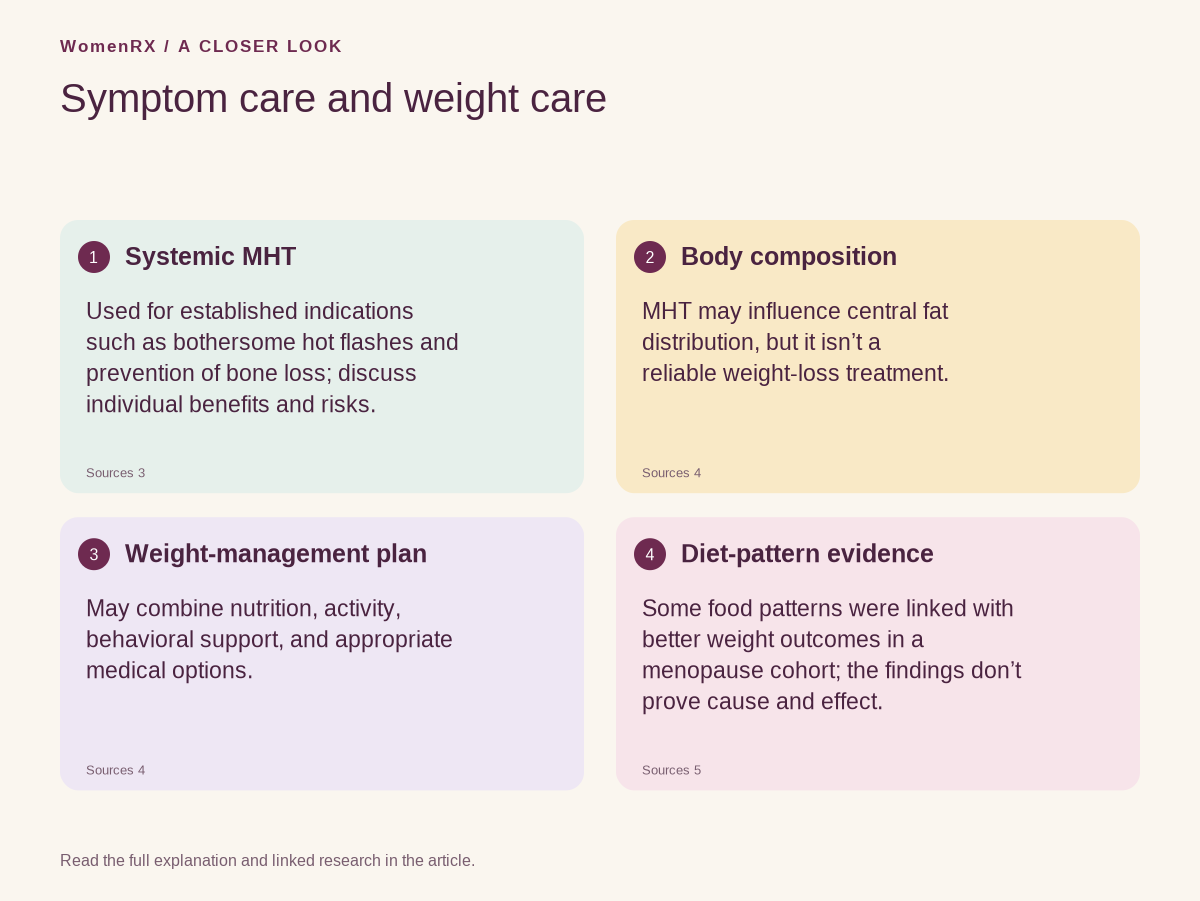
Systemic MHT: Used for established indications such as bothersome hot flashes and prevention of bone loss; discuss individual benefits and risks.3
Body composition: MHT may influence central fat distribution, but it isn’t a reliable weight-loss treatment.4
Weight-management plan: May combine nutrition, activity, behavioral support, and appropriate medical options.4
Diet-pattern evidence: Some food patterns were linked with better weight outcomes in a menopause cohort; the findings don’t prove cause and effect.5
Read the figure as text
These approaches can be considered together, but they have different goals and shouldn’t be treated as substitutes.- Systemic MHT: Used for established indications such as bothersome hot flashes and prevention of bone loss; discuss individual benefits and risks.3
- Body composition: MHT may influence central fat distribution, but it isn’t a reliable weight-loss treatment.4
- Weight-management plan: May combine nutrition, activity, behavioral support, and appropriate medical options.4
- Diet-pattern evidence: Some food patterns were linked with better weight outcomes in a menopause cohort; the findings don’t prove cause and effect.5
More questions, answered
Will menopause hormone therapy make me gain weight?
The clinical review describes trial findings that did not show greater weight gain with MHT than placebo in one large study. That’s reassuring if weight gain is your concern, but it doesn’t mean MHT causes weight loss or should be chosen for weight management. 4
Can I work on weight management without taking hormone therapy?
Yes. MHT is considered for established indications such as bothersome hot flashes and prevention of bone loss; weight management is a separate decision with lifestyle and, when appropriate, medical options. 3 4
Sources you can check
- Body Weight: MedlinePlusAccessed 2026-09-25Return to first citation
- Dietary Supplements for Weight Loss - Health Professional Fact SheetAccessed 2026-09-25Return to first citation
- The 2022 hormone therapy position statement of The North American Menopause Society.“The 2022 Hormone Therapy Position Statement of The North American Menopause Society” Advisory Panel. · Menopause (New York, N.Y.) · 2022Return to first citation
- Clinical review: Menopause hormone therapy in weight management.Younglove C. · Obesity pillars · 2026Return to first citation
- Optimal Dietary Patterns for Lower Weight Gain and Risk of Obesity Surrounding Menopause.Xia T, Haslam DE, Eliassen AH, Manson JE, Sun Q, Willett WC, Bhupathiraju SN, Zhang C, Hu FB. · JAMA network open · 2026Return to first citation