How to Check a Belly-Fat Supplement Claim
A smaller number on the scale, a smaller waist, and less abdominal fat are different outcomes, and a supplement claim should say which one was actually studied.
Don’t judge a “belly-fat burner” by the ingredient list alone. Check whether a human study tested a comparable product in women, compared it with a placebo, and measured waist size or abdominal fat rather than only body weight. In one trial of 74 women, CLA changed hip circumference compared with placebo, but not waist circumference or body weight.3 Then check each ingredient for safety concerns that apply to you.
Start with the outcome in the claim
“Burns belly fat” sounds precise. The proof needs to be precise, too. Body weight tells you what happened on the scale. Waist circumference tells you whether a measurement around the middle changed. Neither, by itself, shows how much abdominal fat changed or where fat was lost.
A trial of conjugated linoleic acid, or CLA, shows why the distinction matters. Researchers randomly assigned 74 adults with overweight or obesity, all women, to CLA or a sunflower-oil placebo for 12 weeks. Hip circumference decreased more with CLA, but waist circumference, body weight, and BMI did not differ significantly between groups. The hip result doesn’t support a claim that CLA reduces belly fat.3
When you see a promising result, ask: Which measurement changed compared with the control group? A testimonial, a before-and-after photo, or a study reporting only weight loss can’t answer a claim about abdominal fat.
Match the study to the product you’re holding
Look for the full ingredient list and the amount of each ingredient. Then look past a product page’s “clinically studied” badge: Was the finished formula studied, or just one ingredient? Were participants women? Was there a placebo group? How long did the study run, and what outcomes did it measure?
Those questions matter even when a study enrolled women. A three-month placebo-controlled trial of a supplement for menopausal symptoms reported decreases in body weight and waist circumference during the study. Its abstract does not give enough detail about the waist change compared with placebo to establish a belly-fat benefit. It also doesn’t report a direct measure of abdominal fat.4 If a product cites that finding, the accurate takeaway is narrower than “proven to burn menopausal belly fat.”
Green tea is another example of why an ingredient finding isn’t a formula guarantee. The National Center for Complementary and Integrative Health says the catechins and caffeine in green tea or its extracts may have a modest effect on body weight, with effects varying by product composition and physical activity. That is not evidence that a particular multi-ingredient capsule reduces abdominal fat.2
Read the safety information alongside the promise
A green tea drink and a concentrated green tea extract aren’t interchangeable choices. NCCIH reports no safety concerns for green tea consumed as a beverage by adults, while noting that it contains caffeine. Reported side effects of green tea extract supplements include nausea, constipation, abdominal discomfort, and increased blood pressure.2
If a formula contains caffeine, count your other caffeine sources, such as coffee, tea, or energy drinks, when thinking about how it may affect you. Caffeine can raise blood pressure, and people differ in their sensitivity. MedlinePlus also flags potential interactions with stimulants, certain antibiotics, asthma medicines, and heart medicines.1 For green tea products, NCCIH describes interactions involving nadolol, atorvastatin, and raloxifene.2 If you take one of these medicines, check the specific ingredient with your pharmacist or prescribing clinician before trying the supplement.
Pregnancy and breastfeeding change the calculation as well. Green tea contains caffeine, and caffeine passes into breast milk; high maternal caffeine intake may cause fussiness and poor sleep in an infant. If you’re pregnant or might be pregnant, get individualized advice about caffeine intake rather than assuming a weight-loss blend has the same safety profile as a cup of tea.2 If you’re breastfeeding, MedlinePlus likewise advises checking whether you should limit caffeine.1
You may also see synephrine on a label. Don’t treat its presence, a “natural” description, or its pairing with caffeine as proof of either a belly-fat benefit or safety. The useful next step is to identify exactly what’s in the product and seek evidence for that formula and its measured outcomes, rather than borrowing results from a different ingredient or product.
The simplest way to assess a claim is to keep its three parts together: the product tested, the women studied, and the outcome measured. If the evidence answers a question about body weight or hip size, it hasn’t yet answered your question about belly fat.
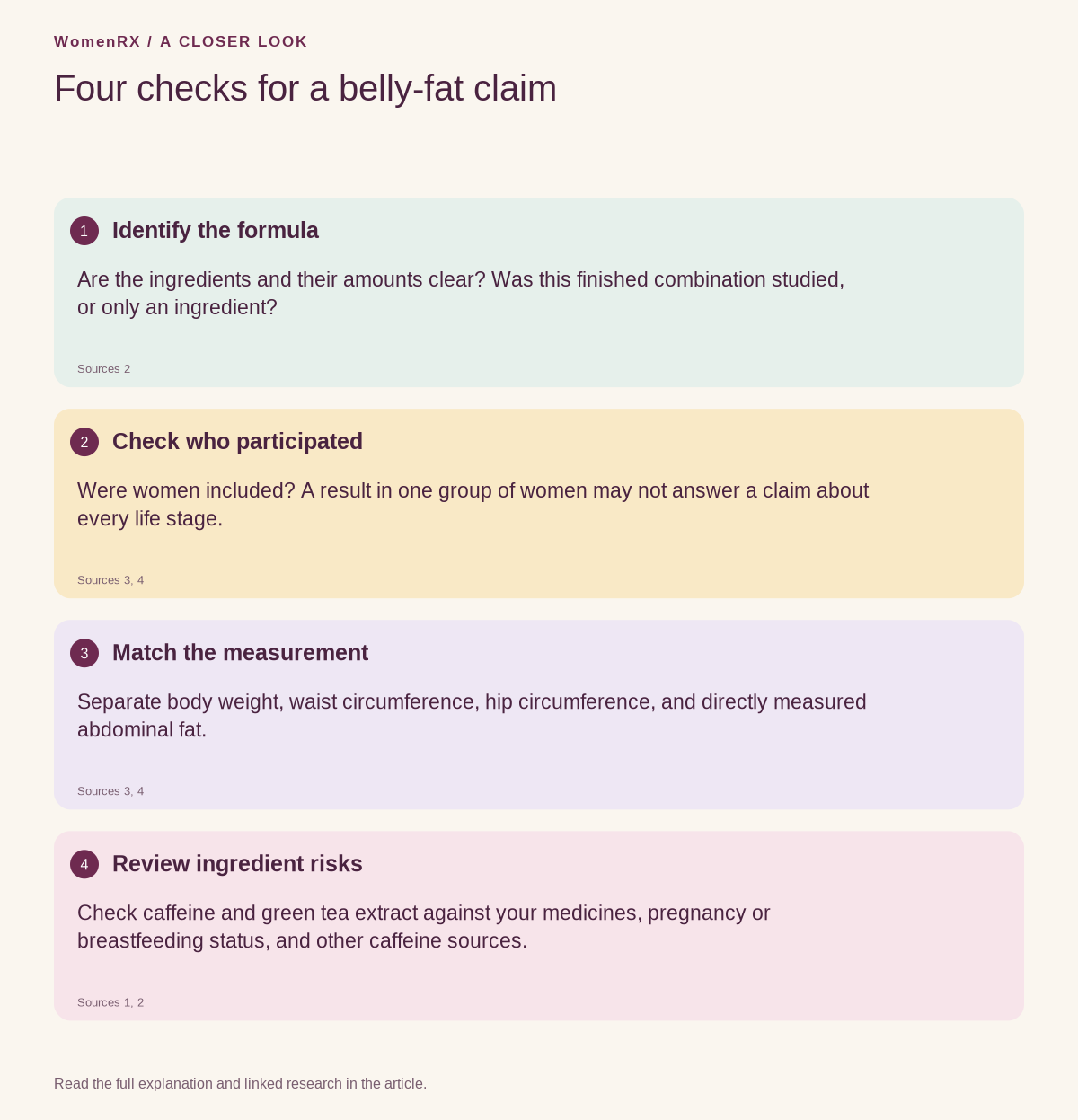
Four checks for a belly-fat claim
Identify the formula: Are the ingredients and their amounts clear? Was this finished combination studied, or only an ingredient?2
Check who participated: Were women included? A result in one group of women may not answer a claim about every life stage.34
Match the measurement: Separate body weight, waist circumference, hip circumference, and directly measured abdominal fat.34
Review ingredient risks: Check caffeine and green tea extract against your medicines, pregnancy or breastfeeding status, and other caffeine sources.12
Read the figure as text
Use these questions to see whether a study supports the promise on a supplement label. This is a reading aid, not a safety certification.- Identify the formula: Are the ingredients and their amounts clear? Was this finished combination studied, or only an ingredient?2
- Check who participated: Were women included? A result in one group of women may not answer a claim about every life stage.34
- Match the measurement: Separate body weight, waist circumference, hip circumference, and directly measured abdominal fat.34
- Review ingredient risks: Check caffeine and green tea extract against your medicines, pregnancy or breastfeeding status, and other caffeine sources.12
More questions, answered
Does a smaller waist measurement prove a supplement reduced visceral fat?
No. Waist circumference describes a change in size, not a direct measurement of fat inside the abdomen. Check whether a study measured abdominal fat itself before accepting a claim about where fat was lost. The CLA trial illustrates another distinction: its hip measurement changed compared with placebo, while its waist measurement did not.3
Sources you can check
- Caffeine: MedlinePlusAccessed 2026-09-25Return to first citation
- Green Tea: Usefulness and Safety | NCCIHAccessed 2026-09-25Return to first citation
- Twelve weeks CLA supplementation decreases the hip circumference in overweight and obese women. A double-blind, randomized, placebo-controlled trial.Mądry E, Chudzicka-Strugała I, Grabańska-Martyńska K, Malikowska K, Grebowiec P, Lisowska A, Bogdański P, Walkowiak J. · Acta scientiarum polonorum. Technologia alimentaria · 2016Return to first citation
- Treatment of climacteric symptoms with an ammonium succinate-based dietary supplement: a randomized, double-blind, placebo-controlled trial.Radzinskii VE, Kuznetsova IV, Uspenskaya YB, Repina NB, Gusak YK, Zubova OM, Burchakov DI, Osmakova AA. · Gynecological endocrinology : the official journal of the International Society of Gynecological Endocrinology · 2016Return to first citation