Weight-Loss Pills: A Practical Evidence and Safety Check
Before trusting a weight-loss claim, check whether the exact product was studied, what the trial actually found, and how its ingredients could interact with your health or medicines.
Start by separating an approved medicine, such as orlistat, from a dietary supplement: supplements aren’t reviewed or approved by the FDA for safety and effectiveness before sale. For either, look for human trials of the exact product and dose, compare weight change with a control group, and check reported harms. Pregnancy, breastfeeding, and your medicines can change the safety discussion. 123
First, identify what kind of product it is
A product sold as a “weight-loss pill” might be a prescription medicine, an over-the-counter medicine, or a dietary supplement. Those categories don’t have the same evidence or regulatory pathway. For example, orlistat is sold in the U.S. in prescription and nonprescription forms. A supplement, even one promoted as “natural,” is not an FDA-approved medicine: supplements don’t undergo FDA premarket review and approval for safety and effectiveness. Manufacturers are responsible for product safety and truthful claims; the FDA and Federal Trade Commission can take action against unsafe products or unsubstantiated claims. 123
That distinction isn’t a guarantee that every medicine is right for you or that every supplement is unsafe. It tells you what to verify. For a medicine, check its official label and the evidence for the approved use. For a supplement, don’t assume a striking claim has the same level of review or proof.
Match the study to the bottle
A trial of one ingredient doesn’t establish that a finished blend works. Supplements often combine several ingredients, use different amounts, or leave the amount of an active ingredient unclear. ODS notes that this makes it difficult to compare products or predict how a combination will work. 1
When you read a claim, ask:
- Was the exact product tested in people? A laboratory or animal finding can suggest a question for research, but it doesn’t show that a pill produces weight loss in people.
- Was it compared with a placebo or another control? A change in the treatment group alone doesn’t show how much change the product contributed.
- How long did the study last, and how many people took part? A small or short study can offer limited information about lasting results and less common harms.
- What happened to both groups? Look at the difference between groups, not only a headline number from the product group.
- Were harms measured and reported? A study that finds no significant problem in a small group over a short period can’t settle every safety question.
One example: in an eight-week randomized trial, 53 adults with overweight or moderate obesity were assigned to glucomannan or placebo. The groups lost similar amounts of weight, and the researchers found no significant difference in the other measured outcomes. This trial doesn’t support a weight-loss benefit for the product studied over that period. It also doesn’t settle the evidence for every product or combination containing glucomannan. 4
Compare results, not just claims
Orlistat offers a contrast with the supplement examples. In pooled clinical-trial data for prescription Xenical, mean weight loss after one year was 13.4 pounds with orlistat plus diet and 5.8 pounds with placebo plus diet. The average difference in percent weight loss between groups was 3%. Those figures describe the trial populations and combined approach, not a promised result for an individual. 3
The prescription trials included 80.2% women, but that figure alone doesn’t show that the medicine works differently in women than in men. The glucomannan trial included men and women, but its reported results don’t provide a women-specific outcome. A study can include many women without answering whether its results differ by sex. 34
For supplement ingredients, findings are often less decisive. ODS describes possible modest weight effects for caffeine and green tea extract, while noting safety concerns for green tea extract, including liver damage. A systematic review of bitter orange found just one eligible placebo-controlled trial, with 20 people followed for six weeks; it found no statistically significant weight-loss benefit and offered limited safety information. 15
Check safety in the context of your life
Read the full ingredient list, including the amount of each ingredient when provided, and compare it with the product studied. A proprietary blend or a product with unclear amounts makes that comparison harder. An ingredient’s evidence or safety record also may not carry over to a multi-ingredient product. 1
Check the label against your medicines and health conditions, rather than asking only whether the product is “natural.” For example, the over-the-counter orlistat label advises checking with a doctor or pharmacist when taking antiretroviral medicines or other weight-loss products. It also flags medicines used to prevent transplant rejection and asks people with a history of gallbladder problems or pancreatitis to ask a doctor first. 2
Pregnancy changes the discussion: prescription Xenical is contraindicated during pregnancy because weight loss offers no benefit and may harm the fetus. If you’re pregnant, breastfeeding, or planning a pregnancy, don’t assume a supplement is suitable just because it’s sold without a prescription. The safety information here doesn’t establish that weight-loss supplements are safe in those circumstances; check the specific product and your situation with a pharmacist or clinician before using it. 134
A quick claim check
Before buying or starting a product, see if you can answer these questions from its label and the actual study:
- Is it a medicine or a dietary supplement?
- Was the exact finished product tested in people, at a comparable amount?
- What was the difference from the control group, and over what period?
- What side effects or safety concerns were reported, and what remains uncertain?
- Do the ingredients or label warnings matter for your medicines, health conditions, pregnancy, or breastfeeding?
If key details are missing, that’s a reason to be cautious about the claim, not evidence that the product works. A pharmacist can help check a label against your medicines; a clinician can help put the product’s expected benefit and risks in context.
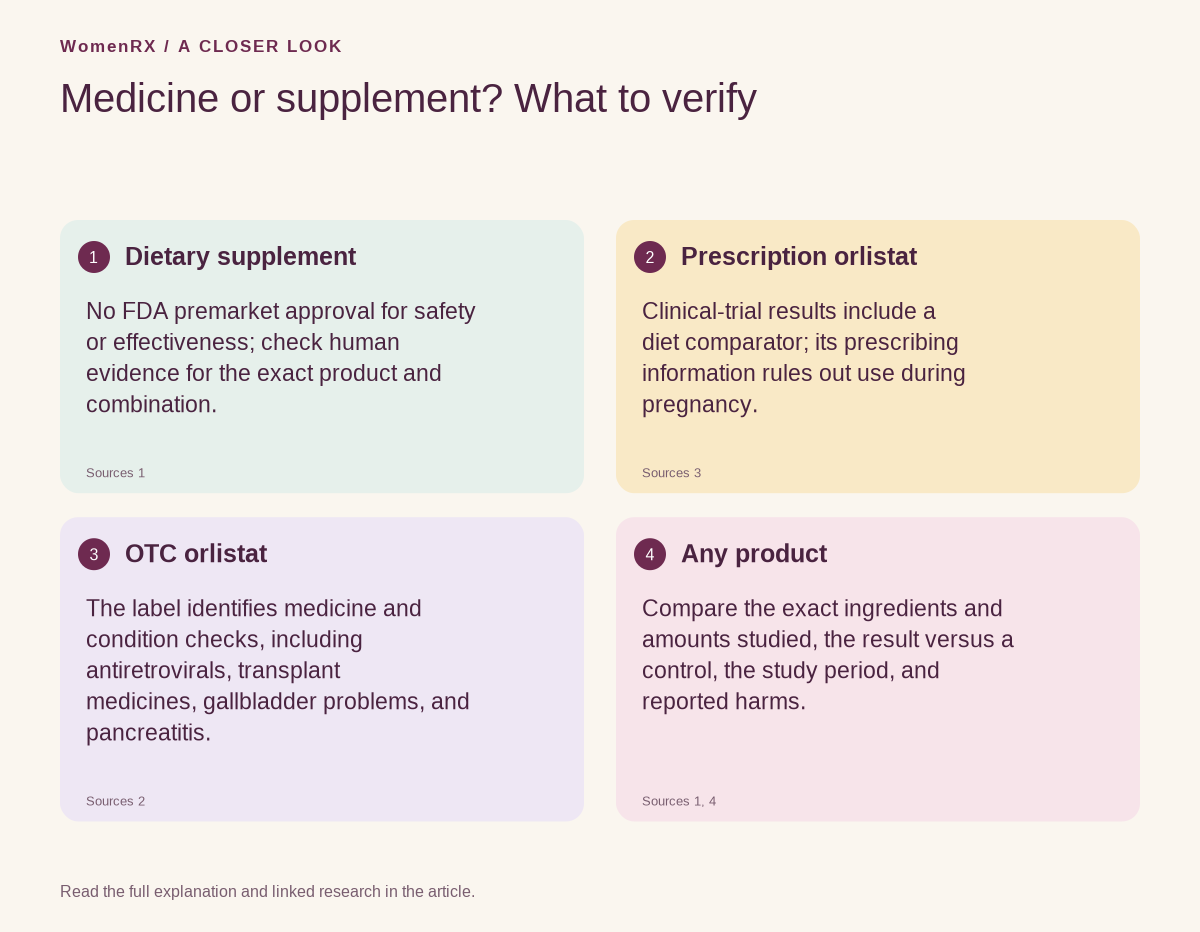
Medicine or supplement? What to verify
Dietary supplement: No FDA premarket approval for safety or effectiveness; check human evidence for the exact product and combination.1
Prescription orlistat: Clinical-trial results include a diet comparator; its prescribing information rules out use during pregnancy.3
OTC orlistat: The label identifies medicine and condition checks, including antiretrovirals, transplant medicines, gallbladder problems, and pancreatitis.2
Any product: Compare the exact ingredients and amounts studied, the result versus a control, the study period, and reported harms.14
Read the figure as text
The category changes what kind of evidence and label checks are relevant; neither category removes the need to consider personal safety.- Dietary supplement: No FDA premarket approval for safety or effectiveness; check human evidence for the exact product and combination.1
- Prescription orlistat: Clinical-trial results include a diet comparator; its prescribing information rules out use during pregnancy.3
- OTC orlistat: The label identifies medicine and condition checks, including antiretrovirals, transplant medicines, gallbladder problems, and pancreatitis.2
- Any product: Compare the exact ingredients and amounts studied, the result versus a control, the study period, and reported harms.14
More questions, answered
Does FDA regulation mean a weight-loss supplement is proven to work?
No. Dietary supplements are regulated, but they do not require FDA premarket review or approval for safety and effectiveness. Manufacturers are responsible for safety and truthful labeling; that is different from a medicine being approved for a specific use. 1
If a trial includes women, does that prove the product works differently for women?
No. A study’s percentage of women tells you who took part, not whether outcomes differed by sex. Orlistat’s cited clinical trials included 80.2% women, but that alone doesn’t establish a women-specific effect. 3
Sources you can check
- Dietary Supplements for Weight Loss - Health Professional Fact SheetAccessed 2026-09-25Return to first citation
- ALLI (ORLISTAT) CAPSULE [HALEON US HOLDINGS LLC] | US prescribing information and patient instructionsAccessed 2026-09-25Return to first citation
- XENICAL (ORLISTAT) CAPSULE [H2-PHARMA LLC] | US prescribing information and patient instructionsAccessed 2026-09-25Return to first citation
- Safety and efficacy of glucomannan for weight loss in overweight and moderately obese adults.Keithley JK, Swanson B, Mikolaitis SL, DeMeo M, Zeller JM, Fogg L, Adamji J. · Journal of obesity · 2013Return to first citation
- Safety and efficacy of citrus aurantium for weight loss.Bent S, Padula A, Neuhaus J. · The American journal of cardiology · 2004Return to first citation