Weight-Loss Supplements for Women: What the Evidence Shows
Two small trials in women found short-term weight changes, but broader green tea research suggests any effect is small and may not last.
There isn’t enough evidence to name a best weight-loss supplement for women. Small trials found short-term weight changes with specific ingredient combinations, but broader research suggests green tea’s average effect is small, and a year-long trial in postmenopausal women found no overall weight effect from green tea extract. Weight results also don’t settle safety: concentrated green tea extract has been linked to liver problems. 1 4 6
First, separate supplements from medicines
A “weight-loss supplement” might contain one ingredient or a blend of many. Orlistat, which may appear alongside supplements in weight-loss searches, is a medicine. That distinction matters: dietary supplements don’t undergo FDA premarket review and approval like drugs. Some weight-loss supplement ingredients may cause harm or interact with medicines. 1 2
Prescription orlistat has more extensive trial evidence than the supplement combinations discussed below. In pooled results from five clinical trials, people taking orlistat plus diet lost an average of 13.4 pounds over one year, compared with 5.8 pounds for people taking placebo plus diet. The prescription label describes seven long-term trials in which 80.2% of the trial population were women. It doesn’t give a women-only estimate for the pooled weight result. Women were well represented in those trials, but that isn’t the same as knowing whether the average effect differed for women. 3
The over-the-counter orlistat label says most people in its studies lost 5-10 pounds over six months. It also describes oily spotting, loose stools, and reduced absorption of some vitamins. The label flags potential problems with anticoagulants and HIV medicines, and says not to use the product after an organ transplant because it can interfere with medicines used to prevent rejection. These findings and warnings concern orlistat, not dietary supplements. 2
What short trials in women found
In an eight-week randomized trial, 50 women with overweight received either a supplement combining green tea, capsaicin, and ginger extracts or a placebo. The supplement group lost an average of 1.8 kg; the placebo group gained an average of 0.4 kg. Because the ingredients were tested together, the trial can’t tell you whether green tea, either other ingredient, or the combination accounted for the difference. Eight weeks also can’t tell you whether the change lasted. 4
A separate 12-week randomized trial included 54 women with overweight and polycystic ovary syndrome (PCOS). The group assigned chromium plus carnitine lost an average of 3.6 kg, compared with 1.0 kg in the placebo group. That’s a finding about a particular combination in women with PCOS. It doesn’t show that either ingredient works alone, that the combination helps women without PCOS, or that it improves periods. 6
Those short trials need context. A review of 14 randomized trials involving 1,562 people with overweight or obesity found that green tea preparations produced an average of 0.95 kg more weight loss than placebo over 12 to 13 weeks. But when researchers looked at six studies conducted outside Japan, they found no statistically significant difference. The NIH reference describes any weight effect as small and unlikely to be clinically meaningful. These findings concern green tea preparations overall, not the specific three-ingredient blend tested in the women-only trial. 1
Duration and life stage matter, too. In a separate 12-month trial, decaffeinated green tea extract had no overall effect on body weight, BMI, or waist circumference among 121 postmenopausal women with overweight or obesity. That longer study gives a different result from short-term findings and makes it harder to treat a brief weight change as evidence of a lasting benefit. 1
Neither short-term weight result establishes that its ingredient blend is safe. A difference on the scale doesn’t settle adverse effects or risks with longer use. 4 6
Green tea extract has a separate safety question
Green tea as a drink and concentrated green tea extract aren’t interchangeable when you’re weighing safety. The NIH reference reports no adverse effects from green tea beverage consumption, but describes nausea, abdominal discomfort, constipation, increased blood pressure, and possible liver damage with green tea extract. In a study of 1,021 postmenopausal women, those taking green tea extract for 12 months had significantly increased liver enzymes compared with placebo, and some developed moderate or more severe liver-function abnormalities. This is ingredient-level safety evidence, not a finding about the three-ingredient blend trial. 1
Read the weight result and the risk separately
A change on the scale isn’t a safety finding. When you see a product claim, first look for a human study of the same ingredients together. Check who participated, what the comparison group received, and how long weight was measured. Then look separately for information about adverse effects and medication interactions. A short trial can report a weight difference without settling what longer use would mean. 4 6
The ingredient list matters too. Some weight-loss products contain numerous ingredients, and NIH notes that some labels list caffeine-containing herbs without stating the product’s caffeine amount. If you take medication, a general promise that a product is “natural” tells you nothing useful about whether its ingredients could interfere with it. 1
How life stage changes the question
Pregnancy: The prescription orlistat label says weight loss offers no benefit during pregnancy and may harm the fetus; orlistat is contraindicated during pregnancy. That’s an orlistat-specific warning, not evidence that every supplement carries the same risk. The short supplement trials above don’t establish suitability during pregnancy. 3 4 6
Breastfeeding: Neither of those reported trial results answers whether its supplement combination is suitable while breastfeeding. A weight-change finding in other women can’t fill that gap. 4 6
PCOS and menstrual health: The chromium-and-carnitine trial enrolled women with PCOS, but its reported weight and metabolic results aren’t evidence of a benefit for menstrual symptoms. 6
After menopause: A six-month study in postmenopausal women compared calcium plus vitamin D supplements, low-fat dairy foods, and placebo as additions to calorie-restricted diets. Its secondary analysis focused on cardiometabolic measures. It doesn’t establish that calcium or vitamin D alone causes weight loss. 5
If a product ad quotes a number, the most useful question is: A difference compared with what, in whom, and for how long? Those details can turn an impressive-sounding claim into a more modest, usable finding. They can also reveal when a result from a medicine, a multi-ingredient blend, or a particular group of women is being stretched to sell something else.
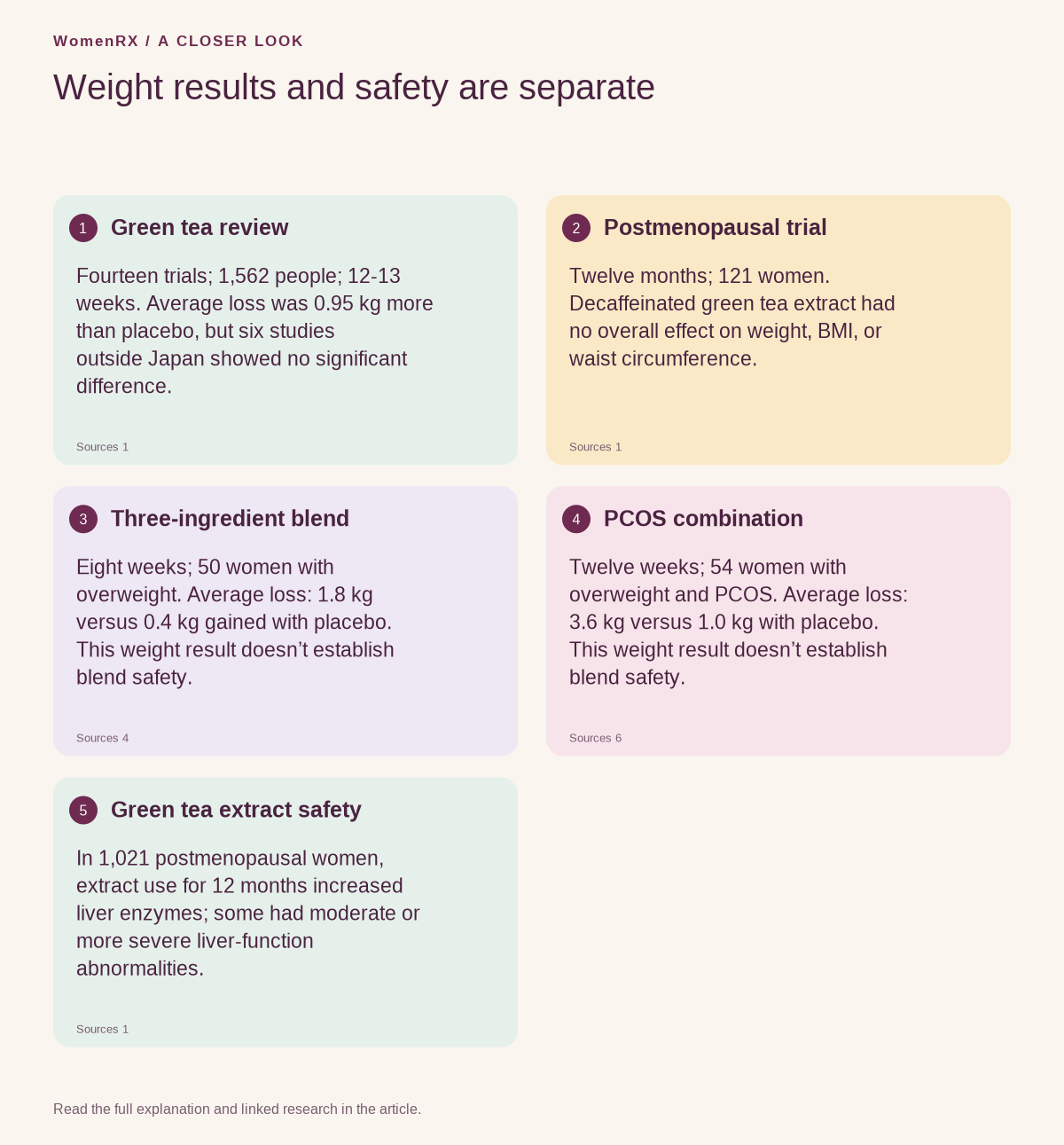
Weight results and safety are separate
Green tea review: Fourteen trials; 1,562 people; 12-13 weeks. Average loss was 0.95 kg more than placebo, but six studies outside Japan showed no significant difference.1
Postmenopausal trial: Twelve months; 121 women. Decaffeinated green tea extract had no overall effect on weight, BMI, or waist circumference.1
Three-ingredient blend: Eight weeks; 50 women with overweight. Average loss: 1.8 kg versus 0.4 kg gained with placebo. This weight result doesn’t establish blend safety.4
PCOS combination: Twelve weeks; 54 women with overweight and PCOS. Average loss: 3.6 kg versus 1.0 kg with placebo. This weight result doesn’t establish blend safety.6
Green tea extract safety: In 1,021 postmenopausal women, extract use for 12 months increased liver enzymes; some had moderate or more severe liver-function abnormalities.1
Read the figure as text
Compare what was measured, who participated, and for how long, then consider safety evidence separately from the scale result.- Green tea review: Fourteen trials; 1,562 people; 12-13 weeks. Average loss was 0.95 kg more than placebo, but six studies outside Japan showed no significant difference.1
- Postmenopausal trial: Twelve months; 121 women. Decaffeinated green tea extract had no overall effect on weight, BMI, or waist circumference.1
- Three-ingredient blend: Eight weeks; 50 women with overweight. Average loss: 1.8 kg versus 0.4 kg gained with placebo. This weight result doesn’t establish blend safety.4
- PCOS combination: Twelve weeks; 54 women with overweight and PCOS. Average loss: 3.6 kg versus 1.0 kg with placebo. This weight result doesn’t establish blend safety.6
- Green tea extract safety: In 1,021 postmenopausal women, extract use for 12 months increased liver enzymes; some had moderate or more severe liver-function abnormalities.1
Sources you can check
- Dietary Supplements for Weight Loss - Health Professional Fact SheetAccessed 2026-09-25Return to first citation
- ALLI (ORLISTAT) CAPSULE [HALEON US HOLDINGS LLC] | US prescribing information and patient instructionsAccessed 2026-09-25Return to first citation
- XENICAL (ORLISTAT) CAPSULE [H2-PHARMA LLC] | US prescribing information and patient instructionsAccessed 2026-09-25Return to first citation
- The Effect of Dietary Supplements Containing Green Tea, Capsaicin and Ginger Extracts on Weight Loss and Metabolic Profiles in Overweight Women: A Randomized Double-Blind Placebo-Controlled Clinical Trial.Taghizadeh M, Farzin N, Taheri S, Mahlouji M, Akbari H, Karamali F, Asemi Z. · Annals of nutrition & metabolism · 2017Return to first citation
- Cardiometabolic Indices after Weight Loss with Calcium or Dairy Foods: Secondary Analyses from a Randomized Trial with Overweight/Obese Postmenopausal Women.Ilich JZ, Liu PY, Shin H, Kim Y, Chi Y. · Nutrients · 2022Return to first citation
- Effects of Chromium and Carnitine Co-supplementation on Body Weight and Metabolic Profiles in Overweight and Obese Women with Polycystic Ovary Syndrome: a Randomized, Double-Blind, Placebo-Controlled Trial.Jamilian M, Foroozanfard F, Kavossian E, Kia M, Aghadavod E, Amirani E, Asemi Z. · Biological trace element research · 2020Return to first citation