Can Menopause Weight-Loss Supplements Make a Difference?
Some supplements are tested in postmenopausal women, but the available evidence does not show that green tea supplements reliably reduce weight.
Be cautious about weight-loss products that promise a menopause-specific fix. In a review of randomized trials in postmenopausal women, green tea did not significantly improve weight or other measured outcomes besides total cholesterol. More broadly, evidence for many weight-loss supplements is limited, and products can contain multiple ingredients that interact with medicines. Check the exact product and its safety before starting it. 4 1
First, separate the scale from body composition
A change on the scale doesn’t tell you by itself whether you’ve gained fat, lost muscle, or retained more water. Weight includes all of these, and BMI can’t distinguish fat from muscle or bone. Waist measurement and overall health can add context, but they don’t explain a change on their own. 3
Menopause also shouldn’t be treated as the automatic explanation for every midlife weight change. In a two-year study of 223 Swedish women who were one to four years past menopause, body composition and bone measures were assessed separately. That distinction matters: a product claiming to “burn belly fat,” preserve muscle, or change scale weight is making a different claim for each outcome. 5
Before you consider a supplement, ask what result you actually want to change. Is it total weight, waist size, body fat, or maintaining muscle? Evidence for one outcome doesn’t prove an effect on the others.
What the supplement evidence can tell you
Green tea is a useful example of why the study details matter. A 2026 systematic review and meta-analysis included seven randomized trials in postmenopausal women. The review found no statistically significant effect on the other evaluated outcomes besides total cholesterol, including the weight-related measures it assessed. This doesn’t prove that every green tea product has no effect, but it doesn’t support relying on green tea supplements for weight loss. 4
The review also called for better trials with standardized products and durations. That matters because a result for one formulation can’t automatically be applied to a different extract, tea drink, or multi-ingredient capsule. The review cautioned about high-dose concentrated extracts and noted that liver-function monitoring may be warranted. 4
For weight-loss supplements overall, the NIH Office of Dietary Supplements says little is known about whether many products work. Some contain many ingredients, and ingredients can interact with or interfere with medicines. Products may also include caffeine from sources such as guarana or yerba maté, and some labels don’t state the amount of caffeine. 1
A menopause-related ingredient isn’t necessarily a weight-loss ingredient. Black cohosh, for example, is commonly sold for menopausal symptoms such as hot flashes. The evidence summarized by NIH is about symptom relief, not weight reduction, so a menopause claim shouldn’t be taken as proof of a weight benefit. 2
A practical way to assess a claim
When a label promises weight loss, look for three things:
- A study of the actual ingredient and product. A study of a single ingredient may not apply to a blend with several ingredients. A product claim is more useful when the formula studied matches the one being sold. Weight-loss products can contain dozens of ingredients. 1
- A measured outcome that matches the promise. Look for whether the research measured weight, waist, or body composition. “Metabolic support” is not the same outcome as demonstrated weight loss, and a change in cholesterol is not evidence of a change in weight. 4
- Safety information for the whole formula. Read the Supplement Facts panel, including caffeine sources, and consider whether the product could interact with medicines you take. If the label lists a blend without making the amounts clear, it may be difficult to compare it with research or assess its ingredients. 1
In the US, dietary supplements aren’t reviewed and approved by the FDA as drugs before they’re marketed. That’s one reason a confident label claim shouldn’t substitute for evidence about the specific product. 1
What to discuss before you start
Bring the product name or a clear photo of its Supplement Facts panel, and be ready to list your medicines and other supplements. Ask what the product is meant to change, whether that outcome has been studied in women at a similar life stage, and what is known about interactions or side effects. It’s also reasonable to ask what you’d use to judge whether it’s helping, rather than continuing based on a general promise.
If the change in weight is sudden or happening without trying, that’s a reason to seek medical review rather than assume it’s menopause or try a weight-loss supplement. 3
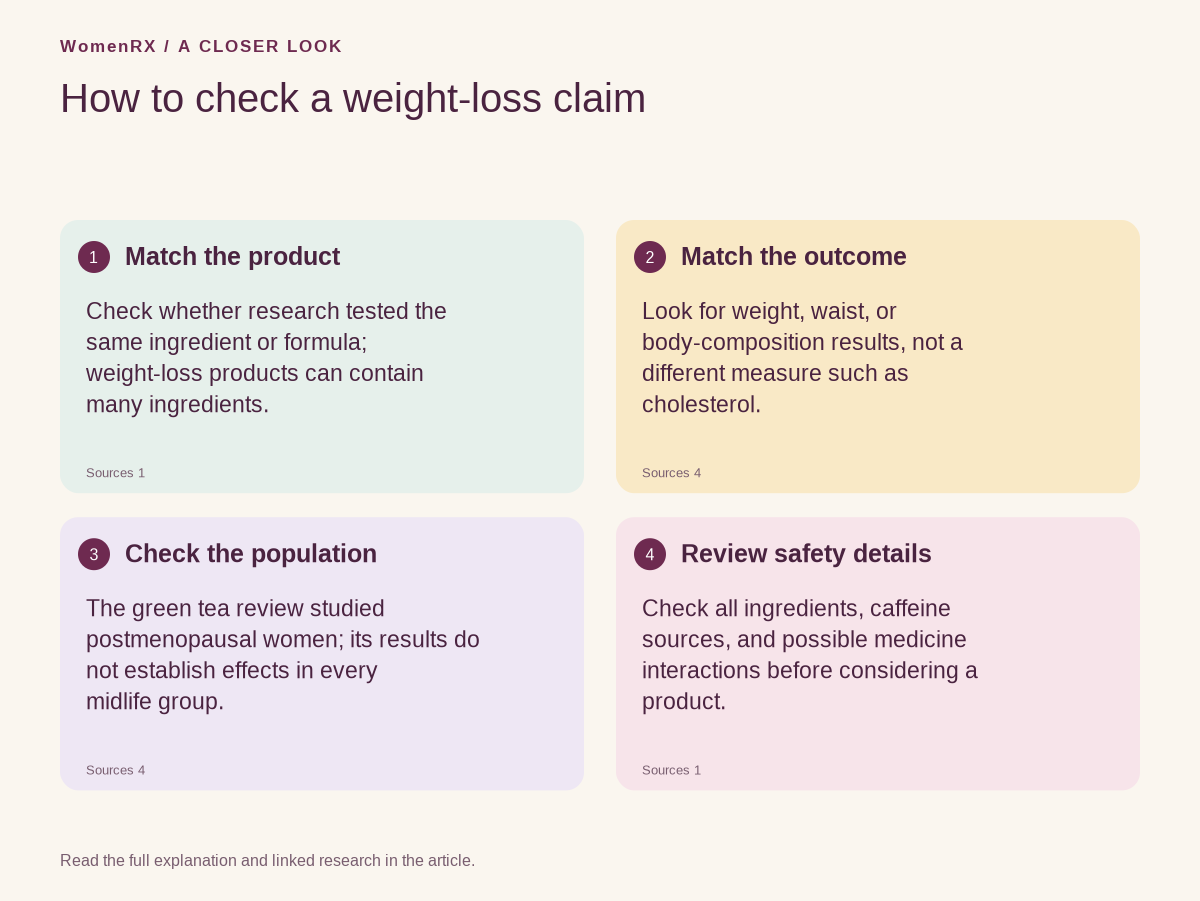
How to check a weight-loss claim
Match the product: Check whether research tested the same ingredient or formula; weight-loss products can contain many ingredients.1
Match the outcome: Look for weight, waist, or body-composition results, not a different measure such as cholesterol.4
Check the population: The green tea review studied postmenopausal women; its results do not establish effects in every midlife group.4
Review safety details: Check all ingredients, caffeine sources, and possible medicine interactions before considering a product.1
Read the figure as text
Use these questions to tell a study-backed, outcome-specific claim from a broad product promise, and to check for safety concerns.- Match the product: Check whether research tested the same ingredient or formula; weight-loss products can contain many ingredients.1
- Match the outcome: Look for weight, waist, or body-composition results, not a different measure such as cholesterol.4
- Check the population: The green tea review studied postmenopausal women; its results do not establish effects in every midlife group.4
- Review safety details: Check all ingredients, caffeine sources, and possible medicine interactions before considering a product.1
More questions, answered
Does a menopause supplement claim mean it helps with weight?
No. A product marketed for menopausal symptoms may have been studied for symptoms such as hot flashes, not for weight. Check that the research measured the specific outcome the product promises. 2 4
What if my weight changed suddenly without trying?
An unexpected gain or loss can sometimes signal a medical problem. MedlinePlus advises discussing sudden, unexplained weight change with a health care provider rather than assuming it is part of menopause. 3
Sources you can check
- Dietary Supplements for Weight Loss - Health Professional Fact SheetAccessed 2026-09-25Return to first citation
- Black Cohosh - Health Professional Fact SheetAccessed 2026-09-25Return to first citation
- Body Weight: MedlinePlusAccessed 2026-09-25Return to first citation
- Effects of green tea use on the metabolic profile of postmenopausal women: systematic review and meta-analysis.Zago IHR, Colonetti L, Balbinot EL, Taschetto IS, Grande AJ, da Rosa MI, Colonetti T. · European journal of nutrition · 2026Return to first citation
- Associations between body composition and bone loss in early postmenopausal women.Geraldi MV, Gregori G, Johansson L, Hjertonsson U, Brättemark E, Lorentzon M. · Journal of bone and mineral research : the official journal of the American Society for Bone and Mineral Research · 2026Return to first citation