Menopause Weight Changes: Do Supplements Help?
A supplement’s general weight-loss claim doesn’t show that it works for weight change during menopause.
There’s no good reason to treat a weight-loss supplement as a dependable fix for menopause-related weight change. A trial of green tea extract in postmenopausal women found no overall change in weight, BMI, or waist circumference, while a small trial of CLA in postmenopausal women with obesity and type 2 diabetes reported a reduction in body fat. These different findings don’t establish a general menopause benefit. 1
Weight changes around menopause can raise a reasonable question: is there a supplement that helps? The useful answer is to separate three things that advertisements often blend together: weight on the scale, waist size, and body composition. Evidence for one doesn’t automatically show a benefit for the others.
What the trials actually measure
A scale can’t tell you whether a change comes from fat, muscle, bone, or water. Waist circumference adds a different piece of information: more fat around the abdomen can be associated with higher risk of heart disease and type 2 diabetes. Neither measure, on its own, tells the whole story. 2
Body-composition findings add another distinction. For example, a 16-week trial in 35 postmenopausal women with obesity and type 2 diabetes found that CLA reduced BMI and total body fat compared with safflower oil. This is a specific finding in a small, defined group. It doesn’t establish that CLA helps women generally during menopause, and the reported result is not the same as evidence of a benefit for waist circumference. 1
That distinction matters when weighing supplement claims. A product might be promoted as “burning fat,” but the human trial could measure only body weight, run for a short time, or test a blend whose individual ingredients can’t be separated. The NIH Office of Dietary Supplements notes that weight-loss supplement studies often have small samples or short durations, and that multi-ingredient products make it hard to tell which ingredient, if any, produced a result. 1
A menopause-specific example: green tea extract
The evidence for green tea extract includes a 12-month trial of 121 postmenopausal women with overweight or obesity. The extract was decaffeinated. It had no overall effect on body weight, BMI, or waist circumference. This is directly relevant to postmenopause, but it doesn’t answer whether every formulation or every group of women would have the same result. 1
It’s also worth separating the supplement from the drink. Evidence about green tea extract isn’t a reason to expect a brewed cup of green tea to produce weight loss. And extract has a safety concern the beverage evidence doesn’t share: green tea extract has been linked to liver injury, and one trial in postmenopausal women reported increased liver enzymes and some moderate or more serious liver-function abnormalities. 1
What about glucomannan, berberine, and other popular ingredients?
Glucomannan is a soluble fiber. Despite claims that it helps by increasing fullness, two reviews summarized by NIH found no significant weight-loss benefit compared with placebo. Those summarized results don’t establish a menopause-specific benefit. Tablet forms also have been associated with esophageal obstruction. 1
For berberine, look for the same kind of evidence you’d want for any ingredient: a human trial in women at the relevant menopause stage, with a comparison group and a clearly measured outcome such as weight, waist circumference, or body composition. A result for another health outcome, a proposed mechanism, or a study in a different population wouldn’t establish that it helps with menopause-related weight change.
That population distinction matters beyond individual ingredients. A bibliometric analysis of US research publications on supplements and menopause-related health found that perimenopause was notably underrepresented. It also described research covering many different ingredients with limited replication. This analysis maps research coverage; it does not assess whether supplements are effective. So evidence in postmenopausal women shouldn’t automatically be assumed to apply to perimenopause, and general adult weight-loss results shouldn’t automatically be assumed to apply to either group. 3
A quick way to screen a supplement claim
Before buying, ask:
- Which outcome improved? Weight, waist, and body fat are not interchangeable. Ask what the trial measured and whether that result matches your goal.
- Who was studied? Check whether participants were in the menopause stage you’re asking about, or whether the findings came from a broader group.
- Was the ingredient tested alone? If the study tested a blend, it may not show that the advertised ingredient caused the result.
- How meaningful was the difference? A statistically significant change isn’t necessarily large enough to matter in daily life. Look for the difference compared with placebo, not just the change from the start of the study.
- What are the risks and unknowns? Check the full ingredient list, possible side effects, and whether ingredients may interact with medicines. Supplement formulas and amounts can vary, and many weight-loss supplements haven’t been studied thoroughly. 1
What weight change around menopause can and can’t tell you
A supplement trial can tell you whether an ingredient changed a measured outcome in its study group. It can’t establish what caused your own weight change during the menopause transition. Separately, general weight guidance identifies diet and family history or genetics among factors that matter; body weight also includes muscle, bone, fat, and water. 12
The research picture also differs by stage: a bibliometric analysis of US supplement publications identifies perimenopause as notably underrepresented. Findings from postmenopausal participants don’t automatically answer questions about the transition. 3 If weight management is your goal, a healthy dietary pattern and physical activity are the foundation of long-term weight loss. It can also help to look beyond the scale and consider strength, energy, and waist size, depending on what matters to you. 12
If weight changes suddenly or without trying, get it checked rather than assuming it’s a normal part of menopause. 2
treat a menopause-weight supplement claim as a question to verify, not a promise. Ask for human evidence that matches the ingredient, menopause stage, and outcome, then weigh the size of the result against the product’s uncertainties and risks.
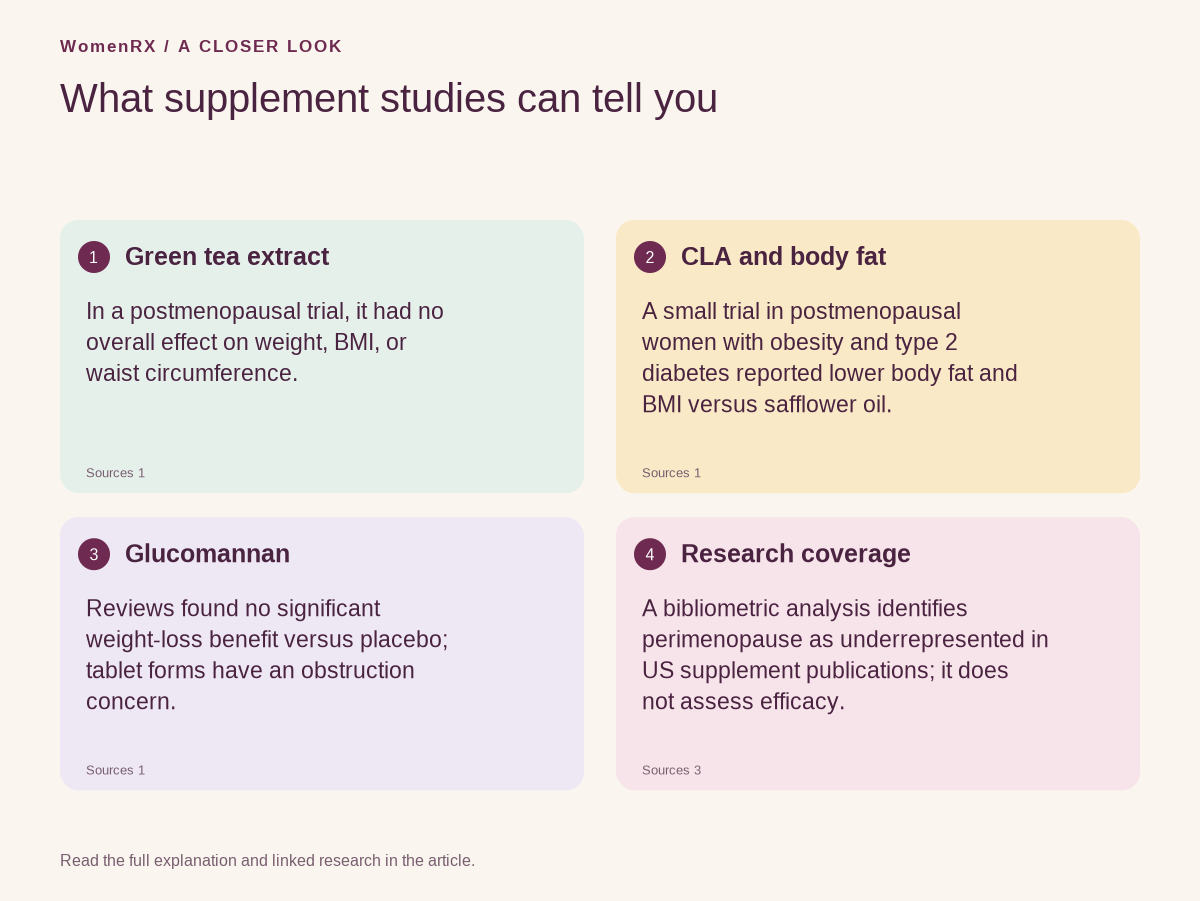
What supplement studies can tell you
Green tea extract: In a postmenopausal trial, it had no overall effect on weight, BMI, or waist circumference.1
CLA and body fat: A small trial in postmenopausal women with obesity and type 2 diabetes reported lower body fat and BMI versus safflower oil.1
Glucomannan: Reviews found no significant weight-loss benefit versus placebo; tablet forms have an obstruction concern.1
Research coverage: A bibliometric analysis identifies perimenopause as underrepresented in US supplement publications; it does not assess efficacy.3
Read the figure as text
Compare the population, outcome, and limits before treating a supplement result as relevant to menopause-related weight change.- Green tea extract: In a postmenopausal trial, it had no overall effect on weight, BMI, or waist circumference.1
- CLA and body fat: A small trial in postmenopausal women with obesity and type 2 diabetes reported lower body fat and BMI versus safflower oil.1
- Glucomannan: Reviews found no significant weight-loss benefit versus placebo; tablet forms have an obstruction concern.1
- Research coverage: A bibliometric analysis identifies perimenopause as underrepresented in US supplement publications; it does not assess efficacy.3
More questions, answered
Does a weight-loss result in postmenopausal women apply during perimenopause?
Not automatically. A bibliometric analysis of US supplement research publications identifies perimenopause as notably underrepresented, so a result in postmenopausal women may not answer whether the same ingredient works during the transition. 3
Is green tea extract the same as drinking green tea?
No. The weight-loss evidence discussed here concerns supplements or extracts, not a guarantee of weight loss from drinking green tea. Green tea extract also has a liver-injury concern that makes it important to distinguish the extract from the beverage. 1
Sources you can check
- Dietary Supplements for Weight Loss - Health Professional Fact SheetAccessed 2026-09-25Return to first citation
- Body Weight: MedlinePlusAccessed 2026-09-25Return to first citation
- Dietary supplements for menopausal symptoms and health: a bibliometric analysis of US research (2000-2024).Canino MC, Cohen B, Byrd C, Gahche JJ. · Menopause (New York, N.Y.) · 2026Return to first citation