Weight Changes Around Menopause: What the Measures Show
The scale alone can’t show whether a change is in total weight, waist size, or the balance of fat and lean mass.
Perimenopause is the transition leading up to the final menstrual period; postmenopause is the time after it. Body-composition changes may begin during the transition and continue into the early postmenopausal years. One study of early postmenopausal women measured weight, fat mass, and lean mass, but it cannot tell readers whether typical weight change differs between the two stages. 2
The stage tells you when, not what the scale will do
Perimenopause is the transition toward the final menstrual period. Postmenopause is the period after it; some research separates out the early postmenopausal years. These labels describe timing, not a guaranteed pattern of weight change. In one study, for example, researchers included women aged 50 to 60 who were one to four years past menopause. 2
A key point is that body-composition changes may cross the boundary between stages. Research summarized in that study describes fat mass increases and lean mass losses during the menopause transition that can persist for up to two years after the final menstrual period. That doesn’t mean every woman experiences these changes, or that they necessarily show up as a higher number on the scale. 2
Weight, waist, and body composition are different measures
Body weight is the combined mass of fat, muscle, bone, and water. A scale can tell you that total, but not what contributed to it. BMI also can’t distinguish fat from muscle or bone. 1
Waist circumference adds a different piece of information: it can help indicate whether more body fat is carried around the abdomen rather than the hips. It still doesn’t measure fat and lean tissue separately. 1
To see body composition more directly, the Swedish study of early postmenopausal women used DXA to assess weight, fat mass, and appendicular lean mass, meaning lean mass in the arms and legs. Because it also examined how these measures related to bone outcomes, it should not be read as a comparison of typical weight change in perimenopause versus postmenopause. 2
What the study windows actually tell us
Menopause-stage windows depend on the question a study is asking. The Swedish body-composition study included women aged 50 to 60 who were one to four years past menopause. A separate Japanese study of urate levels, not weight, defined perimenopause as the five years before menopause through menopause, then categorized the years afterward as postmenopause. That urate-study definition shouldn’t be treated as a standard for weight research. 23
“Weight change” can also mean different outcomes. A study measuring body weight may miss a shift between fat and lean mass if total weight changes little. A waist measure captures something different again. MedlinePlus notes that weight includes several types of tissue and water, while BMI does not distinguish fat from muscle and bone. 1
The Swedish study followed 223 women for two years and measured body composition, but its reported findings concern associations with bone measures, not a direct comparison of average weight trajectories between stages. 2
A practical way to read your own change
If you’re trying to understand what has changed, separate three questions: Has total weight changed? Has your waist measurement changed? Is there evidence about fat and lean mass, rather than weight alone? Those measures answer different questions, so a change in one doesn’t tell the whole story. 12
For example, if the scale is steady but your waist measurement is different, the scale hasn’t ruled out a change in body composition or fat distribution. It also can’t confirm one. If you’re gaining or losing weight suddenly without trying, MedlinePlus advises discussing the change with a healthcare provider. 1
The useful distinction is that fat-mass increases and lean-mass losses may extend from the menopause transition into early postmenopause, while a scale records only total weight. 12
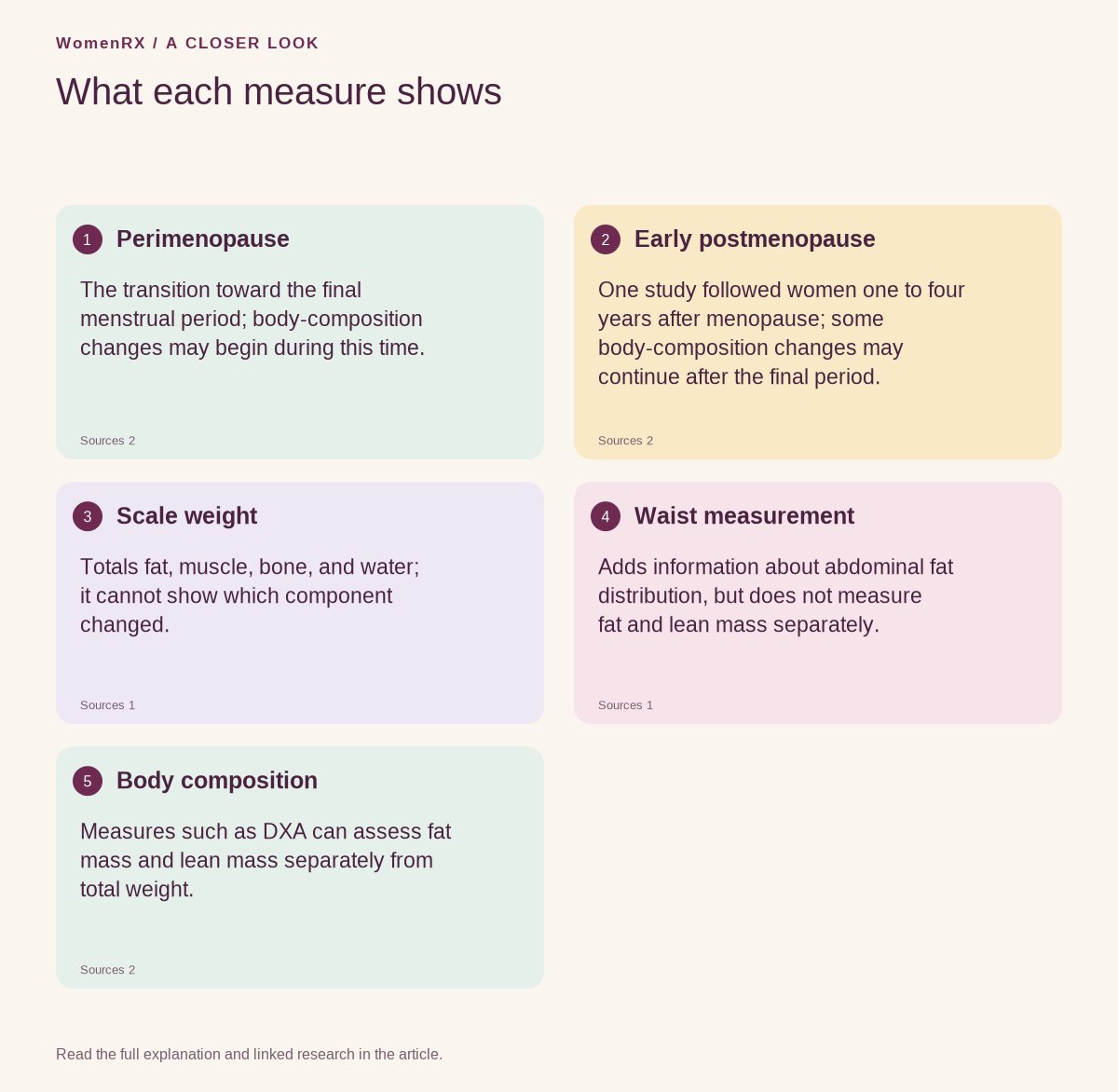
What each measure shows
Perimenopause: The transition toward the final menstrual period; body-composition changes may begin during this time.2
Early postmenopause: One study followed women one to four years after menopause; some body-composition changes may continue after the final period.2
Scale weight: Totals fat, muscle, bone, and water; it cannot show which component changed.1
Waist measurement: Adds information about abdominal fat distribution, but does not measure fat and lean mass separately.1
Body composition: Measures such as DXA can assess fat mass and lean mass separately from total weight.2
Read the figure as text
Menopause stage gives timing; the measure used determines what kind of body change a study can detect.- Perimenopause: The transition toward the final menstrual period; body-composition changes may begin during this time.2
- Early postmenopause: One study followed women one to four years after menopause; some body-composition changes may continue after the final period.2
- Scale weight: Totals fat, muscle, bone, and water; it cannot show which component changed.1
- Waist measurement: Adds information about abdominal fat distribution, but does not measure fat and lean mass separately.1
- Body composition: Measures such as DXA can assess fat mass and lean mass separately from total weight.2
More questions, answered
Can your weight stay the same while your body composition changes?
Yes. Total weight combines fat, muscle, bone, and water, so the scale alone can’t show how those components have shifted. 1
Sources you can check
- Body Weight: MedlinePlusAccessed 2026-09-25Return to first citation
- Associations between body composition and bone loss in early postmenopausal women.Geraldi MV, Gregori G, Johansson L, Hjertonsson U, Brättemark E, Lorentzon M. · Journal of bone and mineral research : the official journal of the American Society for Bone and Mineral Research · 2026Return to first citation
- Longitudinal Changes in Serum Urate Levels From Premenopause Through Postmenopause: Interrupted Time-Series Analyses.Billa S, Fukui S, Paudel ML, Suzuki T, Imai R, Kim Y, Nakai T, Tamaki H, Kishimoto M, Ørbo HS, Tedeschi SK, Choi HK, Okada M, Solomon DH. · Arthritis & rheumatology (Hoboken, N.J.) · 2026Return to first citation