Can Magnesium Change Weight Around Menopause?
A large review found a small average weight difference, but it didn’t show that magnesium prevents menopause-related weight gain.
Magnesium hasn’t been shown to prevent or reverse weight gain specifically around menopause. A 2026 review of adult trials found a small average reduction in body weight with supplementation, but it wasn’t a menopause-specific result, and the review said its clinical importance was uncertain. A study in women over 45 used several nutrients together, so it can’t show that magnesium was responsible. 2 3
What the weight-loss evidence actually says
A 2026 systematic review and meta-analysis of 78 randomized controlled trials in adults found that participants taking magnesium had an average body weight 0.70 kg lower than participants in control groups. The review described the effects as generally modest and said their clinical importance was uncertain. It found no significant pooled effects on body mass index, waist circumference, or body-fat percentage. 2
That is a small average difference across adult trials, not proof that magnesium helps women lose weight during menopause. The review’s reported findings don’t establish a menopause-specific effect or separate results for midlife and postmenopausal women. They also don’t show that magnesium prevents weight gain over time. 2
Why a midlife study doesn’t settle it
A retrospective study analyzed records from 52 Chinese women aged 45 and older who took a supplement containing magnesium plus vitamins D3, K2, B6, and B12 for 12 weeks. The study reported a decrease in average weight, but because the supplement combined several nutrients, it can’t show that magnesium caused the change. The reported findings also don’t establish participants’ menopausal status, so the result can’t be treated as evidence about perimenopause or postmenopause specifically. 3
This is a useful distinction when you see a supplement claim: a study can include midlife women without testing magnesium alone or establishing an effect specific to menopause.
Weight and metabolic markers answer different questions
Magnesium studies may measure blood sugar, insulin resistance, cholesterol, blood pressure, body weight, or body composition. These outcomes aren’t interchangeable. In the 2026 review, some metabolic measures, including fasting blood glucose and insulin resistance, improved on average. But those findings don’t establish weight loss. The pooled weight difference was small, and BMI, waist circumference, and body-fat percentage did not show significant effects. 2
The scale has limits, too. Body weight includes muscle, bone, fat, and water, so the number alone can’t tell you what changed. 1
Four questions to ask about a weight claim
Before interpreting a magnesium weight-loss claim, check:
- Did the study test magnesium by itself, or a blend of ingredients?
- Were participants in perimenopause or postmenopause, and were results for them reported separately?
- Did researchers measure body weight, or only a metabolic marker?
- How large was the difference compared with a control group, and did other body measures change too?
For this research, those questions point to a measured conclusion: there’s a small average weight finding in broad adult trials, but not evidence that magnesium is a menopause-specific weight-management strategy. A sudden, unexpected weight change is different from a gradual change; MedlinePlus advises discussing unexpected weight gain or loss with a healthcare provider. 1
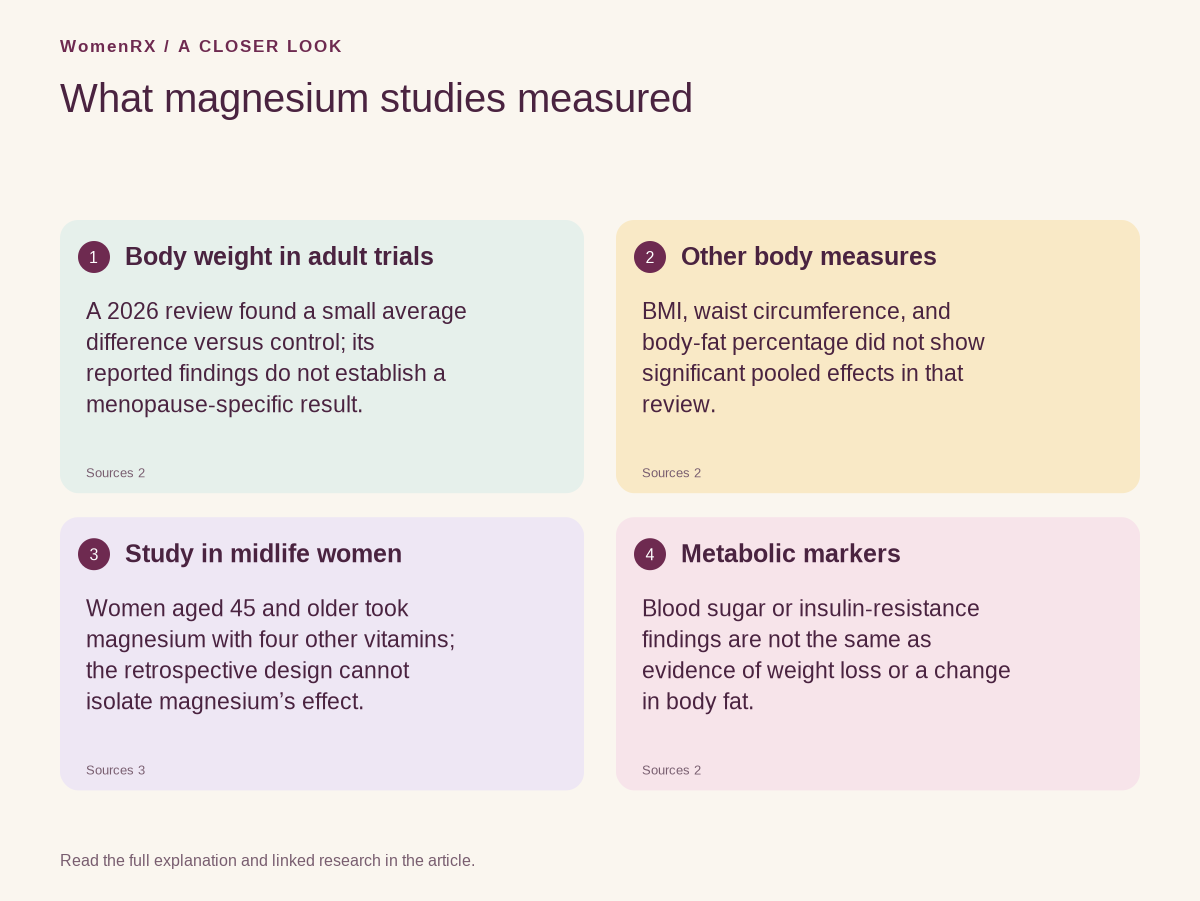
What magnesium studies measured
Body weight in adult trials: A 2026 review found a small average difference versus control; its reported findings do not establish a menopause-specific result.2
Other body measures: BMI, waist circumference, and body-fat percentage did not show significant pooled effects in that review.2
Study in midlife women: Women aged 45 and older took magnesium with four other vitamins; the retrospective design cannot isolate magnesium’s effect.3
Metabolic markers: Blood sugar or insulin-resistance findings are not the same as evidence of weight loss or a change in body fat.2
Read the figure as text
These studies offer different kinds of evidence. The outcome measured and the study design determine what you can reasonably conclude about weight.- Body weight in adult trials: A 2026 review found a small average difference versus control; its reported findings do not establish a menopause-specific result.2
- Other body measures: BMI, waist circumference, and body-fat percentage did not show significant pooled effects in that review.2
- Study in midlife women: Women aged 45 and older took magnesium with four other vitamins; the retrospective design cannot isolate magnesium’s effect.3
- Metabolic markers: Blood sugar or insulin-resistance findings are not the same as evidence of weight loss or a change in body fat.2
More questions, answered
Does low magnesium explain weight gain around menopause?
This research doesn’t establish low magnesium as the cause of weight gain around menopause or show that correcting magnesium levels prevents it. A relationship with metabolic markers would not, by itself, prove a cause-and-effect change in body weight.
Can better blood sugar results mean a supplement caused weight loss?
No. Blood sugar and insulin-resistance measures are different outcomes from body weight, waist size, or body fat. Look for results on the measure you actually want to understand. 2
Sources you can check
- Body Weight: MedlinePlusAccessed 2026-09-25Return to first citation
- Comprehensive Effects of Magnesium Supplementation on Cardiometabolic Risk Factors: A Systematic Review and Dose-Response Meta-Analysis.Mohammadi S, Palermo A, Ojani P, Alaghemand N, Pirayvatlou PS, Mirkarimi M, Mavi SA, Tahouri K, Shokouhifar S, Ettehad Y, Borzabadi A, Ashtary-Larky D, Suzuki K, Bouzas C, Rodrigue... · Nutrients · 2026Return to first citation
- Effects of 12-Week Multiple Micronutrient Supplementation on Immune Function, Body Weight, and Metabolic Parameters in Middle-Aged Women: A Retrospective Study.Sun Y. · Cureus · 2025Return to first citation