Can Food Choices Help With Weight Changes Around Menopause?
A menopause-specific study links overall eating patterns with weight outcomes, but it can’t show that one food caused the difference.
Food choices can be one part of managing weight around menopause. In a 12-year study of women, healthier overall dietary patterns were associated with more favorable weight outcomes, but the study didn’t test whether any individual food prevented weight gain. A practical takeaway is to build meals around a mix of foods you enjoy, rather than relying on a special menopause food or restrictive rules. 2
What the research says about eating patterns
The most directly relevant evidence comes from a prospective study of 38,283 women followed for 12 years around menopause. The researchers compared several dietary-pattern scores with weight change and new cases of obesity. Women gained an average of 0.80 kg per year during the study period. Because this was an observational study, it shows associations, not that a particular way of eating caused the results. 2
Some patterns associated with more favorable weight outcomes included more nuts, legumes, fruits, vegetables, and whole grains, and less red and processed meat, sodium, and French fries. The researchers also compared an insulin-related dietary score, the empirical dietary index for hyperinsulinemia. In the highest versus lowest group for its reverse score, women gained 0.28 kg less per year on average. That is a difference between groups in this study, not a predicted result for an individual. The study reports a dietary score and weight outcomes, not that participants’ insulin levels fell. 2
The study examined patterns of eating. It can’t tell whether one food drove the associations or establish that a particular food prevents weight gain. A food can be nutritious and worth including without being a proven menopause weight treatment.
A flexible way to put the findings to use
Think in terms of what you can add or make more regular, rather than a list of foods to ban. For example, you could add beans or lentils to a meal, choose fruit or nuts for a snack, or include vegetables and whole grains more often. These are examples drawn from food groups associated with favorable dietary-pattern scores in the study, not a prescribed menu or a promise of weight loss. 2
If changing several things feels like too much, pick one adjustment that fits your usual meals and is easy to repeat. Keep the foods you enjoy, and adapt the idea to your appetite, culture, budget, and health needs. The point is a sustainable pattern, not perfect eating.
Menopause is one part of a midlife shift
Weight change in midlife isn’t explained by menopause alone. A review describes age-related changes as a major driver of midlife weight gain, with menopause contributing to changes in body composition and a shift toward more fat around the center. Another review describes increased body fat, particularly centrally, alongside loss of lean mass during the transition and early menopause. 4 3
That’s one reason the scale can’t tell the whole story: body weight includes muscle, bone, fat, and water. A change in weight doesn’t reveal which of those has changed. 1
Diet is also only one piece of weight management. A review reports that combined diet and exercise approaches show evidence of improving weight, body composition, and metabolic risk factors, particularly when used during the menopause transition. It doesn’t establish one ideal menu or one approach that will work for every woman. 3
If your weight changes suddenly or without you trying, MedlinePlus advises discussing the change with a health care provider, since unexpected weight change can sometimes signal a medical problem. 1
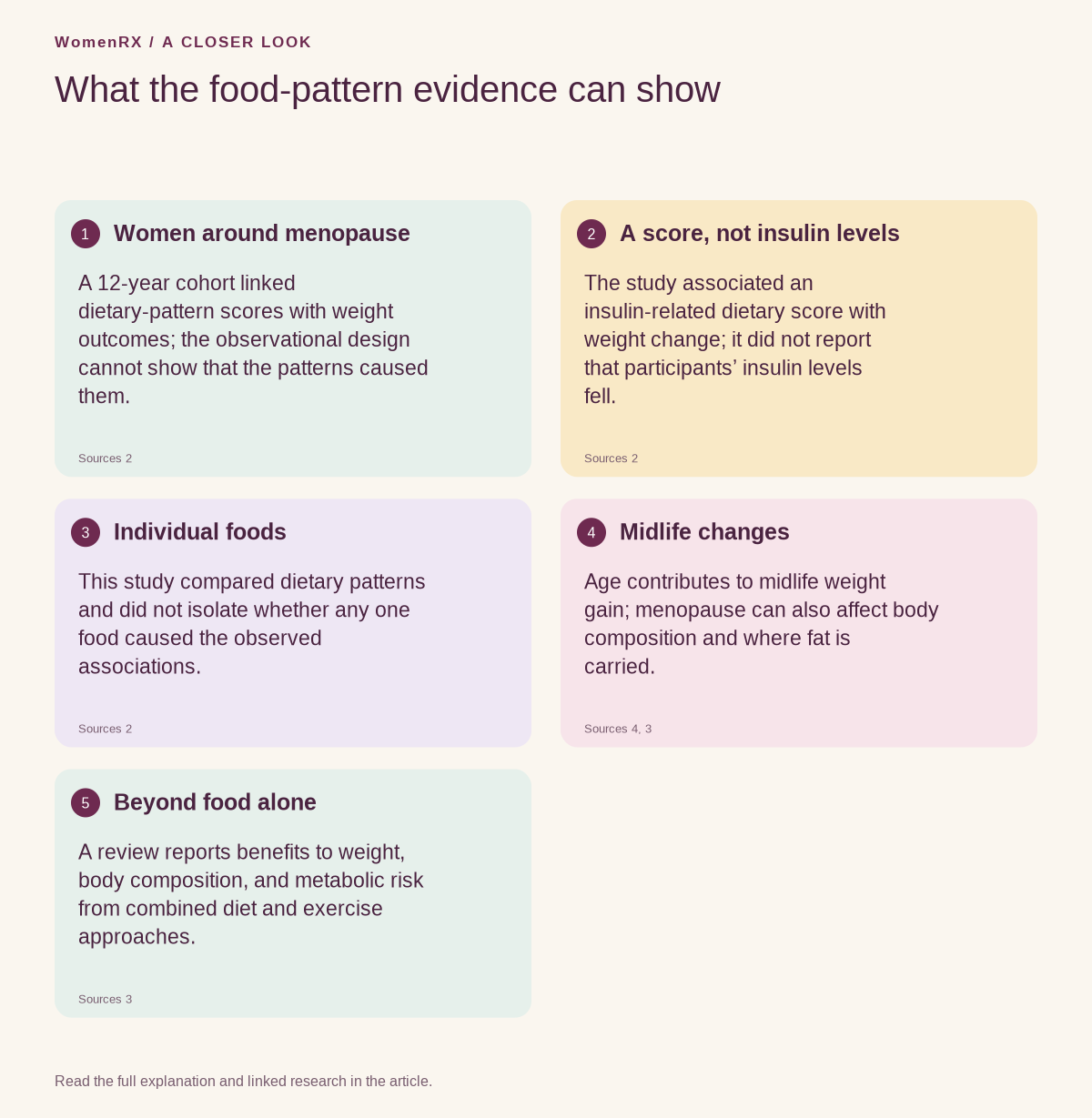
What the food-pattern evidence can show
Women around menopause: A 12-year cohort linked dietary-pattern scores with weight outcomes; the observational design cannot show that the patterns caused them.2
A score, not insulin levels: The study associated an insulin-related dietary score with weight change; it did not report that participants’ insulin levels fell.2
Individual foods: This study compared dietary patterns and did not isolate whether any one food caused the observed associations.2
Midlife changes: Age contributes to midlife weight gain; menopause can also affect body composition and where fat is carried.43
Beyond food alone: A review reports benefits to weight, body composition, and metabolic risk from combined diet and exercise approaches.3
Read the figure as text
These distinctions help separate menopause-specific findings from broader context and claims the cohort study could not test.- Women around menopause: A 12-year cohort linked dietary-pattern scores with weight outcomes; the observational design cannot show that the patterns caused them.2
- A score, not insulin levels: The study associated an insulin-related dietary score with weight change; it did not report that participants’ insulin levels fell.2
- Individual foods: This study compared dietary patterns and did not isolate whether any one food caused the observed associations.2
- Midlife changes: Age contributes to midlife weight gain; menopause can also affect body composition and where fat is carried.43
- Beyond food alone: A review reports benefits to weight, body composition, and metabolic risk from combined diet and exercise approaches.3
Sources you can check
- Body Weight: MedlinePlusAccessed 2026-09-25Return to first citation
- Optimal Dietary Patterns for Lower Weight Gain and Risk of Obesity Surrounding Menopause.Xia T, Haslam DE, Eliassen AH, Manson JE, Sun Q, Willett WC, Bhupathiraju SN, Zhang C, Hu FB. · JAMA network open · 2026Return to first citation
- Weight Management in Menopause: Diet, Physical Activity, Medication, and Surgery.Lu V, Tayachew B, Chevtsov A, Nicklas JM. · Obstetrics and gynecology clinics of North America · 2026Return to first citation
- Midlife weight gain: challenges and solutions.Hung S, Adams KE. · Current opinion in obstetrics & gynecology · 2026Return to first citation