Weight-Loss Supplements for Women: How to Judge the Evidence
A product’s ingredient list, study population, and safety evidence matter more than claims aimed at women.
Most weight-loss supplements have limited evidence, and results for an ingredient don’t prove that a finished product works or is safe. Check whether studies tested the same ingredient and formulation, whether participants resemble you, and what side effects or interactions are known. Pregnancy, breastfeeding, and menopause call for particular care because general adult results don’t establish safety or benefit in those situations. 1 2 6
Start with the ingredient, not the promise
A label may suggest that a product “burns fat,” curbs appetite, or is made for women. Those claims don’t tell you whether the product itself has been tested. Weight-loss supplements can combine several ingredients, and amounts may vary between products. Even when one ingredient has some research behind it, that doesn’t show that the combination works the same way. 1
In the United States, dietary supplements don’t require FDA premarket review or approval for safety and effectiveness. That makes clear evidence for the specific product especially useful when you’re weighing a claim. 1
A practical first check: look for the full ingredient list and amounts, then ask whether human studies tested those same ingredients, in comparable amounts and combinations. A study of one ingredient isn’t proof for a blend that contains it alongside several others. 1
What ingredient studies can tell you
Evidence for common weight-loss ingredients varies. Some findings come from small or short studies, and many products combine ingredients in ways that make it difficult to isolate their effects. A few examples show why the details matter: 1
- Glucomannan: Studies show little to no effect on body weight. Tablet forms have a specific safety concern: they may cause an obstruction in the esophagus. 1
- Caffeine: Short-term studies of combination products suggest a possible modest effect on weight, not a guaranteed or lasting result. Caffeine can cause jitteriness or a fast heartbeat, so count caffeine from drinks, medicines, and other supplements too. 1 2
- Green tea extract: Research suggests a possible modest weight effect, but extracts have also been associated with liver damage. That is a different risk profile from drinking green tea. 1
- Chromium picolinate: A Cochrane review pooled six trials with 392 participants and found an average difference of 1.1 kg in favor of chromium after 12 to 16 weeks. The review rated the evidence low quality and said the clinical importance was debatable. That result isn’t a promise of individual weight loss. 5
These examples aren’t a product ranking. They show how to weigh a possible benefit against side effects and uncertainty. A small potential effect may not be worth a safety concern, especially when a product combines ingredients or the amount of each is unclear. 1 5
Check who the research included
A result in adults generally doesn’t automatically apply to every woman. Look at who enrolled, whether results were reported separately for women, and whether the study says anything about age or reproductive stage. One trial of a multinutrient supplement containing ephedra and caffeine enrolled 61 healthy premenopausal women; 41 completed it. It tested that specific combination, not weight-loss supplements as a category, and its findings don’t establish safety or benefit for other products or life stages. 4
Pregnancy and breastfeeding: Don’t take marketing language as evidence that a weight-loss product is suitable during pregnancy or while breastfeeding. Caffeine passes through the placenta, and MedlinePlus advises pregnant people to check whether they should limit or avoid it. A review also identifies pregnant and breastfeeding people as groups needing particular care with herbal supplements. Those points don’t establish the safety of a weight-loss blend; check its full ingredient list with a clinician or pharmacist before using it. 2 6
Menopause: A product marketed for “hormonal weight gain” still needs menopause-specific evidence to support a claim for that stage. The ingredient evidence summarized here doesn’t establish a distinct weight-loss benefit or safety profile in menopause. A general adult result, or one from premenopausal women, isn’t proof for postmenopause. 1 4
Keep supplements separate from medicines
Orlistat is a weight-loss medicine, not a dietary supplement. Its U.S. over-the-counter label describes use for adults alongside a reduced-calorie, low-fat diet. Because it reduces absorption of some dietary fat, it can cause oily spotting, loose or more frequent stools, and gas. Its label also warns about interactions with certain prescription medicines and reduced absorption of some vitamins. That’s a different evidence and safety question from judging a supplement blend. 3
A quick label-and-evidence check
Before considering a product, see if you can answer these questions:
- What are the active ingredients and amounts? A proprietary blend or unclear amounts makes it harder to compare the product with research. 1
- Was this ingredient or combination tested in people? Animal or laboratory findings don’t show a weight-loss effect in humans. 1
- How large was the effect, compared with what, and for how long? A short study or small average change may not tell you whether a result is meaningful for you. 1 5
- Do the safety findings fit your situation and other products or medicines? For example, consider total caffeine exposure and ask about possible interactions if you take medicines. 2
If a seller makes a dramatic promise but can’t clearly identify the ingredients, amounts, human evidence, and known risks, you don’t have enough information to judge the product as a good choice.
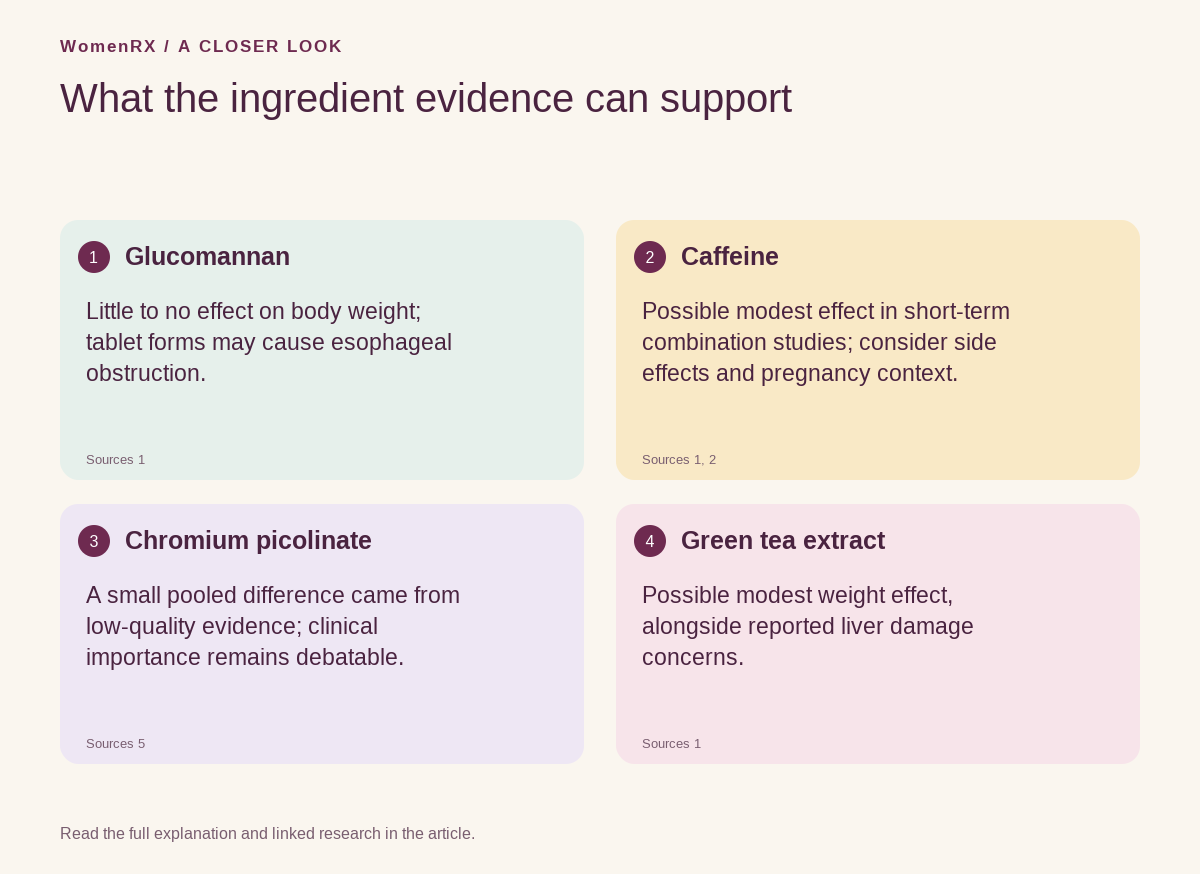
What the ingredient evidence can support
Glucomannan: Little to no effect on body weight; tablet forms may cause esophageal obstruction.1
Caffeine: Possible modest effect in short-term combination studies; consider side effects and pregnancy context.12
Chromium picolinate: A small pooled difference came from low-quality evidence; clinical importance remains debatable.5
Green tea extract: Possible modest weight effect, alongside reported liver damage concerns.1
Read the figure as text
Compare the kind of evidence available with the main caveat before applying a result to yourself.- Glucomannan: Little to no effect on body weight; tablet forms may cause esophageal obstruction.1
- Caffeine: Possible modest effect in short-term combination studies; consider side effects and pregnancy context.12
- Chromium picolinate: A small pooled difference came from low-quality evidence; clinical importance remains debatable.5
- Green tea extract: Possible modest weight effect, alongside reported liver damage concerns.1
More questions, answered
Does “natural” mean a weight-loss supplement is safe?
No. Herbal supplements can have risks, including interactions with medicines, and being plant-derived doesn’t establish safety. Check the specific ingredients and amounts rather than relying on “natural” or “women’s” branding. 1 6
Is orlistat a supplement?
No. Orlistat is a weight-loss medicine. Its U.S. over-the-counter label describes specific use, side effects, and interactions, so it should be assessed separately from dietary supplements. 3
Sources you can check
- Dietary Supplements for Weight Loss - Health Professional Fact SheetAccessed 2026-09-25Return to first citation
- Caffeine: MedlinePlusAccessed 2026-09-25Return to first citation
- ALLI (ORLISTAT) CAPSULE [HALEON US HOLDINGS LLC] | US prescribing information and patient instructionsAccessed 2026-09-25Return to first citation
- Multinutrient supplement containing ephedra and caffeine causes weight loss and improves metabolic risk factors in obese women: a randomized controlled trial.Hackman RM, Havel PJ, Schwartz HJ, Rutledge JC, Watnik MR, Noceti EM, Stohs SJ, Stern JS, Keen CL. · International journal of obesity (2005) · 2006Return to first citation
- Chromium picolinate supplementation for overweight or obese adults.Tian H, Guo X, Wang X, He Z, Sun R, Ge S, Zhang Z. · The Cochrane database of systematic reviews · 2013Return to first citation
- Clinical Implications of Herbal Supplements in Conventional Medical Practice: A US Perspective.Hassen G, Belete G, Carrera KG, Iriowen RO, Araya H, Alemu T, Solomon N, Bam DS, Nicola SM, Araya ME, Debele T, Zouetr M, Jain N. · Cureus · 2022Return to first citation