Weight-Loss Supplements: What Helps and What to Avoid
A promising ingredient isn’t proof that a finished supplement will produce meaningful weight loss or be safe.
Most weight-loss supplements don’t have strong evidence of a meaningful effect. Some ingredients may have modest effects, but studies are often limited, and a result for one ingredient doesn’t establish that a multi-ingredient product works. Before buying, check the full ingredient list, stimulant sources, and known safety concerns. Supplements are not the same category as prescription weight-management medicines. 1

Judge the result, not the mechanism
“Boosts metabolism,” “blocks fat,” and “curbs appetite” describe proposed effects in the body. They don’t tell you whether people lose a meaningful amount of weight, or whether any change lasts. For many popular ingredients, studies are small, short, or difficult to compare. Some report no body-weight effect; others suggest a possible modest effect. 1
A practical evidence scale can help keep a claim in perspective:
- No weight effect shown in the review: Beta-glucans, calcium, capsaicin, and guar gum showed no effect on body weight. Glucomannan and garcinia cambogia showed little to no effect. 1
- Possible modest effect, not a dependable result: The review describes possible modest effects for some caffeine-containing combinations and green tea. That does not establish reliable, lasting weight loss from a supplement. 1
- Too little evidence to judge: Fucoxanthin has insufficient research for firm conclusions, and raspberry ketone has been studied only in combination with other ingredients. 1
This scale is about weight-loss evidence, not a complete safety ranking. An ingredient with a possible effect may still have risks.
The ingredient study may not match the product
A study of an individual ingredient isn’t proof that a retail blend works. Many products combine ingredients, and amounts can vary. That makes it hard to isolate which ingredient might have caused an effect or side effect, and whether the study findings apply to the product you’re considering. 1
Read the full label. Can you identify each ingredient and how much the product contains, or does it list a proprietary blend without revealing amounts? If the blend’s contents or quantities aren’t clear, it’s harder to compare the product with research or assess what you’d be taking. 1
Be especially alert to stimulants. Caffeine may be listed directly or come from ingredients such as guarana, kola nut, or yerba maté. Add in caffeine from drinks and some medicines when thinking about your total exposure. Caffeine can raise blood pressure; too much can cause shakiness or restlessness, and people differ in how sensitive they are. 13
If you’re pregnant or breastfeeding, caffeine deserves particular attention: it passes through the placenta, and a small amount can pass into breast milk. MedlinePlus advises checking whether you should limit or avoid it. 3
Treat specific safety signals as part of the claim
“Natural” doesn’t mean harmless. The NIH review lists increased heart rate and blood pressure among concerns reported with bitter orange, significant safety concerns with yohimbe, and liver damage among reported adverse effects of green tea extract. These findings don’t mean every product containing an ingredient will cause harm, but they are reasons not to dismiss the ingredient list or a product’s warnings. 1
For glucomannan, the form matters: the review flags a risk of esophageal obstruction with tablet forms. 1
Supplements and medicines are different categories
In the United States, dietary supplements aren’t classified as drugs and don’t require FDA premarket review or approval like drugs do. Manufacturers are responsible for determining that supplements are safe and that their label claims are truthful and not misleading; the FDA can take enforcement action against unsafe products. Being sold in a store or online isn’t proof that a supplement has been shown to produce meaningful weight loss. 1
Prescription weight-management medicines are a different category, so supplement research shouldn’t be used to judge a medicine’s effects, or the other way around. If you’re looking for support beyond a supplement, weight-related care can take your health history into account; a clinician may also refer you to a dietitian for help with eating and weight goals. 12
A quick screen before you spend
- What outcome is actually promised? A claim about metabolism or appetite isn’t the same as demonstrated weight loss.
- Was the research on this finished product? Evidence for one ingredient may not apply to a blend. 1
- Are the ingredients and amounts clear? Hidden or variable amounts make the product harder to assess. 1
- Does it add stimulants? Check for caffeine in the supplement as well as in drinks and some medicines. 13
- Are there ingredient-specific risks? Consider the concerns reported for bitter orange, yohimbe, green tea extract, and glucomannan tablets. 1
Women-focused marketing doesn’t establish a women-specific benefit. The review doesn’t report women-specific results for most ingredients. One trial it describes included 66 women with overweight: after three months, groups taking beta-glucan and the control group all lost weight, but there were no significant differences between groups. 1
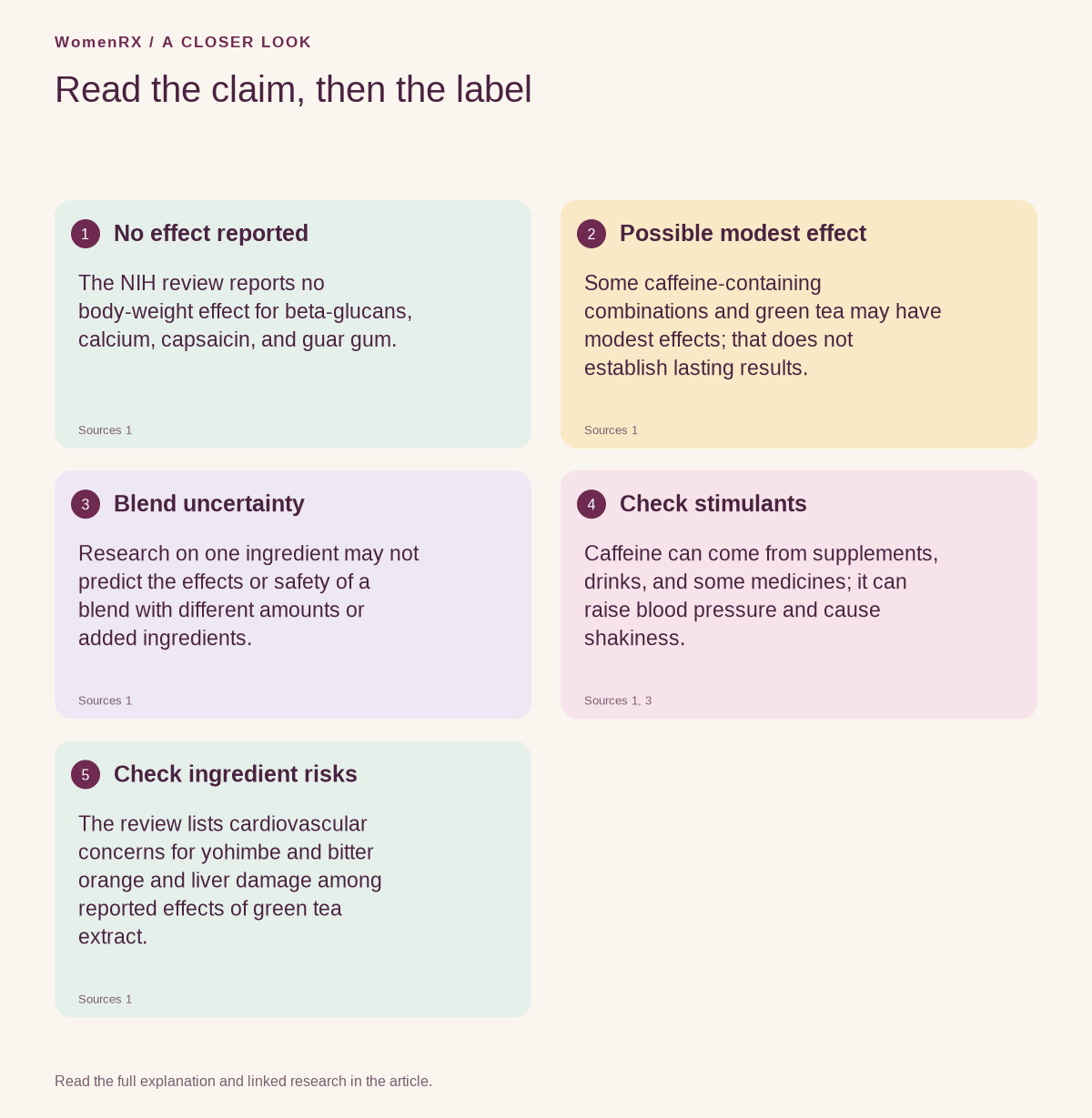
Read the claim, then the label
No effect reported: The NIH review reports no body-weight effect for beta-glucans, calcium, capsaicin, and guar gum.1
Possible modest effect: Some caffeine-containing combinations and green tea may have modest effects; that does not establish lasting results.1
Blend uncertainty: Research on one ingredient may not predict the effects or safety of a blend with different amounts or added ingredients.1
Check stimulants: Caffeine can come from supplements, drinks, and some medicines; it can raise blood pressure and cause shakiness.13
Check ingredient risks: The review lists cardiovascular concerns for yohimbe and bitter orange and liver damage among reported effects of green tea extract.1
Read the figure as text
These distinctions separate ingredient-level weight findings from product-level uncertainty and practical safety questions.- No effect reported: The NIH review reports no body-weight effect for beta-glucans, calcium, capsaicin, and guar gum.1
- Possible modest effect: Some caffeine-containing combinations and green tea may have modest effects; that does not establish lasting results.1
- Blend uncertainty: Research on one ingredient may not predict the effects or safety of a blend with different amounts or added ingredients.1
- Check stimulants: Caffeine can come from supplements, drinks, and some medicines; it can raise blood pressure and cause shakiness.13
- Check ingredient risks: The review lists cardiovascular concerns for yohimbe and bitter orange and liver damage among reported effects of green tea extract.1
More questions, answered
Does “natural” mean a weight-loss supplement is safe?
No. Safety varies by ingredient and product. The NIH review reports cardiovascular concerns with yohimbe and bitter orange, and liver damage among reported adverse effects of green tea extract. 1
Does a supplement being sold mean it has FDA approval?
No. Dietary supplements don’t require FDA premarket review or approval like drugs do. Manufacturers are responsible for safety and truthful, non-misleading claims, and the FDA can take enforcement action against unsafe products. 1
Sources you can check
- Dietary Supplements for Weight Loss - Health Professional Fact SheetAccessed 2026-09-25Return to first citation
- Body Weight: MedlinePlusAccessed 2026-09-25Return to first citation
- Caffeine: MedlinePlusAccessed 2026-09-25Return to first citation