Can Exercise Reduce Thigh Fat Specifically?
Thigh exercises can build strength, but a trial in women did not establish whether regional workouts selectively reduce thigh fat.
Training your thighs can strengthen the muscles underneath, but it doesn’t guarantee a specific reduction in thigh fat. A small trial in women with obesity compared regional and general aerobic exercise, but it measured overall and waist-to-hip changes rather than thigh fat directly. So the practical goal is stronger, more capable legs, with any change in thigh size depending on broader body-composition changes too. 3 2
What thigh-focused exercise can change
Squats, step-ups, and other lower-body movements can challenge the muscles in your thighs and hips. With regular muscle-strengthening activity, you may build or maintain muscle and strength. That can support everyday tasks such as getting out of a chair. It’s a meaningful result even if your thighs don’t get smaller. 2
But working a muscle isn’t evidence that nearby fat shrinks. A thigh workout targets muscle activity; to know whether it also reduces thigh fat selectively, a study would need to measure fat in that area. The trial described below did not do that. 3
What one trial in women does, and doesn’t, show
A randomized trial assigned 60 women with obesity, ages 25 to 50, to general aerobic training, regional aerobic training aimed at the abdomen or lower body, or a combination. After 12 weeks, all three groups had reductions in weight and several other measures. The combined program had the largest reported improvements, but the reported measures cannot establish which group lost more thigh fat. 3
That result is worth considering, but it doesn’t prove that targeted exercise melts fat from the area being worked. The study measured weight, body mass index, waist-to-hip ratio, and blood markers. It did not use imaging to measure thigh fat specifically, and a change in waist-to-hip ratio cannot tell you how much fat changed in one thigh. The study was also limited to women with obesity in this age range, so it can’t settle the question for everyone. 3
The most honest takeaway is that local exercise may be part of a useful overall program, but the trial doesn’t show that it produces selective thigh-fat loss. Don’t treat the word “regional” in a workout study as proof of spot reduction.
Why thighs can look different from one woman to another
Fat distribution varies. Women, on average, tend to store more subcutaneous fat around the hips and thighs, while men tend to store more around the trunk. These patterns develop with age and maturation, and they’re shaped by several influences, including hormones, genes, and environment. A common lower-body pattern isn’t, by itself, a reason to treat your thighs as a problem. 4
Thigh size also isn’t a pure measure of fat. Body weight includes muscle, bone, fat, and water; similarly, a change in how your legs fit or feel doesn’t identify which tissue changed. Strength training may affect muscle, while an overall change in body fat can affect measurements too. 1 2
The trial did not compare responses to thigh-focused exercise during cycling years, perimenopause, or after menopause. Fat distribution changes with age, but that’s not the same as evidence that local exercise works differently at each life stage. 3 4
Choose a goal you can actually train for
If your priority is function, choose lower-body movements you can do consistently and build toward stronger legs over time. For example, sit-to-stands, step-ups, or resistance exercises can be ways to work those muscles. These examples aren’t a special fat-loss formula; their purpose is to challenge and strengthen the legs. Muscle-strengthening activity can help increase or maintain muscle mass and strength. 2
If your priority is body composition, think beyond one area. Exercise can support weight management, and changes in body weight reflect more than fat alone. A tape measure alone can’t tell whether a change in thigh size came from fat or muscle, and the regional-exercise trial didn’t test where fat changed first or most. 1 2 3 If your goal is simply stronger legs, you don’t need to wait for a particular shape change to count your effort as progress.
A useful comparison is: train a muscle to improve what it can do; use broader body-composition goals if you want to change overall fatness; and don’t expect one approach to guarantee a specific thigh measurement. Your thighs don’t have to be smaller for your legs to be stronger or your exercise to be worthwhile.
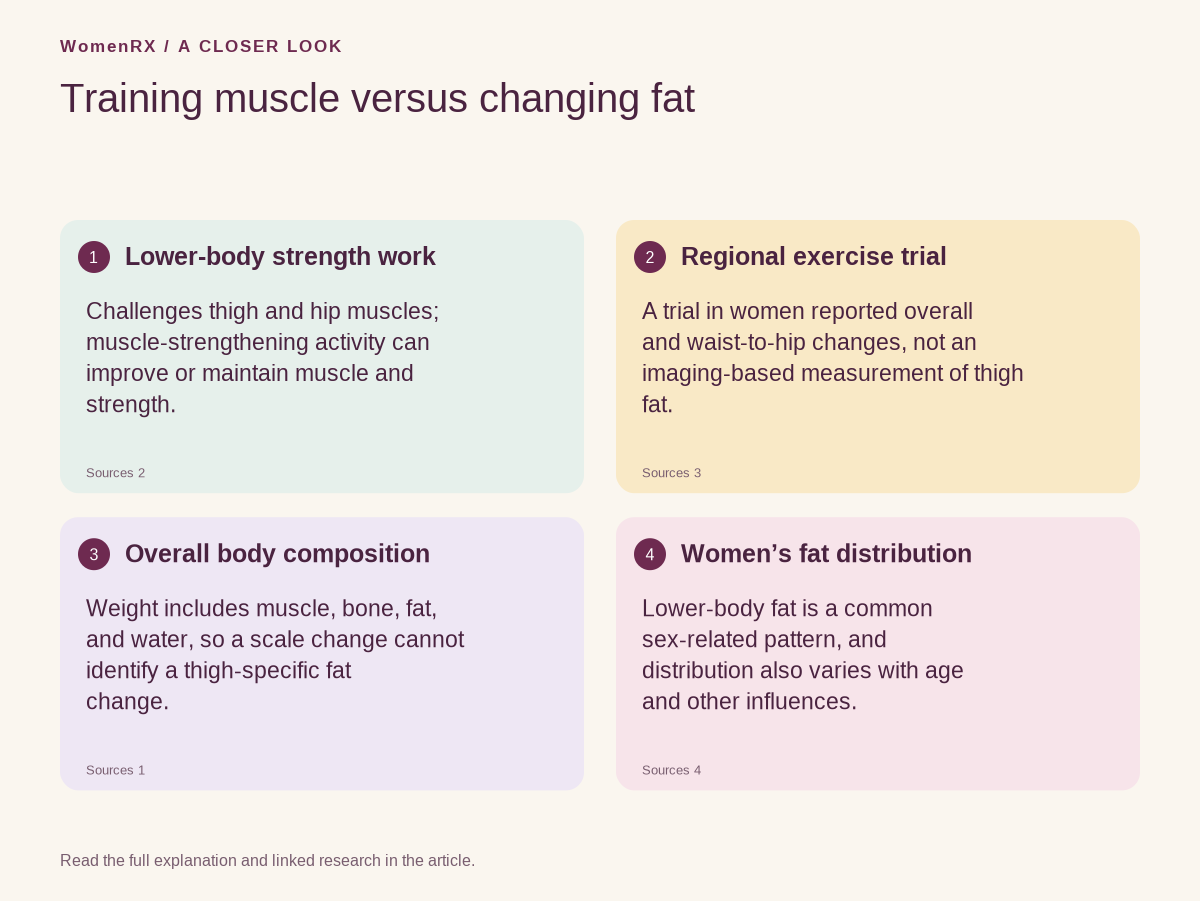
Training muscle versus changing fat
Lower-body strength work: Challenges thigh and hip muscles; muscle-strengthening activity can improve or maintain muscle and strength.2
Regional exercise trial: A trial in women reported overall and waist-to-hip changes, not an imaging-based measurement of thigh fat.3
Overall body composition: Weight includes muscle, bone, fat, and water, so a scale change cannot identify a thigh-specific fat change.1
Women’s fat distribution: Lower-body fat is a common sex-related pattern, and distribution also varies with age and other influences.4
Read the figure as text
These are related goals, but thigh-focused movement and selective thigh-fat loss are not the same outcome.- Lower-body strength work: Challenges thigh and hip muscles; muscle-strengthening activity can improve or maintain muscle and strength.2
- Regional exercise trial: A trial in women reported overall and waist-to-hip changes, not an imaging-based measurement of thigh fat.3
- Overall body composition: Weight includes muscle, bone, fat, and water, so a scale change cannot identify a thigh-specific fat change.1
- Women’s fat distribution: Lower-body fat is a common sex-related pattern, and distribution also varies with age and other influences.4
More questions, answered
Can squats make my thighs bigger?
Strength training can help build or maintain muscle, so the effect on thigh appearance won’t be the same for everyone. Exercise supports strength and muscle, but it doesn’t guarantee a particular change in thigh size. 2 1
Does fat around the hips and thighs mean something is wrong?
Not on its own. Women commonly carry a greater share of subcutaneous fat around the hips and thighs than men do, and fat distribution varies with age and other factors. Thigh fat isn’t automatically a health problem. 4
Sources you can check
- Body Weight: MedlinePlusAccessed 2026-09-25Return to first citation
- Benefits of Exercise: MedlinePlusAccessed 2026-09-25Return to first citation
- Impact of regional and general aerobic exercise on molecular regulators of lipolysis and adipose tissue composition in obese women.Zourmand G, Shaabani Ezdini E, Taheri M, Irandoust K. · Cellular and molecular biology (Noisy-le-Grand, France) · 2025Return to first citation
- The Sexual Dimorphism of Human Adipose Depots.Boulet N, Briot A, Galitzky J, Bouloumié A. · Biomedicines · 2022Return to first citation