Can You Lose Arm Fat? What Exercise Can Really Change
Arm exercises can build strength, but they haven’t been shown to reliably make the trained arm lose more fat.
Arm exercises strengthen the muscles you work, but they don’t reliably burn fat from that spot. In a 12-week study, MRI measurements found no greater loss of upper-arm fat on the trained side than the untrained side; results in women also didn’t show a clear spot-reduction effect. Overall fat loss may change arm size, while strength training can support muscle and function. 4 1
What arm exercises change
A curl trains the muscles that bend your elbow; a pressdown trains the muscles that straighten it. With practice, resistance exercises can build or maintain muscle strength. That can help with everyday tasks as well as exercise. Regular muscle-strengthening activity helps increase or maintain muscle mass and strength. 1
But working a muscle is not the same as directing your body to use fat from the area above it. An arm workout can make the muscles stronger without reliably reducing the fat covering them.
What the spot-reduction study found
One study followed 104 adults, including 59 women, through 12 weeks of supervised resistance training on the nondominant arm. Researchers compared fat under the skin in the trained and untrained arms. MRI measurements did not show greater fat loss in the trained arm, either in the overall group or when results were examined by sex. A skinfold measurement suggested a different result in men, but not in women or in the sample overall. 4
That mismatch matters: the result depended partly on how fat was measured. The study doesn’t prove that every training plan has the same effect, but it doesn’t support a reliable arm-specific fat-loss method for women. It also doesn’t establish whether responses differ by menstrual cycle, perimenopause, or menopause.
Choose the goal you actually want
For stronger arms: Choose resistance exercises that work the muscles you want to strengthen. For example, curls and rows train different pulling muscles, while overhead presses and triceps extensions work other parts of the upper body. These are examples of strength exercises, not a formula for reducing fat in a particular area. Muscle-strengthening activity can help maintain or increase strength and muscle mass. 1
For overall fat loss: Exercise can support weight management, and MedlinePlus describes weight loss as requiring more energy used than taken in. But a change in overall weight doesn’t let you select where fat comes off first. 1 A 2026 meta-analysis of 34 randomized trials in 1,455 people with overweight or obesity found that adding exercise to calorie restriction preserved more fat-free mass, on average, than calorie restriction alone. That finding supports exercise as part of an overall body-composition goal, not as a way to target arm fat. The review reported that only two included studies measured skeletal muscle mass. 3
For fit, comfort, or function: You don’t need to change your arm shape to have a worthwhile goal. You might focus on carrying groceries more comfortably, building strength for a sport, or finding sleeves that feel good. Body weight alone can’t tell you how much of your body is fat, muscle, bone, or water. 2
A realistic way to set expectations
If you enjoy arm exercises, keep them for strength, muscle, and function. If your goal is overall fat loss, think in terms of broader habits and outcomes rather than adding more repetitions for one body part. Your arms may change along with your overall body composition, but the available findings don’t predict how much or when. The clearest distinction is simple: train arms to strengthen them; don’t count on arm exercises to selectively remove arm fat.
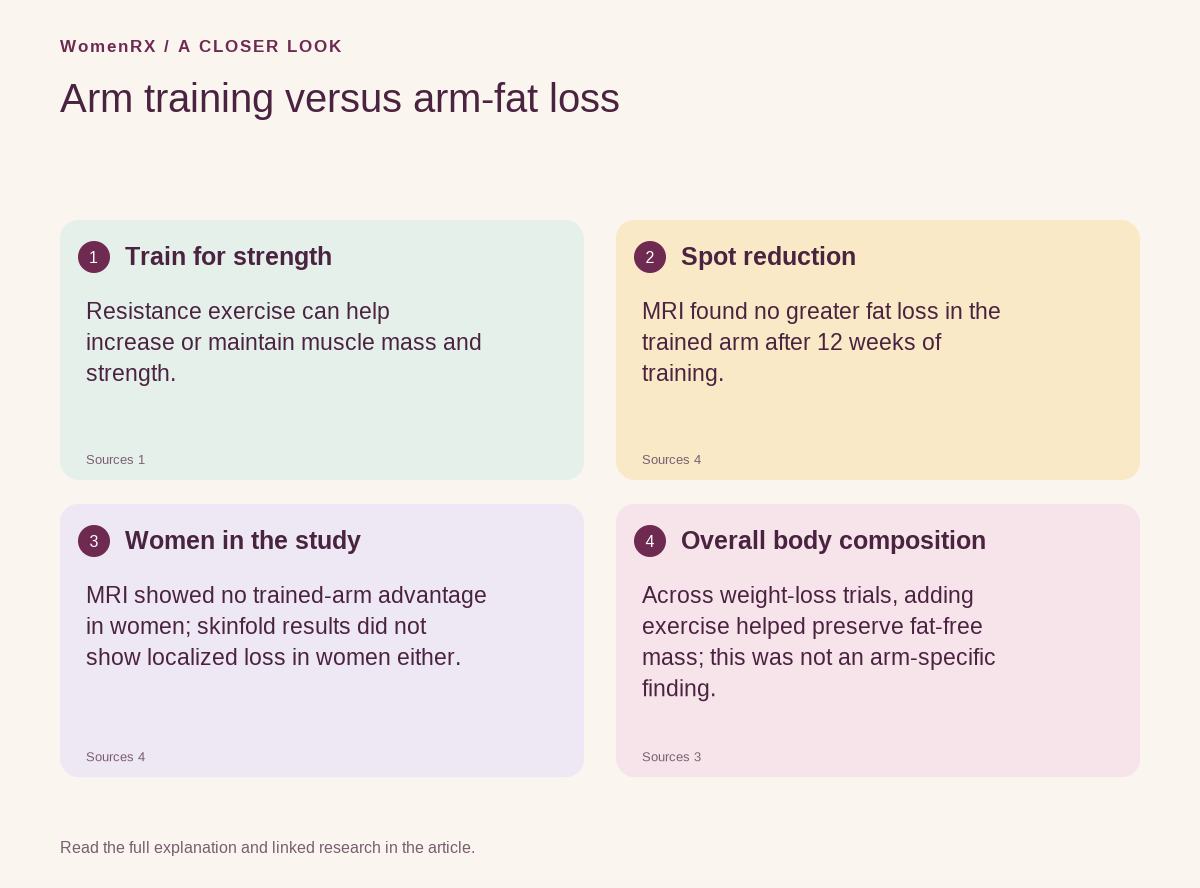
Arm training versus arm-fat loss
Train for strength: Resistance exercise can help increase or maintain muscle mass and strength.1
Spot reduction: MRI found no greater fat loss in the trained arm after 12 weeks of training.4
Women in the study: MRI showed no trained-arm advantage in women; skinfold results did not show localized loss in women either.4
Overall body composition: Across weight-loss trials, adding exercise helped preserve fat-free mass; this was not an arm-specific finding.3
Read the figure as text
The evidence separates the effects of strengthening an arm from selectively reducing fat over that arm.- Train for strength: Resistance exercise can help increase or maintain muscle mass and strength.1
- Spot reduction: MRI found no greater fat loss in the trained arm after 12 weeks of training.4
- Women in the study: MRI showed no trained-arm advantage in women; skinfold results did not show localized loss in women either.4
- Overall body composition: Across weight-loss trials, adding exercise helped preserve fat-free mass; this was not an arm-specific finding.3
More questions, answered
Will arm exercises make my arms look bigger?
They might, if you build muscle, but the change in appearance varies from person to person. Strength training can increase or maintain muscle mass and strength; that’s different from losing fat from the arm. Body weight alone doesn’t distinguish between muscle and fat. 1 2
Does the evidence show a different result for women?
In one study of 59 women and 45 men, MRI did not find greater fat loss in the trained arm for women or men. A skinfold result suggested localized loss in men, but not women; the difference between measurement methods limits a simple conclusion. 4
Sources you can check
- Benefits of Exercise: MedlinePlusAccessed 2026-09-25Return to first citation
- Body Weight: MedlinePlusAccessed 2026-09-25Return to first citation
- Effects of Calorie Restriction With and Without Strength, Endurance or Mixed Training on Fat-Free and Skeletal Muscle Mass in Overweight or Obese Individuals-A Systematic Review With Pairwise Meta-Analysis and Network Meta-Analysis of Randomized Controlled Studies.Deller M, Weiershaus J, Held S, Brinkmann C. · Diabetes, obesity & metabolism · 2026Return to first citation
- Subcutaneous fat alterations resulting from an upper-body resistance training program.Kostek MA, Pescatello LS, Seip RL, Angelopoulos TJ, Clarkson PM, Gordon PM, Moyna NM, Visich PS, Zoeller RF, Thompson PD, Hoffman EP, Price TB. · Medicine and science in sports and exercise · 2007Return to first citation