Back Fat and Exercise: What You Can Actually Change
Back-focused workouts can strengthen your back, but they can’t reliably choose where your body loses fat.
Spot reduction isn’t a dependable way to change back fat. One small trial in men found greater trunk-fat loss with abdominal endurance exercise than with treadmill exercise alone, but it did not study women or the back specifically. A trial in women also doesn’t establish that targeted movement reduces fat in the exercised area. Back training can build strength; overall fat change is different. 3 4
Can back exercises burn back fat?
Not reliably. Rows, pulldowns, and other back exercises train the muscles doing the work. They can help you build strength, but there’s no good basis here for promising that those movements will make your body draw fat specifically from your back. Exercise has broader benefits, including helping maintain or build muscle and supporting weight management. 1
There is a useful wrinkle: the evidence doesn’t justify saying localized fat loss is impossible in every circumstance. In a randomized trial, 16 men with overweight did either treadmill exercise alone or treadmill exercise combined with abdominal endurance exercises. After 10 weeks, trunk fat fell by 7% in the combined-exercise group and didn’t change in the treadmill-only group. Total fat also fell in both groups, by similar amounts. This small study suggests a possible localized effect under a particular training setup, not a proven way to reduce back fat. 4
The study measured trunk fat, not back fat, and included men, not women. It also tested abdominal endurance work, not a back-focused strength routine. So it can’t tell you whether back exercises selectively reduce fat over the back, or whether the result would apply to women. 4
What the women’s study adds
A randomized trial assigned 60 women with obesity to general aerobic exercise, regional aerobic exercise aimed at the abdomen or lower body, or a combination. After 12 weeks, all three groups had reductions in weight, BMI, and waist-to-hip ratio. General aerobic training showed greater systemic fat loss than regional training, while the combined group had the largest overall improvements. 3
That’s relevant evidence in women, but it still doesn’t settle the back-fat question. The study examined abdominal and lower-body movements, not back training. Its reported outcomes don’t establish that exercising a particular area selectively reduced fat in that area. And participants were women with obesity ages 25 to 50, so the findings don’t automatically apply to every woman or every life stage. 3
Taken together, these trials leave room for a limited, exercise-specific local effect, but they don’t show a reliable back-fat method. The practical distinction is clearer: train your back if you want a stronger back; think about overall habits if your goal is overall fat change.
Set a goal that matches the exercise
If you want more strength or muscle, back exercises are a sensible choice. Muscle-strengthening activity can help increase or maintain muscle mass and strength. That may change how your back feels or looks, even if it doesn’t selectively reduce the fat there. 1
If you want to change overall body fat, exercise can be part of a broader approach that includes eating habits. But where fat changes show up first or most is not something these studies let you choose. A scale won’t show which tissue or body area changed, either: body weight includes muscle, fat, bone, and water. 1 2
You also don’t have to treat a fold under a bra band or a difference in how a shirt sits as a health problem. If your main goal is comfort in clothes, trying a different band, fabric, or cut may be a more direct fix than adding a workout aimed at one spot. If you choose back training, let the goal be strength, function, or enjoyment, rather than a promise about where fat will come off.
Training a muscle versus changing fat
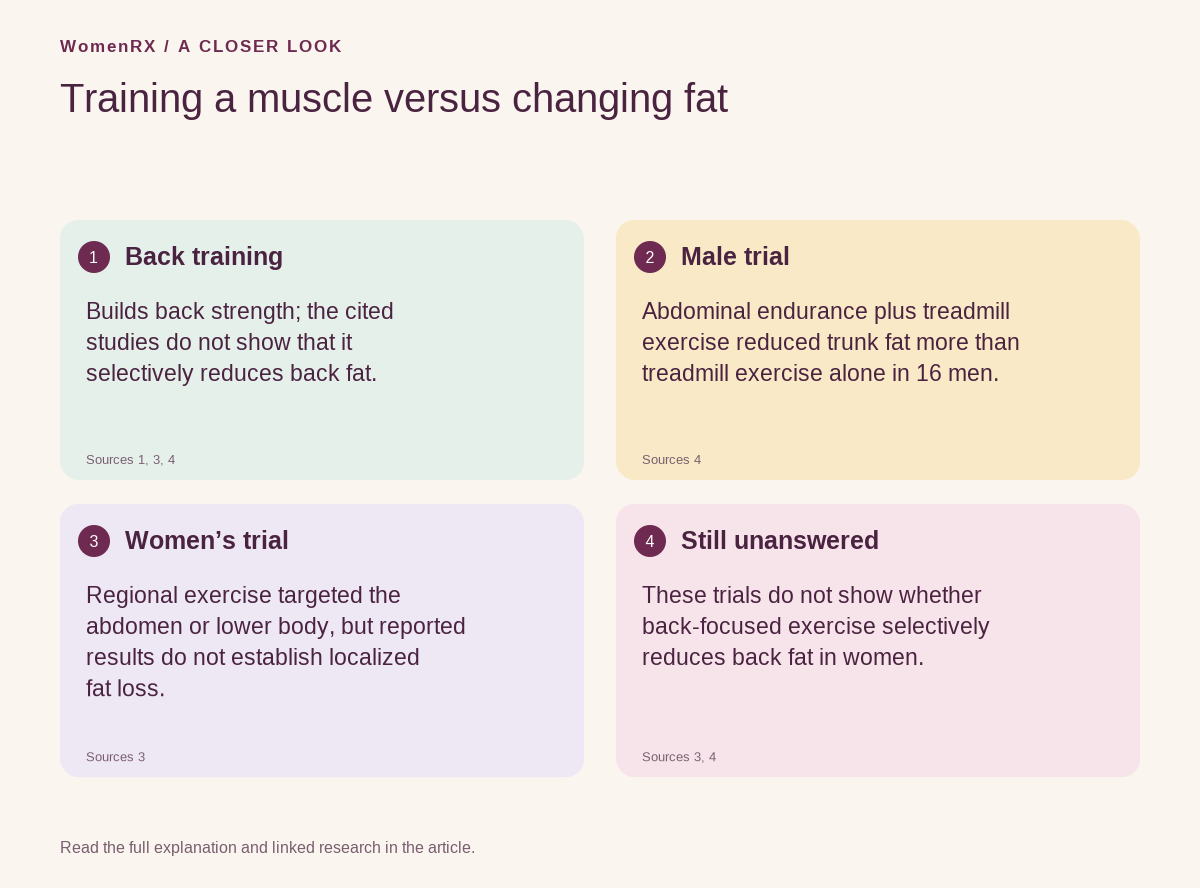
Back training: Builds back strength; the cited studies do not show that it selectively reduces back fat.134
Male trial: Abdominal endurance plus treadmill exercise reduced trunk fat more than treadmill exercise alone in 16 men.4
Women’s trial: Regional exercise targeted the abdomen or lower body, but reported results do not establish localized fat loss.3
Still unanswered: These trials do not show whether back-focused exercise selectively reduces back fat in women.34
Read the figure as text
These distinctions show what targeted exercise can support, what the small spot-reduction trials found, and what they leave unanswered.- Back training: Builds back strength; the cited studies do not show that it selectively reduces back fat.134
- Male trial: Abdominal endurance plus treadmill exercise reduced trunk fat more than treadmill exercise alone in 16 men.4
- Women’s trial: Regional exercise targeted the abdomen or lower body, but reported results do not establish localized fat loss.3
- Still unanswered: These trials do not show whether back-focused exercise selectively reduces back fat in women.34
More questions, answered
Does losing weight guarantee back fat will change?
Overall weight loss may change body shape, but these studies don’t show that you can predict or direct fat loss from the back. Weight also includes muscle, bone, and water, so the scale can’t show which tissue or region changed. 2
Sources you can check
- Benefits of Exercise: MedlinePlusAccessed 2026-09-25Return to first citation
- Body Weight: MedlinePlusAccessed 2026-09-25Return to first citation
- Impact of regional and general aerobic exercise on molecular regulators of lipolysis and adipose tissue composition in obese women.Zourmand G, Shaabani Ezdini E, Taheri M, Irandoust K. · Cellular and molecular biology (Noisy-le-Grand, France) · 2025Return to first citation
- Abdominal aerobic endurance exercise reveals spot reduction exists: A randomized controlled trial.Brobakken MF, Krogsaeter I, Helgerud J, Wang E, Hoff J. · Physiological reports · 2023Return to first citation