Exercise After Menopause: What Helps Beyond Belly Fat
A mix of aerobic activity and strength work can support your health, even when your waist or the scale changes slowly.
For health and weight management after menopause, choose aerobic activity you can sustain and add regular strength work. Studies in adults with overweight or obesity find better evidence for aerobic exercise reducing fat around the internal organs than for resistance training alone; strength work supports muscle and everyday function. The cited exercise comparisons report no postmenopausal-only result, cannot separate menopause from aging or other influences on abdominal fat, and don’t predict how your waist will change. They also don’t identify a workout that targets belly fat specifically. 41
What does “belly fat” mean here?
A waist measurement, the number on a scale, and a scan of fat around your internal organs tell you different things. Research on visceral fat measures fat deeper in the abdomen, often with CT or MRI. That isn’t the same as measuring all the fat you can see or feel at your waist. Body weight has another limitation: it doesn’t distinguish fat from muscle and bone. 42
That distinction makes exercise results more useful. You might be looking for a smaller waist, but a workout can also improve strength, fitness, or health without producing a dramatic change on the scale. Regular activity can help with weight management and blood glucose, while muscle-strengthening activity can help maintain strength. 1
Aerobic activity has the clearest evidence for visceral fat
Aerobic activity is movement that keeps you going, such as a walk, a bike ride, or a swim. In a review of randomized trials involving adults with overweight or obesity, aerobic exercise reduced scan-measured visceral fat compared with a control group. The review did not find a statistically clear reduction for resistance training compared with control. But the smaller set of trials directly comparing aerobic and resistance exercise did not establish a clear winner. These were not results specifically reported for postmenopausal women. 4
One eight-month trial helps put that comparison in context. Among sedentary adults with overweight and abnormal cholesterol levels, aerobic training reduced visceral and total abdominal fat. Resistance training alone reduced fat under the skin of the abdomen but did not significantly reduce visceral fat in that trial. Adding the full resistance program to aerobic training did not produce a statistically distinguishable result from aerobic training alone for the outcomes studied. The abstract does not report a postmenopausal subgroup result. 3
So if abdominal fat is one reason you want to move more, aerobic activity is a sensible part of the plan. It isn’t a promise that a particular pace, class, or machine will change your waist.
Strength work earns its place for a different reason
Strength work asks your muscles to push, pull, or lift against resistance. It can help you increase or maintain muscle mass and strength, which matters for ordinary tasks such as getting out of a chair or carrying groceries. That is a worthwhile outcome even if your weight stays the same. 1
A small, 12-week trial in adults with overweight or obesity and other cardiometabolic risk factors tested supervised sessions combining aerobic and resistance exercise against usual habits. The combined group had lower whole-body fat mass and better handgrip strength at the end of the trial. Participants included men and women, and the study did not report results specifically for postmenopausal women. It also did not compare the combined program with aerobic exercise alone, so it cannot show which part produced which change. 5
The practical tradeoff is straightforward: don’t drop strength work because it hasn’t shown the same visceral-fat result as aerobic activity in these comparisons. And don’t rely on strength work alone if reducing abdominal fat is your main exercise goal. 41
Put the two together without chasing a “belly” workout
For example, you might pair walks or bike rides you enjoy with strength sessions that work several major muscle groups. You could walk on Monday, Wednesday, and Friday and fit strength sessions on Tuesday and Saturday, adjusting the days to suit your schedule. If you’re starting from little activity, starting slowly is a reasonable way to build a routine you can keep. The point of the mix is to give aerobic fitness and muscular strength a place in your week, not to find the one exercise that makes fat leave your abdomen. 14
Core exercises can be part of strength work, but the aerobic-versus-resistance studies above did not test crunches as a way to remove fat from the waist. They offer no basis for promising that working the muscles beneath your abdomen will selectively shrink the fat over them. 43
Finally, exercise is only one influence on weight. Eating patterns, activity, some medicines, and medical conditions can all play a part. These studies don’t separate the effect of menopause itself from aging or those other influences. If your waist or weight is changing, you don’t have to explain the whole change by your workouts, or judge the value of movement by that one measurement. 21
What each kind of movement supports
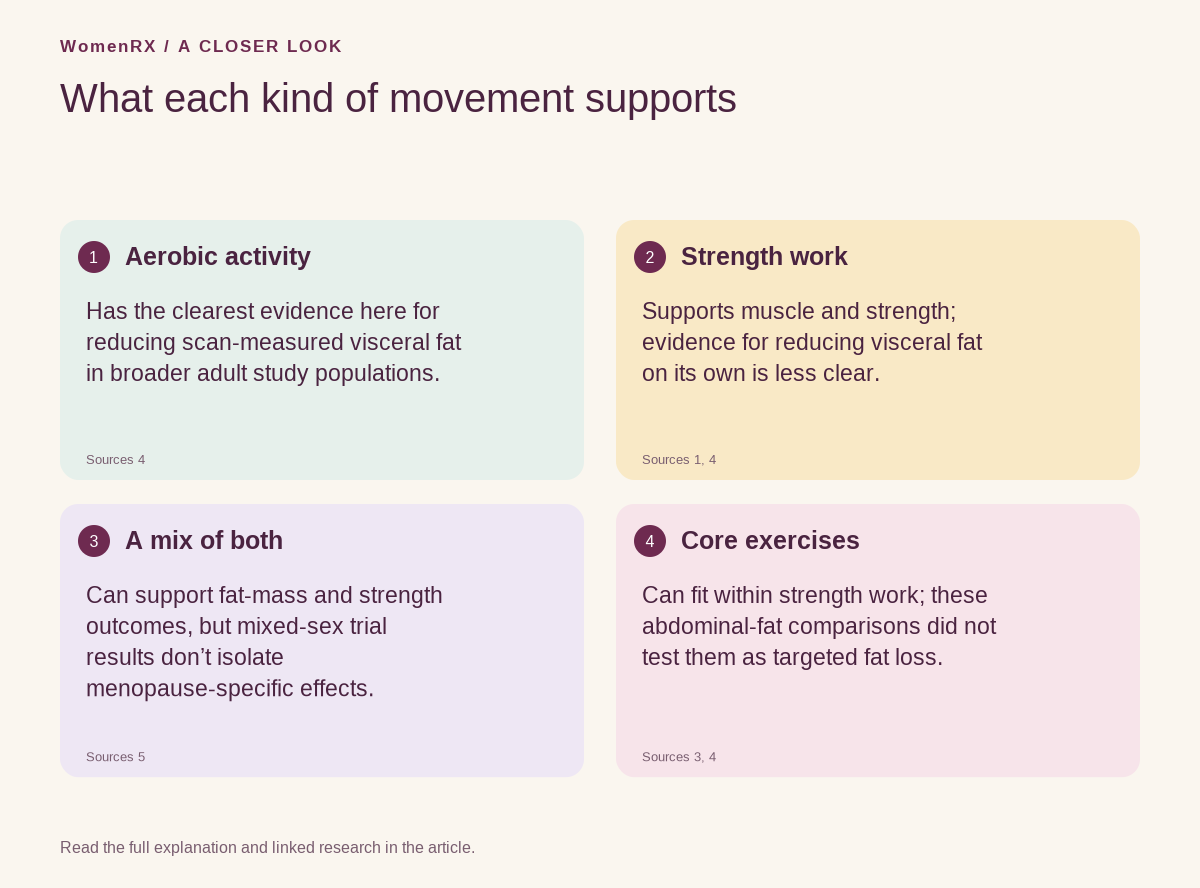
Aerobic activity: Has the clearest evidence here for reducing scan-measured visceral fat in broader adult study populations.4
Strength work: Supports muscle and strength; evidence for reducing visceral fat on its own is less clear.14
A mix of both: Can support fat-mass and strength outcomes, but mixed-sex trial results don’t isolate menopause-specific effects.5
Core exercises: Can fit within strength work; these abdominal-fat comparisons did not test them as targeted fat loss.34
Read the figure as text
Compare outcomes rather than choosing an exercise by a promise to target belly fat.- Aerobic activity: Has the clearest evidence here for reducing scan-measured visceral fat in broader adult study populations.4
- Strength work: Supports muscle and strength; evidence for reducing visceral fat on its own is less clear.14
- A mix of both: Can support fat-mass and strength outcomes, but mixed-sex trial results don’t isolate menopause-specific effects.5
- Core exercises: Can fit within strength work; these abdominal-fat comparisons did not test them as targeted fat loss.34
Sources you can check
- Benefits of Exercise: MedlinePlusAccessed 2026-09-25Return to first citation
- Obesity: MedlinePlusAccessed 2026-09-25Return to first citation
- Effects of aerobic vs. resistance training on visceral and liver fat stores, liver enzymes, and insulin resistance by HOMA in overweight adults from STRRIDE AT/RT.Slentz CA, Bateman LA, Willis LH, Shields AT, Tanner CJ, Piner LW, Hawk VH, Muehlbauer MJ, Samsa GP, Nelson RC, Huffman KM, Bales CW, Houmard JA, Kraus WE. · American journal of physiology. Endocrinology and metabolism · 2011Return to first citation
- A systematic review and meta-analysis of the effect of aerobic vs. resistance exercise training on visceral fat.Ismail I, Keating SE, Baker MK, Johnson NA. · Obesity reviews : an official journal of the International Association for the Study of Obesity · 2012Return to first citation
- Effects of 12-week supervised combined aerobic and resistance training on body composition and physical function in overweight or obese adults with multiple cardiometabolic risk factors: a randomized trial.Chen J, Chen J, Mao K, Chen Z, Lin Z. · Frontiers in public health · 2026Return to first citation