Metabolic Syndrome: What the Five Criteria Measure
Metabolic syndrome is a cluster of heart and diabetes risk markers, not a symptom checklist or a diagnosis based on body shape alone.
Metabolic syndrome means that at least three of five measurements meet diagnostic criteria: waist circumference, triglycerides, HDL cholesterol, blood pressure, and fasting blood sugar. One marker alone doesn’t establish the syndrome, but it still matters on its own. A waist measurement is only one part of the picture, and the threshold used can vary by definition and population. 2 6
What the label is measuring
Metabolic syndrome is a name for a cluster of risk factors linked with a higher chance of heart disease and type 2 diabetes. It isn’t a unique illness with its own symptom checklist. Many of the markers have no obvious symptoms, so the cluster is usually recognized through a checkup and blood tests. 2 3
The commonly used approach looks at five things: waist circumference, triglycerides, HDL cholesterol, blood pressure, and fasting blood sugar. In the harmonized international definition, any three of the five can qualify; waist circumference doesn’t have to be one of them. Some other definitions, including the International Diabetes Federation approach, make central obesity a required component. 6
That difference can affect who receives the label. It’s one reason a diagnosis is best understood alongside the actual readings, rather than as a yes-or-no summary of your health.
The five components, in practical terms
- Waist circumference: This is a measurement around the waist, used as a marker of central fat. A large waist can contribute one component; it cannot establish metabolic syndrome by itself. MedlinePlus lists 35 inches or more for women and 40 inches or more for men in its summary of diagnostic criteria. These aren’t universal cutoffs: waist thresholds can vary with the definition and population being used. If this measurement counted for you, ask which threshold was applied and look at it alongside the other four markers. 2 6
- Triglycerides: These are fats measured in the blood. A high result is one of the five components. Ask which cutoff was used for your result and whether the level needs attention as part of your blood-fat results, regardless of the syndrome label. 2 3
- HDL cholesterol: HDL is a type of lipoprotein that carries cholesterol from other parts of the body back to the liver. A low HDL result is counted as a component. Ask how it fits with the rest of your cholesterol results; HDL is not the same measurement as LDL cholesterol, which is also relevant to heart risk. 2 4
- Blood pressure: MedlinePlus lists a reading of 130/85 mmHg or higher as a criterion. Blood pressure is a measurement, not something you can reliably judge by how you feel. If your reading was high, ask whether it has stayed high over time and what steps might help lower it. Lifestyle changes can help, and sometimes blood-pressure medicine is needed. 2 1
- Fasting blood sugar: This measures glucose after fasting. MedlinePlus lists 100 mg/dL or higher as a criterion. Check whether your test was fasting and ask what the result means for diabetes follow-up; the syndrome label doesn’t replace assessing the blood sugar itself. 2 3
For triglycerides and HDL, ask which diagnostic definition and lipid thresholds were used rather than assuming every organization applies identical criteria.
What a waist threshold can, and can’t, tell you
Waist cutoffs are used as a practical screening measurement, but they aren’t a direct measure of your overall heart risk. A review of Japanese research found that the evidence behind that country’s waist thresholds is debated, and that waist circumference alone had inconsistent links with future cardiovascular disease, particularly among women. Those findings are specific to the Japanese evidence reviewed; they don’t establish a replacement cutoff for women in the United States. 6
For women, the waist value should be interpreted with the other measurements, not as a verdict about body shape. PCOS is listed as a group associated with increased metabolic-syndrome risk, but it is not itself one of the five criteria. 2 Menopausal status also doesn’t substitute for checking the measurements that define the cluster.
What to follow up after a result
Start with the individual numbers and whether they were measured in the right context. A clinician may use a physical exam and blood tests to assess the cluster. Ask which results counted toward the diagnosis, what definition was applied, and whether any individual reading needs follow-up even if you have fewer than three components. 2
Then follow the markers themselves over time. A high blood-pressure reading raises the question of whether your pressure stays high and needs treatment. A raised fasting glucose result calls for attention to blood sugar and possible diabetes risk. High triglycerides and low HDL are separate blood-fat results, so review both rather than treating them as one interchangeable cholesterol number. The diagnosis doesn’t mean that all five are abnormal, and not meeting the cluster definition doesn’t make an individual result irrelevant. Care may include lifestyle changes and, when needed, medicines for issues such as blood pressure or cholesterol. 1 2 3 4
The label can be useful as a prompt to look at risk factors together, but it isn’t a precise forecast of whether or when someone will have a heart problem. In a large follow-up study of adults with both men and women represented, developing metabolic syndrome was associated with higher cardiovascular risk across the criteria examined. The study also found lower risk after remission only under its optimized criteria, so it doesn’t show that simply losing the label guarantees a particular outcome. 5
A practical next step is to get a copy of your waist measurement, blood pressure, and lab results, then discuss what each one means for you. That gives you a more useful picture than the cluster name alone.
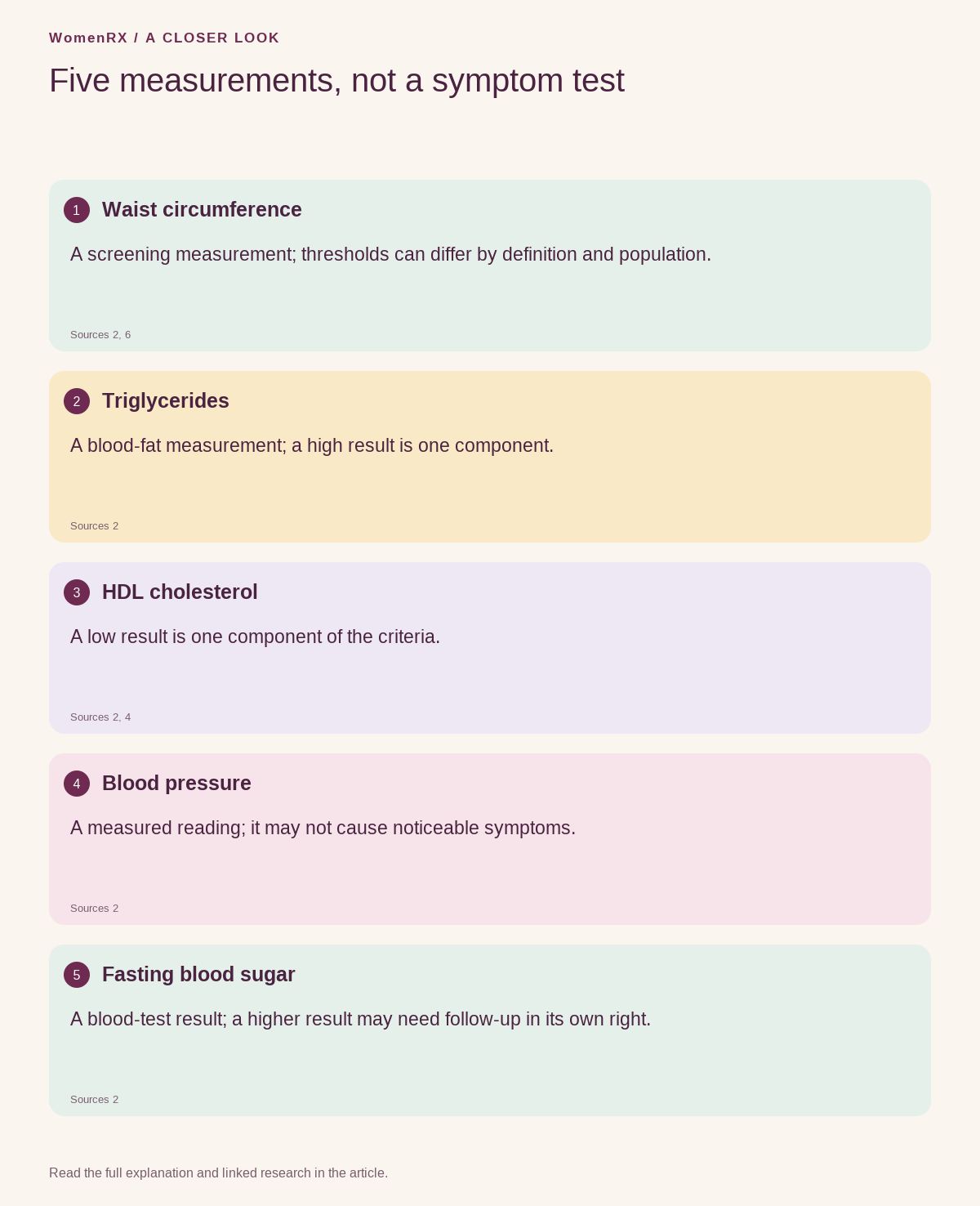
Five measurements, not a symptom test
Waist circumference: A screening measurement; thresholds can differ by definition and population.26
Triglycerides: A blood-fat measurement; a high result is one component.2
HDL cholesterol: A low result is one component of the criteria.24
Blood pressure: A measured reading; it may not cause noticeable symptoms.2
Fasting blood sugar: A blood-test result; a higher result may need follow-up in its own right.2
Read the figure as text
These are the five measurements used to assess the cluster. A single item, including waist circumference, does not establish metabolic syndrome.- Waist circumference: A screening measurement; thresholds can differ by definition and population.26
- Triglycerides: A blood-fat measurement; a high result is one component.2
- HDL cholesterol: A low result is one component of the criteria.24
- Blood pressure: A measured reading; it may not cause noticeable symptoms.2
- Fasting blood sugar: A blood-test result; a higher result may need follow-up in its own right.2
More questions, answered
Can you have metabolic syndrome without symptoms?
Yes. Most of the component risk factors have no obvious signs, which is why the cluster is often found through measurements and blood tests rather than a symptom checklist. 2 3
Does PCOS count as one of the criteria?
No. PCOS is associated with increased risk of metabolic syndrome, but the diagnostic components are waist circumference, triglycerides, HDL cholesterol, blood pressure, and fasting blood sugar. 2
Sources you can check
- Blood Pressure Medicines | MedlinePlusAccessed 2026-09-25Return to first citation
- Metabolic Syndrome | MedlinePlusAccessed 2026-09-25Return to first citation
- Metabolic syndrome - NHSAccessed 2026-09-25Return to first citation
- Cholesterol | MedlinePlusAccessed 2026-09-25Return to first citation
- Association between Changes in Status Based on Multiple Metabolic Syndrome Criteria and Cardiovascular Disease Risk.Takizawa H, Fujihara K, Sato T, Ferreira ED, Laymon K, Osawa T, Kitazawa M, Matsubayashi Y, Yamada T, Kodama S, Horikawa C, Sone H. · Diabetes & metabolism journal · 2026Return to first citation
- A Literature Review on the Waist Circumference Criteria for Metabolic Syndrome in Japan: Evidence and Implications for Cardiovascular Risk Stratification.Uchida T, Hirata A. · Journal of atherosclerosis and thrombosis · 2026Return to first citation