Metabolic Syndrome: What Your Numbers Mean Together
Metabolic syndrome is assessed using five measurements, but the next step depends on your individual heart and diabetes risks.
In a study of middle-aged and older Hong Kong Chinese adults applying NCEP ATP III criteria, metabolic syndrome was identified when at least three of five findings were present: a larger waist measurement, elevated blood pressure, elevated fasting glucose, high triglycerides, or low HDL cholesterol. The study is not a current US diagnostic guideline, and its waist cutoff should not be applied to every woman. The measurements matter even if you don’t meet the three-of-five definition. Ask which findings apply to you, whether any need confirmation, and what follow-up makes sense for your heart and diabetes risk. 31
Five findings, not one symptom
A blood pressure reading, a waist measurement, and blood tests can tell different parts of the same story. Metabolic syndrome is the name for a cluster of findings linked to cardiovascular and diabetes risk. Under the NCEP ATP III criteria applied in a study of middle-aged and older Hong Kong Chinese adults, a person met the definition when at least three of five findings were present: central obesity measured by waist circumference, elevated blood pressure, elevated fasting glucose, high triglycerides, and low HDL cholesterol. Triglycerides and HDL are measured in a lipid panel. 37
You can’t tell whether you have this cluster by how you feel. High blood pressure usually has no symptoms, and a blood test is needed to know your glucose and lipid results. Just as importantly, you don’t need to reach three findings before an individual result deserves attention. 13
Read the measurements without mixing up their meanings
The numbers used to identify a metabolic-syndrome component aren’t always the numbers used to diagnose or treat that condition on its own. For example, the syndrome criteria described in one study counted systolic pressure of at least 130 mm Hg or diastolic pressure of at least 85 mm Hg as a component. US blood-pressure categories classify 130-139 systolic or 80-89 diastolic as stage 1 high blood pressure. A clinician also uses readings from separate appointments before diagnosing high blood pressure. So a single reading can prompt a closer look without settling either question. 31
The same study used a fasting glucose of at least 100 mg/dL and triglycerides of at least 150 mg/dL as components. Its HDL threshold differed for women and men. Waist cutoffs can also vary by population: the study used a cutoff specific to Asian women, not a universal cutoff for every woman in the US. Rather than applying its waist number to yourself, ask which criteria are being used for you. 3
LDL cholesterol is worth discussing too, but it isn’t one of the five metabolic-syndrome components. A lipid panel provides information beyond HDL and triglycerides, and cholesterol goals depend on a person’s broader risk factors. That’s one reason a care plan should address your full results, not just whether you meet a three-of-five definition. 37
What your history adds to the picture
Your history can change what deserves follow-up without changing the five-part definition. If you had gestational diabetes, mention it even if your blood sugar returned to normal after giving birth. Gestational diabetes is associated with a higher chance of type 2 diabetes later, and follow-up blood testing after pregnancy and continued testing are advised. If you’re pregnant now or recently gave birth, ask about the glucose follow-up appropriate to that stage rather than using an ordinary metabolic-syndrome checklist in place of pregnancy care. 6
PCOS is another reason to look beyond a reproductive-health concern. The 2023 international PCOS guideline describes metabolic effects across the lifespan, and a later review reports higher cardiometabolic risks among people with PCOS. Neither PCOS nor gestational diabetes counts as one of the five metabolic-syndrome findings; both are useful history when discussing glucose, blood pressure, and lipids. 453
Menopause belongs in the conversation as context, too. Cholesterol levels tend to rise with age, and women’s risk of high cholesterol rises after menopause. Menopause itself isn’t a metabolic-syndrome component, and a change in cholesterol doesn’t mean menopause is necessarily its only cause. It does make it useful to review your current lipid results rather than rely on older ones. 73
Turn the results into a plan
Start with the finding that needs the clearest next step. If blood pressure is elevated, ask whether it needs repeat measurements and what would change the plan. If glucose is concerning, ask what the result means for diabetes follow-up, especially if you’ve had gestational diabetes or have PCOS. If triglycerides, HDL, or LDL are outside your target range, ask which lipid results matter most for your overall cardiovascular risk. These are different questions, even when the results arrive on the same lab report. 1647
Changes to daily habits can be part of that plan, but they needn’t be presented as a single cure for the cluster. Heart-healthy eating and physical activity can help with blood-pressure management; reducing saturated fat can help lower cholesterol. Blood-pressure treatment may also include medication when lifestyle changes aren’t enough. The useful outcome of the discussion is knowing which measurement you’re working on, how it will be checked again, and what else in your history affects the decision. 127
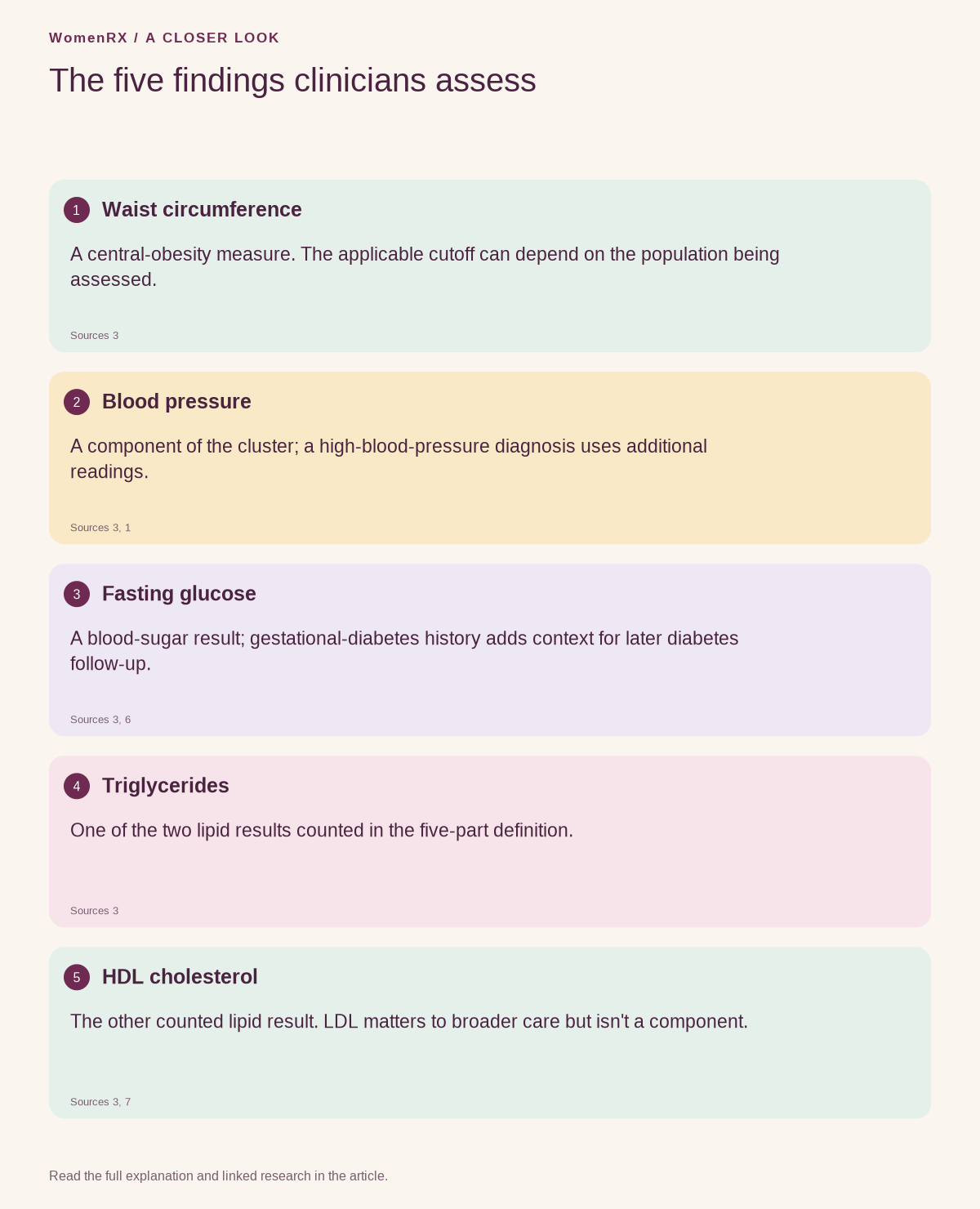
The five findings clinicians assess
Waist circumference: A central-obesity measure. The applicable cutoff can depend on the population being assessed.3
Blood pressure: A component of the cluster; a high-blood-pressure diagnosis uses additional readings.31
Fasting glucose: A blood-sugar result; gestational-diabetes history adds context for later diabetes follow-up.36
Triglycerides: One of the two lipid results counted in the five-part definition.3
HDL cholesterol: The other counted lipid result. LDL matters to broader care but isn't a component.37
Read the figure as text
Together, these measurements assess the cluster under the cited study’s criteria; your history and the individual results shape follow-up.- Waist circumference: A central-obesity measure. The applicable cutoff can depend on the population being assessed.3
- Blood pressure: A component of the cluster; a high-blood-pressure diagnosis uses additional readings.31
- Fasting glucose: A blood-sugar result; gestational-diabetes history adds context for later diabetes follow-up.36
- Triglycerides: One of the two lipid results counted in the five-part definition.3
- HDL cholesterol: The other counted lipid result. LDL matters to broader care but isn't a component.37
More questions, answered
If I have only one or two findings, can I ignore them?
No. The three-of-five definition used in the cited study describes the cluster; it doesn’t make an elevated blood pressure, glucose, or lipid result harmless on its own. Ask what that specific result means and whether it needs confirmation or follow-up. 317
Sources you can check
- High Blood Pressure | Hypertension | MedlinePlusAccessed 2026-09-25Return to first citation
- How to Prevent High Blood Pressure: MedlinePlusAccessed 2026-09-25Return to first citation
- Association of endothelin-1 and matrix metallopeptidase-9 with metabolic syndrome in middle-aged and older adults.Yu AP, Tam BT, Yau WY, Chan KS, Yu SS, Chung TL, Siu PM. · Diabetology & metabolic syndrome · 2015Return to first citation
- Recommendations from the 2023 International Evidence-based Guideline for the Assessment and Management of Polycystic Ovary Syndrome†.Teede HJ, Tay CT, Laven J, Dokras A, Moran LJ, Piltonen TT, Costello MF, Boivin J, Redman LM, Boyle JA, Norman RJ, Mousa A, Joham AE, International PCOS Network. · Human reproduction (Oxford, England) · 2023Return to first citation
- Recent advances in polyendocrine metabolic ovarian syndrome, formerly polycystic ovary syndrome, with emphasis on endocrine and metabolic dysfunction and cardiovascular risk.Forslund M, Melin J, Joham AE, Piltonen TT, Rees DA, Teede HJ. · Journal of internal medicine · 2026Return to first citation
- Gestational diabetes - NHSAccessed 2026-09-25Return to first citation
- Cholesterol Levels: What You Need to Know: MedlinePlusAccessed 2026-09-25Return to first citation