NAC Doses in Research: What the Numbers Mean
A NAC label may show the same daily amount used in a study, but the schedule and reason for taking it can be quite different.
There isn’t one research-backed NAC dose for every purpose. For example, directions to take 600 mg twice daily would total 1,200 mg, the amount studied with phototherapy for vitiligo. That number alone doesn’t reproduce the study or tell you whether NAC is appropriate during pregnancy, breastfeeding or another treatment. Compare the label’s daily total, schedule and purpose with the research relevant to you. 15
The condition changes what a dose means
A number on a NAC bottle may look reassuring if you’ve seen the same number in a study. But the number alone leaves out the reason it was tested, how often it was taken, what other treatment people received and how long researchers followed them.
For example, a review of 14 randomized trials in adults with chronic obstructive pulmonary disease (COPD) examined oral NAC compared with placebo. Across the trials, NAC was associated with fewer COPD flare-ups. In a dose subgroup analysis, studies using 600 mg per day or less showed a statistically significant reduction; those using more than 600 mg per day did not. That does not establish 600 mg as the right dose for you, or prove that a higher dose cannot help. These were COPD treatment studies, not a head-to-head test of supplement doses for general wellness. 2
Other studies answer narrower questions. In a trial of 60 people with breast cancer receiving paclitaxel, researchers tested oral NAC at 1,200 mg daily for two days around each paclitaxel cycle: one day before treatment began and on treatment day, alongside chemotherapy, against placebo alongside chemotherapy. Fewer participants in the NAC group reported neuropathy by the last cycle. This was a small study of a specific cancer treatment schedule, not a reason to add NAC to cancer care on your own. 3
A 35-person OCD trial studied 2,400 mg of NAC per day for 12 weeks, added to sertraline, versus placebo added to sertraline. The NAC group had greater improvement in the study’s OCD symptom measure, while cognitive measures did not differ significantly between groups. The reported regimen doesn’t establish that taking an oral supplement on your own would reproduce those results. Nor does studying NAC alongside sertraline establish that every combination with an antidepressant is safe. 4
In a 16-person vitiligo pilot trial, one group received oral NAC at 600 mg twice daily with narrow-band UVB phototherapy for four months; the comparison group received phototherapy alone. The groups did not differ significantly on the reported measure of vitiligo extent. Most participants were men, so the study offers particularly little basis for a women-specific conclusion. 5
Put the label beside the study regimen
Start with the bottle’s amount per serving and directions for servings per day. For a concrete example, if a label directed 600 mg twice daily, its daily total would be 1,200 mg. That matches the daily total in the vitiligo pilot, where NAC was taken twice daily with phototherapy for four months. It also matches the daily amount in the breast cancer trial, where NAC was taken only for two days around each paclitaxel cycle. Neither match makes that hypothetical bottle regimen equivalent to either studied treatment. These are examples of how to read a label, not directions to take NAC. 35
The same 1,200 mg daily total would fall into the more-than-600-mg-per-day subgroup in the COPD review. That subgroup result describes trials in people with COPD; it cannot tell you whether a particular bottle is effective or appropriate for another purpose. 2
Check the route and any treatment given alongside NAC, too. NAC is used in different forms: Memorial Sloan Kettering describes oral and parenteral drug use for acetaminophen overdose, inhaled and oral solutions for mucus-related clinical uses, and capsules marketed as supplements. Those uses don’t share one set of personal dosing directions. 6
That distinction matters especially with medicines. The breast cancer trial investigated NAC around paclitaxel treatment; the OCD trial investigated it alongside sertraline. Neither trial was a general interaction study, so neither can settle what NAC might mean for your own medication list. If you take prescription medicines, a pharmacist or the clinician managing that treatment can review the exact NAC product and your reason for taking it. 34
What the safety results do and don’t cover
Stomach upset is a reported side effect of NAC. The COPD review found no increased risk of adverse events overall with oral NAC compared with placebo across its included trials. In the small OCD trial, reported adverse events were mild and comparable between groups. In the vitiligo pilot, one participant taking NAC reported dizziness, which resolved after a dose adjustment. These findings are useful, but they don’t make every dose or treatment combination equally well studied. 6245
Pregnancy and breastfeeding call for a different question than “Was NAC tolerated in a COPD trial?” A review of fetal growth restriction describes NAC as a preclinical antioxidant candidate and says effective, safe antioxidant approaches still need clinical study. It does not establish that taking NAC as a supplement improves pregnancy outcomes. The trials discussed above also do not answer whether a proposed NAC regimen is appropriate while breastfeeding or during fertility or other reproductive-health treatment. In those situations, bring the product and your treatment plan into the same conversation before starting it. 12345
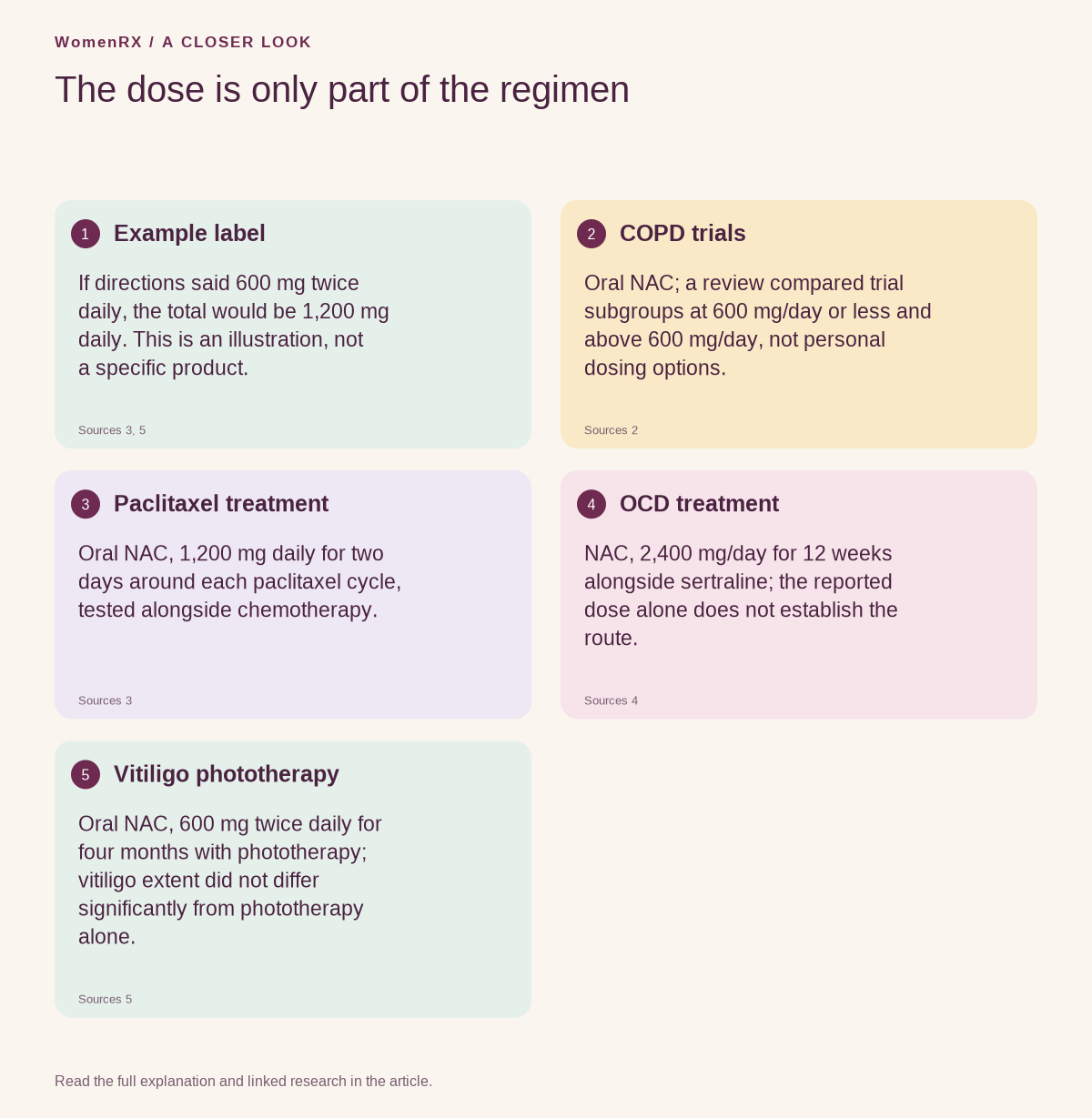
The dose is only part of the regimen
Example label: If directions said 600 mg twice daily, the total would be 1,200 mg daily. This is an illustration, not a specific product.35
COPD trials: Oral NAC; a review compared trial subgroups at 600 mg/day or less and above 600 mg/day, not personal dosing options.2
Paclitaxel treatment: Oral NAC, 1,200 mg daily for two days around each paclitaxel cycle, tested alongside chemotherapy.3
OCD treatment: NAC, 2,400 mg/day for 12 weeks alongside sertraline; the reported dose alone does not establish the route.4
Vitiligo phototherapy: Oral NAC, 600 mg twice daily for four months with phototherapy; vitiligo extent did not differ significantly from phototherapy alone.5
Read the figure as text
The label example and research regimens can share a daily total while answering different questions.- Example label: If directions said 600 mg twice daily, the total would be 1,200 mg daily. This is an illustration, not a specific product.35
- COPD trials: Oral NAC; a review compared trial subgroups at 600 mg/day or less and above 600 mg/day, not personal dosing options.2
- Paclitaxel treatment: Oral NAC, 1,200 mg daily for two days around each paclitaxel cycle, tested alongside chemotherapy.3
- OCD treatment: NAC, 2,400 mg/day for 12 weeks alongside sertraline; the reported dose alone does not establish the route.4
- Vitiligo phototherapy: Oral NAC, 600 mg twice daily for four months with phototherapy; vitiligo extent did not differ significantly from phototherapy alone.5
Sources you can check
- Reactive oxygen species in fetal growth restriction mechanisms and therapeutic directions (Review).Cheng D, Yang S, Wang C, Fan K, Gao F, Sun Q. · International journal of molecular medicine · 2026Return to first citation
- The efficacy of N-acetylcysteine in the management of chronic obstructive pulmonary disease: a systematic review and meta-analysis.Cai X, Peng S, Mao S, Zhong Y, Yu X. · PeerJ · 2026Return to first citation
- Evaluation of the Safety and Efficacy of N-acetylcysteine in the Prevention of Paclitaxel-induced Peripheral Neuropathy: A Randomized, Double-blind, and Placebo-controlled Trial.Ramezaninejad S, Zaboli E, Eslamijouybari M, Mirzakhani L, Shaki F, Moosazadeh M, Namvar HR, Shabani AM, Salehifar E. · Journal of research in pharmacy practice · 2025Return to first citation
- Clinical symptoms and cognitive functioning following adjunctive N-acetylcysteine in obsessive-compulsive disorder: a double-blind, placebo-controlled trial.Askari S, Eghdami S, Tavasoli M, Shariat SV, Yarahmadi M, Ghanbari Jolfaei A, Shirazi E, Tajik Esmaeeli S, Shalbafan M. · Communications medicine · 2026Return to first citation
- The Effectiveness and Safety of Oral N-Acetylcysteine in Combination With Narrow-Band Ultraviolet B (NB-UVB) Phototherapy Compared With NB-UVB Phototherapy Alone in the Treatment of Vitiligo: A Pilot Study.Sadeghzadeh-Bazargan A, Farahani S, Goodarzi A, Zeinali R, Gheisari M, Atefi N, Ghassemi M, Roohaninasab M, Dehghani A. · Health science reports · 2025Return to first citation
- N-Acetylcysteine | Memorial Sloan Kettering Cancer CenterAccessed 2026-09-25Return to first citation