NAC Side Effects, Interactions, and Precautions
Oral NAC can upset your stomach, and pregnancy or a change in your medicines calls for a closer safety check.
Oral NAC can cause nausea, vomiting, diarrhea, heartburn, constipation, or gas. These effects may vary with dose. Interaction research is sparse, though one review flags possible effects on psychiatric-medication concentrations. A study using a high dose also reported worsening symptoms in participants with Parkinson’s disease. If you’re pregnant, breastfeeding, or taking medicines, check with your prescriber or pharmacist before starting NAC. 3 4 2
What side effects are reported?
With oral NAC, reported effects include nausea, vomiting, diarrhea, heartburn, constipation, and flatulence. A review describes these gastrointestinal effects as generally mild to moderate; it also reports that they may be dose-related. That doesn’t mean you should adjust a prescribed treatment yourself. If symptoms are troubling, ask the person who recommended NAC what to do. 3
Dizziness has also been reported. In a small randomized trial, 16 people with generalized vitiligo were enrolled in total. One group received oral NAC alongside narrow-band UVB (NB-UVB) phototherapy, while the other received phototherapy alone; one person in the NAC group reported dizziness. That study can’t tell us how often dizziness occurs among people using NAC more broadly. 5
The form and reason for use matter
NAC is used in different ways. Oral NAC is also used as a prescribed antidote for acetaminophen overdose, and IV NAC is used for that purpose in medical care. Evidence about side effects from oral use shouldn’t be treated as a complete safety guide to IV or inhaled NAC. The information here is mainly about oral use; a clinician directs treatment when NAC is being used as an antidote. 3
If you’re considering an over-the-counter product, check the label and bring the product name and amount per serving to a pharmacist or prescriber. Don’t use a supplement in place of prescribed NAC for an overdose, and don’t stop or change another prescribed medicine because you’re thinking about taking NAC.
A health condition can matter, too. In research summarized by a 2023 review, participants with Parkinson’s disease reported worsening symptoms while taking a studied high dose of oral NAC, whereas that dose was generally well tolerated by healthy participants. This doesn’t show that everyone with Parkinson’s disease must avoid NAC at every dose. It does make Parkinson’s disease worth mentioning before starting it. 3
What about interactions with medicines?
The interaction picture is not well mapped. A 2023 review reports that formal drug-interaction studies had not been conducted. A separate review of supplements in dermatology says NAC may interfere with concentrations of some medicines used in psychiatric care, but its abstract doesn’t identify specific medicines or explain how large or reliable the effect is. That’s a reason to check your exact medication list, not proof that NAC interacts with every psychiatric medicine. 3 4
When you ask, include prescriptions, over-the-counter medicines, and other supplements. A pharmacist can check the specific combination. Don’t stop a medicine or change its timing without guidance.
Pregnancy and breastfeeding
If you’re pregnant or breastfeeding, ask your care team about NAC before starting it. Pregnancy guidance advises checking before starting medicines, herbs, or supplements, and not stopping a needed medicine without discussing the risks and benefits. During breastfeeding, some medicines can pass into breast milk; that general guidance doesn’t determine NAC-specific risk. 2 1
A quick check before combining NAC
Before starting NAC, be ready to tell your pharmacist or prescriber:
- Which NAC product and form you’re considering, and why.
- Every prescription medicine, nonprescription medicine, and supplement you take.
- Whether you have Parkinson’s disease, given the symptom worsening reported at a studied high dose. 3
- Whether you’re pregnant, trying to become pregnant, or breastfeeding.
- What symptoms you’ve had with NAC before, if any.
This makes the conversation specific to your situation without treating a supplement as automatically safe or assuming a possible interaction is certain.
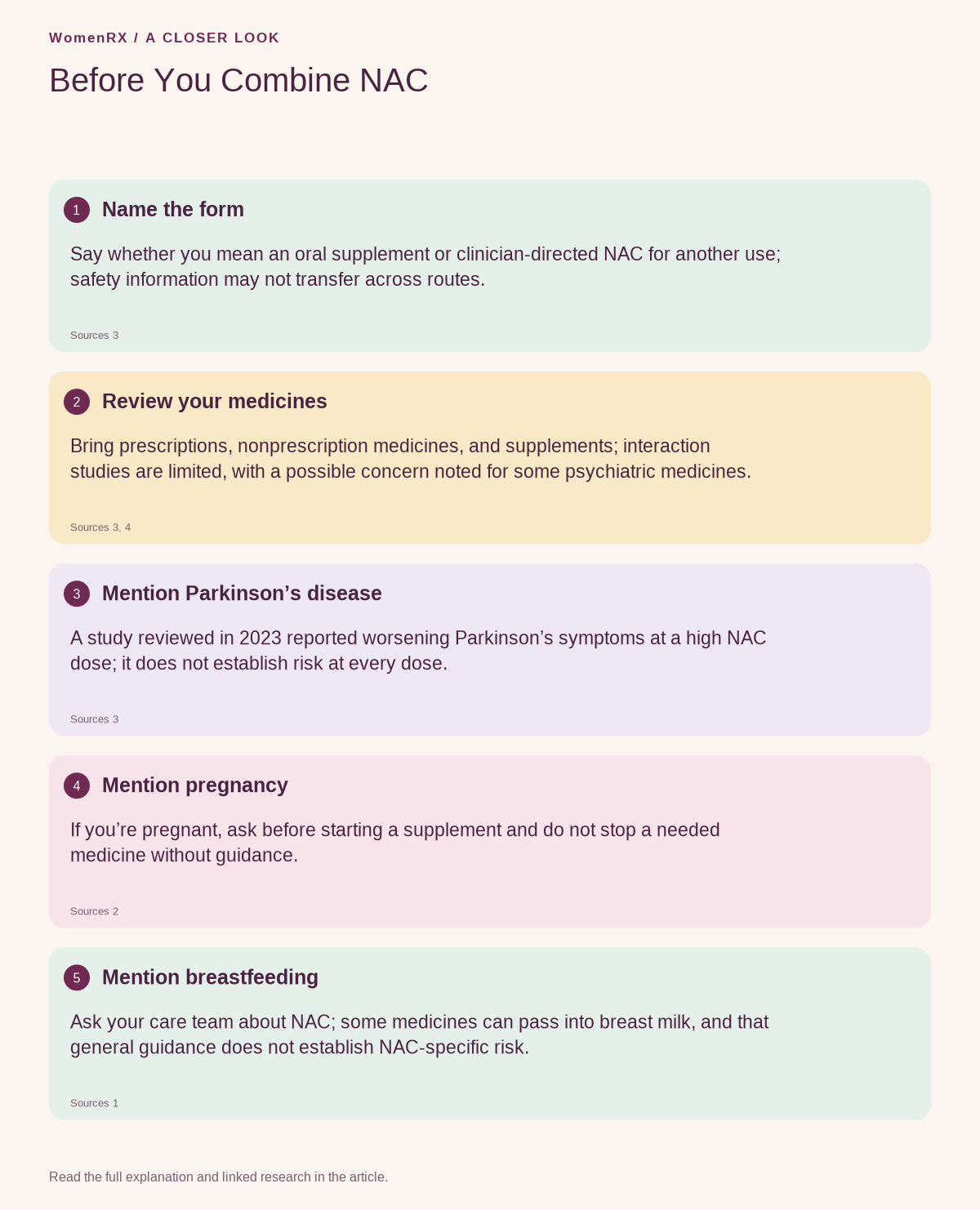
Before You Combine NAC
Name the form: Say whether you mean an oral supplement or clinician-directed NAC for another use; safety information may not transfer across routes.3
Review your medicines: Bring prescriptions, nonprescription medicines, and supplements; interaction studies are limited, with a possible concern noted for some psychiatric medicines.34
Mention Parkinson’s disease: A study reviewed in 2023 reported worsening Parkinson’s symptoms at a high NAC dose; it does not establish risk at every dose.3
Mention pregnancy: If you’re pregnant, ask before starting a supplement and do not stop a needed medicine without guidance.2
Mention breastfeeding: Ask your care team about NAC; some medicines can pass into breast milk, and that general guidance does not establish NAC-specific risk.1
Read the figure as text
Use these prompts to make a product-specific safety check with a pharmacist or prescriber.- Name the form: Say whether you mean an oral supplement or clinician-directed NAC for another use; safety information may not transfer across routes.3
- Review your medicines: Bring prescriptions, nonprescription medicines, and supplements; interaction studies are limited, with a possible concern noted for some psychiatric medicines.34
- Mention Parkinson’s disease: A study reviewed in 2023 reported worsening Parkinson’s symptoms at a high NAC dose; it does not establish risk at every dose.3
- Mention pregnancy: If you’re pregnant, ask before starting a supplement and do not stop a needed medicine without guidance.2
- Mention breastfeeding: Ask your care team about NAC; some medicines can pass into breast milk, and that general guidance does not establish NAC-specific risk.1
More questions, answered
Should I stop a medicine before taking NAC?
No. Don’t stop or change a prescribed medicine on your own. Interaction evidence is limited, and the possible concern noted for some psychiatric medicines doesn’t identify a universal interaction. Ask a pharmacist or prescriber to check your exact combination. 3 4
Is NAC safe during pregnancy or breastfeeding?
If you’re pregnant or breastfeeding, ask your care team about NAC before starting it. General pregnancy guidance advises checking before starting supplements, and some medicines can pass into breast milk. Those general points don’t establish NAC-specific risk. 2 1
Sources you can check
- Breastfeeding | Benefits of Breastfeeding | MedlinePlusAccessed 2026-09-25Return to first citation
- Pregnancy and Medicines | MedlinePlusAccessed 2026-09-25Return to first citation
- N-acetylcysteine Pharmacology and Applications in Rare Diseases-Repurposing an Old Antioxidant.Sahasrabudhe SA, Terluk MR, Kartha RV. · Antioxidants (Basel, Switzerland) · 2023Return to first citation
- Drug interactions of natural supplements in dermatology: a review.Hadeler EK, Maderal AD. · International journal of dermatology · 2021Return to first citation
- The Effectiveness and Safety of Oral N-Acetylcysteine in Combination With Narrow-Band Ultraviolet B (NB-UVB) Phototherapy Compared With NB-UVB Phototherapy Alone in the Treatment of Vitiligo: A Pilot Study.Sadeghzadeh-Bazargan A, Farahani S, Goodarzi A, Zeinali R, Gheisari M, Atefi N, Ghassemi M, Roohaninasab M, Dehghani A. · Health science reports · 2025Return to first citation