NAC Supplements: Side Effects, Safety, and Medication Checks
NAC’s safety depends on the product and purpose: evidence from a medical treatment or one health condition doesn’t automatically apply to an over-the-counter supplement.
Oral NAC can cause stomach upset, nausea, gas, drowsiness, or skin reactions, though studies have not established a clear overall side-effect risk across uses. Medical NAC treatment, such as treatment for acetaminophen overdose, is different from taking a supplement. Sports studies do not identify specific medication interactions, so they cannot clear NAC for use with your medicines. 1 2 3
One ingredient, different kinds of use
N-acetylcysteine, often called NAC, is sold as an oral supplement and also has clinician-directed medical uses. These are not interchangeable. NAC is used medically in acetaminophen overdose treatment and as a mucus-thinning medicine in some respiratory conditions. Evidence or safety experience from a medical use does not, by itself, show that a retail supplement will help a different concern or has the same risks. 3
That distinction matters if you’re considering NAC for a broad goal like “detox,” breathing symptoms, or fertility. The benefit question depends on the specific condition and use. A sports supplement review, for example, cannot establish that NAC treats a respiratory illness or a reproductive condition.
What side effects have been reported?
Reported effects in controlled studies of adult men using NAC as a sports supplement included gas, upset stomach, nausea, drowsiness, vomiting, sweating, flushing, skin rash, and itching. Some studies reported no adverse reactions; others reported mild reactions, and one reported effects described as mild to severe. The review does not establish how often severe effects occur. These findings come from male exercise studies, so they don’t settle the side-effect profile for women or for other reasons for taking NAC. 2
A review of NAC supplementation in sport pooled 17 studies for side effects. It found no clear difference between NAC and placebo, but the estimate was imprecise, and the authors said inconsistent reporting made the overall risk difficult to determine. This is not proof that side effects never happen. 1
The practical takeaway is to pay attention to what happens after starting a product, including digestive or skin symptoms, and to consider the full formula rather than assuming NAC is the only possible cause.
What about your medications?
These studies do not provide a reliable list of NAC’s medication interactions. That means they cannot tell you whether NAC is compatible with a medicine you take. A report of few side effects in an exercise study is not an interaction check. 1 2
If you ask a pharmacist or clinician about a particular product, show them:
- The exact NAC product label, including all added ingredients
- The amount listed per serving and how often you expect to take it
- Your prescription and over-the-counter medicines, plus other supplements
- The health concern you want NAC to address
This is information for a product-specific review, not a way to determine interactions on your own. It also helps distinguish a product containing NAC alone from a combination formula, and a supplement plan from clinician-directed treatment.
Pregnancy, breastfeeding, and PCOS are separate questions
If you’re pregnant, trying to conceive, or breastfeeding, don’t assume that findings in general adult supplement studies apply to you. One small early-pregnancy study included NAC as part of a combination containing calcium and several other nutrients. Because the ingredients were given together, its results cannot show what NAC alone does. It also doesn’t answer breastfeeding safety. 4
PCOS claims need their own condition-specific evidence. Findings about NAC in sports or psychiatric research don’t demonstrate a benefit for PCOS, fertility, or ovulation. If a product is being considered for PCOS, make sure the discussion is about that specific goal and how it fits with your current care, rather than relying on NAC’s antioxidant description. 2 3
A useful way to decide
Before buying NAC, ask two different questions: “Is there evidence for my particular reason for taking it?” and “Is this exact product a sensible choice with my medicines and circumstances?” A favorable answer to one doesn’t settle the other. If your reason is a diagnosed condition, or if pregnancy or breastfeeding is relevant, take the product label to a pharmacist or the clinician who knows your care.
Medical NAC and supplement NAC
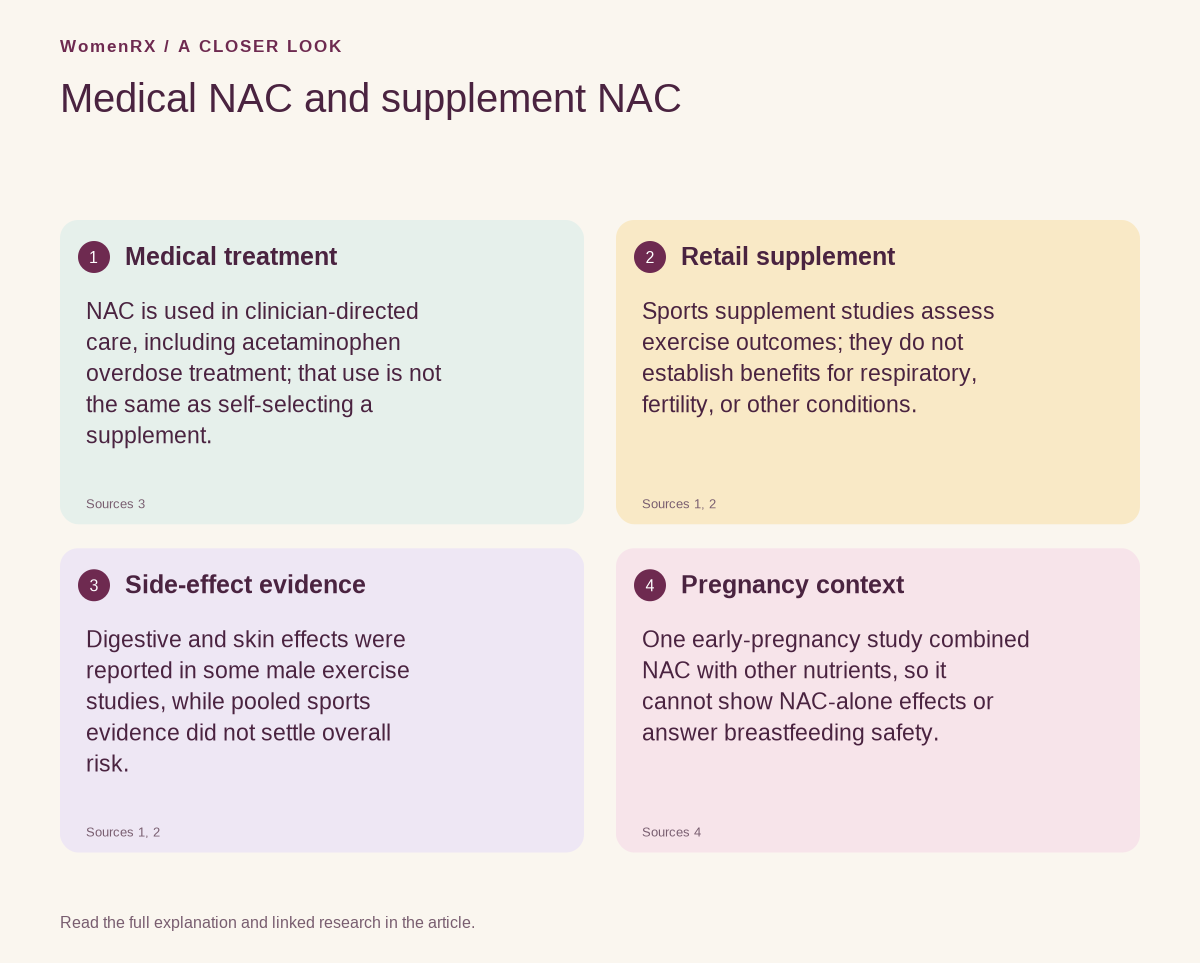
Medical treatment: NAC is used in clinician-directed care, including acetaminophen overdose treatment; that use is not the same as self-selecting a supplement.3
Retail supplement: Sports supplement studies assess exercise outcomes; they do not establish benefits for respiratory, fertility, or other conditions.12
Side-effect evidence: Digestive and skin effects were reported in some male exercise studies, while pooled sports evidence did not settle overall risk.12
Pregnancy context: One early-pregnancy study combined NAC with other nutrients, so it cannot show NAC-alone effects or answer breastfeeding safety.4
Read the figure as text
Why the purpose and setting of NAC use matter when interpreting benefits and safety.- Medical treatment: NAC is used in clinician-directed care, including acetaminophen overdose treatment; that use is not the same as self-selecting a supplement.3
- Retail supplement: Sports supplement studies assess exercise outcomes; they do not establish benefits for respiratory, fertility, or other conditions.12
- Side-effect evidence: Digestive and skin effects were reported in some male exercise studies, while pooled sports evidence did not settle overall risk.12
- Pregnancy context: One early-pregnancy study combined NAC with other nutrients, so it cannot show NAC-alone effects or answer breastfeeding safety.4
More questions, answered
Does medical use of NAC prove supplements are safe?
No. Clinician-directed medical use, such as treatment for acetaminophen overdose, is a different context from taking an over-the-counter product for another purpose. Evidence from one use does not establish the benefit or safety of another. 3
Do NAC studies establish a PCOS benefit?
The sports and psychiatric findings discussed here do not establish that NAC treats PCOS or improves fertility. Those are separate questions that require evidence specific to those outcomes. 2 3
Sources you can check
- Performance and Side Effects of Supplementation with N-Acetylcysteine: A Systematic Review and Meta-Analysis.Rhodes K, Braakhuis A. · Sports medicine (Auckland, N.Z.) · 2017Return to first citation
- Influence of N-Acetylcysteine Supplementation on Physical Performance and Laboratory Biomarkers in Adult Males: A Systematic Review of Controlled Trials.Fernández-Lázaro D, Domínguez-Ortega C, Busto N, Santamaría-Peláez M, Roche E, Gutiérez-Abejón E, Mielgo-Ayuso J. · Nutrients · 2023Return to first citation
- N-Acetylcysteine for the Treatment of Psychiatric Disorders: A Review of Current Evidence.Ooi SL, Green R, Pak SC. · BioMed research international · 2018Return to first citation
- Calcium supplementation commencing before or early in pregnancy, or food fortification with calcium, for preventing hypertensive disorders of pregnancy.Hofmeyr GJ, Manyame S. · The Cochrane database of systematic reviews · 2017Return to first citation