Peptides: Which Claims Deserve a Closer Look?
A prescription medicine, a collagen powder, and a skin serum can all contain peptides, but evidence for one tells you little about another.
Start with the exact product and what you want it to do. Semaglutide is a peptide-based prescription medicine with product-specific prescribing information; collagen supplements and cosmetic peptides are studied for different outcomes. Peptides promoted for recovery or “anti-aging” may have much less human evidence. A convincing claim should match the substance, formulation, route, and intended use you’re considering. 1356

One word, several different decisions
If you’ve seen peptides offered for weight, joint comfort, skin, sexual desire, or recovery, it’s reasonable to wonder whether the same evidence applies across them. It doesn’t. “Peptide” describes a type of molecule, not a shared treatment effect. Semaglutide, for example, is a GLP-1 receptor agonist with a peptide backbone. Collagen peptides are taken as an oral supplement, while cosmetic peptides are put into creams and serums. Those differences change the question you need to ask: Which product was tested, in whom, and for what outcome? 136
For a prescription medicine, check the specific use and label
A prescription peptide has evidence and safety information tied to a particular medicine, formulation, and use. Oral and injected semaglutide are a useful example: they contain the same active ingredient, but their product instructions and practical considerations aren’t interchangeable. The prescribing information for Wegovy also addresses medication absorption because semaglutide delays stomach emptying. These are product-level questions, not properties you can assume for every peptide. 12
Reproductive plans can change this decision. Wegovy’s prescribing information says to discontinue it at least two months before a planned pregnancy because semaglutide remains in the body for a long time. The oral semaglutide labeling likewise says pregnancy data in women are insufficient to evaluate several pregnancy outcomes and gives a two-month interval before a planned pregnancy. Neither statement establishes a rule for unrelated peptides. If pregnancy is possible or planned, look at the specific medicine’s information rather than a general peptide claim. 12
Another distinct route is bremelanotide, a peptide medicine discussed for a specific form of low sexual desire in premenopausal women. That is not evidence that a product sold under the broader name PT-141 treats every cause of low desire, or that findings apply unchanged after menopause. The reading paths below separate how this medicine works, its precautions, and what its U.S. approval covers. 5
For a supplement, match the claim to the people studied
Suppose the claim is that collagen peptides will ease knee discomfort. In one randomized trial, physically active men and women ages 18 to 30 who had exercise-related knee pain, but no diagnosed joint disease, took a specific collagen-peptide preparation or placebo for 12 weeks. Activity-related pain fell more in the collagen group. Pain at rest and pain after squats did not differ significantly between groups. That’s a narrower finding than “collagen fixes joints,” and it doesn’t establish the same result for arthritis or for every collagen powder. 3
The outcome matters just as much as the ingredient. A trial of collagen alongside resistance training that reported body-composition changes enrolled men, not women. Its results can’t answer whether the same program would have the same effect for a woman in perimenopause or postmenopause. 4 If your real question is about joint pain, muscle, or skin, choose evidence that measured that outcome in a relevant population, rather than borrowing a result from another use.
For a skin product, look past the ingredient name
Peptide skin care has some human trial evidence, but formulation makes a difference. A systematic review of randomized trials found improvements in some skin measures, particularly with oral formulations, while results for elasticity were inconsistent. Most included studies tested oral products; only two tested topical ones. Peptides and outcomes varied enough that a pooled result can’t tell you what a particular serum will do. 6
That’s especially useful to remember when a cream contains several ingredients. Ask whether a study tested the finished formula you’re looking at, the peptide on its own, or a different product altogether. Skin-barrier penetration is also a practical hurdle for topical peptides, so evidence for an oral supplement doesn’t automatically transfer to a cream. 67
For recovery and “anti-aging” injections, separate promise from proof
Some peptides marketed for tissue repair or hormone-related effects have encouraging animal or laboratory findings but limited human testing. A review covering BPC-157, CJC-1295, and ipamorelin, among others, describes substantial gaps in clinical validation and long-term safety. An effect on a biological pathway is not the same thing as a demonstrated benefit for your recovery, body composition, or healthy aging. 5
The most useful next move is to follow the concern that brought you here. Use the reading paths below for prescription-peptide safety, sexual desire, collagen versus injectable products, or skin claims. Within any route, keep the exact product and its claimed use together. That simple check prevents a result for one peptide from becoming an unsupported promise about another. 1356
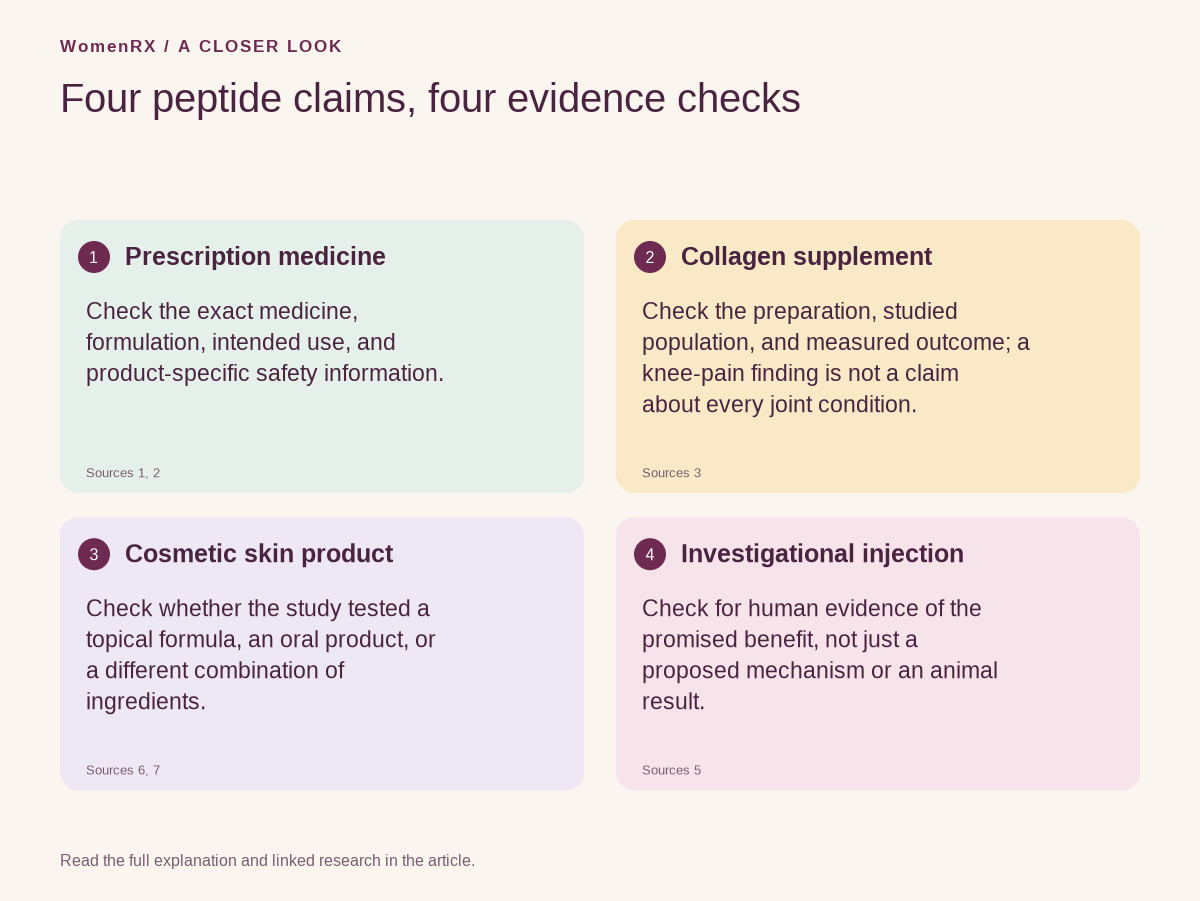
Four peptide claims, four evidence checks
Prescription medicine: Check the exact medicine, formulation, intended use, and product-specific safety information.12
Collagen supplement: Check the preparation, studied population, and measured outcome; a knee-pain finding is not a claim about every joint condition.3
Cosmetic skin product: Check whether the study tested a topical formula, an oral product, or a different combination of ingredients.67
Investigational injection: Check for human evidence of the promised benefit, not just a proposed mechanism or an animal result.5
Read the figure as text
Match the kind of product to the question its evidence can actually answer.- Prescription medicine: Check the exact medicine, formulation, intended use, and product-specific safety information.12
- Collagen supplement: Check the preparation, studied population, and measured outcome; a knee-pain finding is not a claim about every joint condition.3
- Cosmetic skin product: Check whether the study tested a topical formula, an oral product, or a different combination of ingredients.67
- Investigational injection: Check for human evidence of the promised benefit, not just a proposed mechanism or an animal result.5
Sources you can check
- WEGOVY (SEMAGLUTIDE) INJECTION, SOLUTION WEGOVY (SEMAGLUTIDE) TABLET [NOVO NORDISK PHARMACEUTICAL INDUSTRIES, LP] | US prescribing information and patient instructionsAccessed 2026-09-25Return to first citation
- OZEMPIC (ORAL SEMAGLUTIDE) TABLET RYBELSUS (ORAL SEMAGLUTIDE) TABLET [NOVO NORDISK PHARMACEUTICAL INDUSTRIES, LP] | US prescribing information and patient instructionsAccessed 2026-09-25Return to first citation
- The Influence of Specific Bioactive Collagen Peptides on Knee Joint Discomfort in Young Physically Active Adults: A Randomized Controlled Trial.Zdzieblik D, Brame J, Oesser S, Gollhofer A, König D, König D. · Nutrients · 2021Return to first citation
- The Influence of Specific Bioactive Collagen Peptides on Body Composition and Muscle Strength in Middle-Aged, Untrained Men: A Randomized Controlled Trial.Zdzieblik D, Jendricke P, Oesser S, Gollhofer A, König D. · International journal of environmental research and public health · 2021Return to first citation
- Therapeutic peptides in gerontology: mechanisms and applications for healthy aging.Mavrych V, Shypilova I, Bolgova O. · Frontiers in aging · 2026Return to first citation
- Oral and topical peptides for skin aging: systematic review and meta-analysis of randomized controlled trials.Nukaly HY, Halawani IR, Irtaza HM, Alturkistani T, Serafi MR, Alhawsawi W, Bogari HO, Ahmed FA, Alhaddad Y, Shadid A, Alharithy R, Jfri A. · Frontiers in medicine · 2026Return to first citation
- The Innovative and Evolving Landscape of Topical Exosome and Peptide Therapies: A Systematic Review of the Available Literature.Ash M, Zibitt M, Shauly O, Menon A, Losken A, Gould D. · Aesthetic surgery journal. Open forum · 2024Return to first citation