Which Supplements Are Worth Considering During Menopause?
For most menopause concerns, a supplement makes more sense when it fills a specific nutritional gap than when it promises to ease symptoms.
There’s no well-supported menopause supplement stack. For hot flashes and night sweats, current evidence-based guidance doesn’t recommend supplements or herbal remedies such as black cohosh or soy extracts. For bone health, consider calcium and vitamin D in relation to your food intake, age, and any identified deficiency or risk, rather than treating them as menopause symptom remedies. Review supplement choices alongside your medicines. 1 2 3 6
Start with the concern, not a stack
Menopause-related changes can prompt very different questions: “Will this help my hot flashes?” and “Am I getting what I need to protect my bones?” Those aren’t the same supplement decision. Evidence-based guidance does not recommend supplements or herbal remedies for menopause-related hot flashes and night sweats. Calcium and vitamin D, by contrast, are nutrients connected to bone health, but that doesn’t make them a general treatment for menopause symptoms. 2 3 6
A practical first step is to name the outcome you want. Then ask whether the supplement is meant to treat a symptom, make up for a dietary shortfall, or address a deficiency or risk. Evidence for one purpose shouldn’t be assumed to prove another.
If hot flashes or night sweats are the problem
The North American Menopause Society’s 2023 position statement does not recommend supplements or herbal remedies for vasomotor symptoms, which include hot flashes and night sweats. Its list also includes soy foods and soy extracts among options not recommended for these symptoms. Black cohosh has been studied in women, but trial results have varied, and the evidence does not establish it as an effective choice. 1 6
One randomized trial in 106 women in perimenopause reported improvements with a particular combination supplement. That result applies to the specific product and study, not to supplements as a category or to every ingredient sold for menopause. It doesn’t outweigh the broader position statement’s assessment of supplements and herbal remedies for hot flashes and night sweats. 6 8
If symptoms are disrupting your sleep or daily life, you don’t have to make supplements your only option. Hormone therapy remains the most effective treatment for vasomotor symptoms; whether it’s appropriate depends on your health and individual risks. The 2023 position statement also identifies several evidence-supported nonhormonal treatments. 5 6
If your concern is bone health
After menopause, lower estrogen contributes to increased bone remodeling and a drop in bone mineral density. Calcium and vitamin D support bone-related needs, but supplements make most sense in the context of what you already get from food and your individual circumstances. Calcium is available in foods and fortified products as well as supplements. 2 3 4
Think of these nutrients as addressing nutritional needs, not as a stand-alone substitute for treatment of osteoporosis or as a proven way to prevent every fracture. A 2025 network meta-analysis in postmenopausal women compared supplements using bone-turnover markers. Those markers are not the same as demonstrating fewer fractures or better health in everyday life, so the findings don’t establish a universal supplement choice. 7
If you suspect a deficiency or have a risk factor
Vitamin D deficiency can contribute to loss of bone density. Some people are more likely to have low vitamin D, including people with conditions that impair nutrient absorption and people taking certain medicines that affect vitamin D levels. A blood test can measure vitamin D; if you have a risk factor, that’s a more specific starting point than adding a high-dose product on guesswork. 2
Too much vitamin D from supplements can be harmful, including by raising blood calcium and damaging the kidneys. Check the total amount across products if you use more than one, and get advice that accounts for your medicines and health conditions. 2
For calcium, first look at dietary sources and fortified foods. Postmenopausal women are among the groups who may need to pay attention to calcium intake and absorption, but that doesn’t mean every woman needs a supplement. A supplement is a way to fill a gap, not an automatic addition to a menopause routine. 3 4
What your menopause stage and medicines change
The evidence isn’t equally specific to every stage. Bone-turnover supplement research cited here focuses on postmenopausal women, while the small combination-product trial was in perimenopausal women and cannot establish benefits for other products. The guidance against supplements and herbal remedies for hot flashes addresses menopause-associated vasomotor symptoms broadly. 6 7 8
If you’re taking hormone therapy, that doesn’t create a reason to add a standard supplement stack. Hormone therapy is a separate option with benefits and risks that depend on factors such as age, timing, and health history; consider its role separately from whether you need a nutrient supplement. 5
Some cholesterol, anti-seizure, steroid, and weight-loss medicines can affect vitamin D levels. If you take medicines, ask a pharmacist or prescriber to check your specific medication list alongside the exact supplement product you’re considering. Black cohosh preparations vary, and its active ingredients and potential mechanisms aren’t clear, so don’t assume findings about one product apply to another. 1 2
A simple decision rule
If you’re considering a product for hot flashes, current guidance doesn’t support supplements as a reliable choice. If you’re considering calcium or vitamin D, connect the decision to your diet, a documented deficiency or risk, and your medicines. If the goal is to treat a bone condition or disruptive menopause symptoms, ask about established treatment options rather than expecting a supplement to do that job. 2 3 5 6
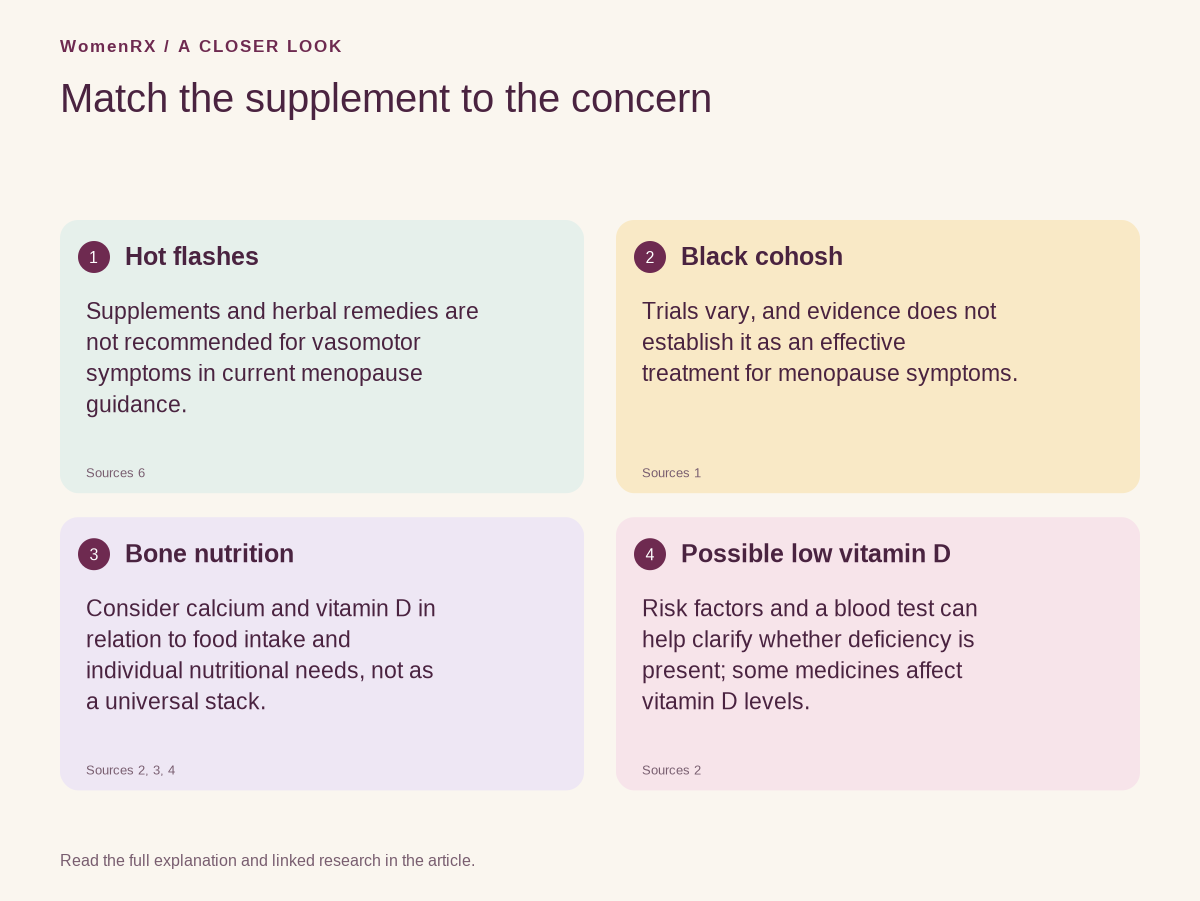
Match the supplement to the concern
Hot flashes: Supplements and herbal remedies are not recommended for vasomotor symptoms in current menopause guidance.6
Black cohosh: Trials vary, and evidence does not establish it as an effective treatment for menopause symptoms.1
Bone nutrition: Consider calcium and vitamin D in relation to food intake and individual nutritional needs, not as a universal stack.234
Possible low vitamin D: Risk factors and a blood test can help clarify whether deficiency is present; some medicines affect vitamin D levels.2
Read the figure as text
The key distinction is whether a product is being considered for a menopause symptom or to address a nutrient shortfall or risk.- Hot flashes: Supplements and herbal remedies are not recommended for vasomotor symptoms in current menopause guidance.6
- Black cohosh: Trials vary, and evidence does not establish it as an effective treatment for menopause symptoms.1
- Bone nutrition: Consider calcium and vitamin D in relation to food intake and individual nutritional needs, not as a universal stack.234
- Possible low vitamin D: Risk factors and a blood test can help clarify whether deficiency is present; some medicines affect vitamin D levels.2
More questions, answered
Does black cohosh have proven benefits for menopause symptoms?
No. Studies have produced varying results, and the 2023 menopause position statement does not recommend supplements or herbal remedies for hot flashes and night sweats. Black cohosh products also vary in composition, so findings about one preparation may not apply to another. 1 6
Should I take vitamin D just because I’m postmenopausal?
Not automatically. Vitamin D is relevant to bone health, but whether you need a supplement depends on factors such as your intake, deficiency risk, and medicines. A blood test can measure vitamin D when deficiency is a concern. 2
Sources you can check
- Black Cohosh - Health Professional Fact SheetAccessed 2026-09-25Return to first citation
- Vitamin D Deficiency: MedlinePlusAccessed 2026-09-25Return to first citation
- Calcium - Health Professional Fact SheetAccessed 2026-09-25Return to first citation
- Calcium | MedlinePlusAccessed 2026-09-25Return to first citation
- The 2022 hormone therapy position statement of The North American Menopause Society.“The 2022 Hormone Therapy Position Statement of The North American Menopause Society” Advisory Panel. · Menopause (New York, N.Y.) · 2022Return to first citation
- The 2023 nonhormone therapy position statement of The North American Menopause Society.Menopause (New York, N.Y.) · 2023Return to first citation
- Effects of dietary supplements on bone turnover markers in women after menopause: a network meta-analysis.Wei Y, Lei C, Zhong Y, Shen H. · PeerJ · 2025Return to first citation
- Clinical Evaluation of Effectiveness and Safety of Combined Use of Dietary Supplements Amberen® and Smart B® in Women with Climacteric Syndrome in Perimenopause.Kachko VA, Shulman LP, Kuznetsova IV, Uspenskaya YB, Burchakov DI. · Advances in therapy · 2024Return to first citation