Eating During Stress: What Food Can and Cannot Do
If stress and a changed appetite or meal routine are showing up together, a low-pressure eating plan may help you stay nourished, but no particular food is proven to switch stress off.
A changed appetite or disrupted meal routine can make eating feel harder, whether you’re eating more or less than usual. Start with practical support, such as keeping easy meals or snacks available, rather than searching for a stress-curing food. Small studies of dietary programs have reported changes in perceived stress, but they don’t establish that a particular food reliably lowers stress. 2 4 5
First, separate the eating change from its cause
You might notice that meals are becoming irregular, that eating feels less appealing, or that you’re reaching for food more often. Those changes are worth responding to, but noticing them during a stressful period doesn’t prove that stress caused them. Research on stress-related eating points to varied patterns and inconsistent findings about why some people eat more under stress. 3
The useful first question is simple: What would make eating workable today? That’s a different question from “Which food will lower my stress?” The first has practical answers. The second has no reliable food-based solution established by this research.
If eating less or skipping meals is your pattern
When a full meal feels like too much effort, try reducing the number of steps between you and something to eat. For example, keep a few familiar, ready-to-eat options within reach, choose a simple meal you already like, or ask someone who’s helping with caregiving to bring food along. These are practical ways to make eating easier, not a treatment for stress.
If you’re pregnant, postpartum, or caring for someone else, your schedule and support needs may shape what’s realistic. These studies don’t show that women in these stages respond differently to stress through appetite, or identify a particular diet that works for them. Aim for the simplest routine that fits your circumstances, rather than adding a demanding food plan.
If you’re losing weight without trying, don’t assume the change is only stress. Unintentional weight loss can have several causes and warrants an evaluation. 1
If you’re eating more often than you intend
Try to notice what’s happening without turning it into a test of willpower. For example, you might ask whether a regular meal would help you feel more settled, or whether eating has become one of the few breaks in a demanding day. A predictable meal or snack routine may make your day easier to manage, but it shouldn’t be presented as a proven way to stop stress-related eating.
There’s no need to label foods as good or bad to make this adjustment. A useful goal is a routine that feels manageable and nourishing, not a stricter set of rules. If eating changes are becoming distressing or are affecting your health, getting support is a reasonable next move.
What dietary studies can, and can’t, tell you
In a randomized study of 45 adults, a four-week diet emphasizing prebiotic and fermented foods was compared with a control diet. Perceived stress fell by 32% within the diet group and 17% within the control group, but the change was not significantly different between groups. That means the study didn’t show that the diet lowered stress more than the control. It also wasn’t large or long enough to establish a dependable effect for individuals. 5
Another randomized crossover study involved 40 adults, 75% of them women, who took part in eight weekly group cooking classes alongside a vegan dietary program. Perceived stress was 19% lower after the intervention than before it. But the program combined dietary change with cooking classes and group participation, so the result can’t tell us whether the food, the social contact, cooking, or something else made the difference. The study also didn’t report a women-specific effect. 4
Together, these studies offer a reason to be curious about food-based programs, not a reason to treat a specific diet as stress therapy. You can choose foods you enjoy and can manage without expecting a particular ingredient or dietary pattern to reliably change how stressed you feel.
Don’t ask food to do every job
Stress can involve work, money, family demands, or difficult life events. Food may support your daily routine, but it can’t resolve those pressures by itself. MedlinePlus suggests getting enough sleep, avoiding too much caffeine, and deciding what needs attention now and what can wait as approaches to managing long-term stress. 2
If caffeine is part of your routine, avoiding too much of it is one option for managing long-term stress. That doesn’t mean caffeine is the cause of your stress. 2
When stress is persistent or is making everyday life hard to manage, consider support beyond changes to food. Seeking help is a practical suggestion, not a treatment recommendation made by the dietary studies above. If stress comes with thoughts of suicide or feeling unable to cope, MedlinePlus says to get help right away. 2
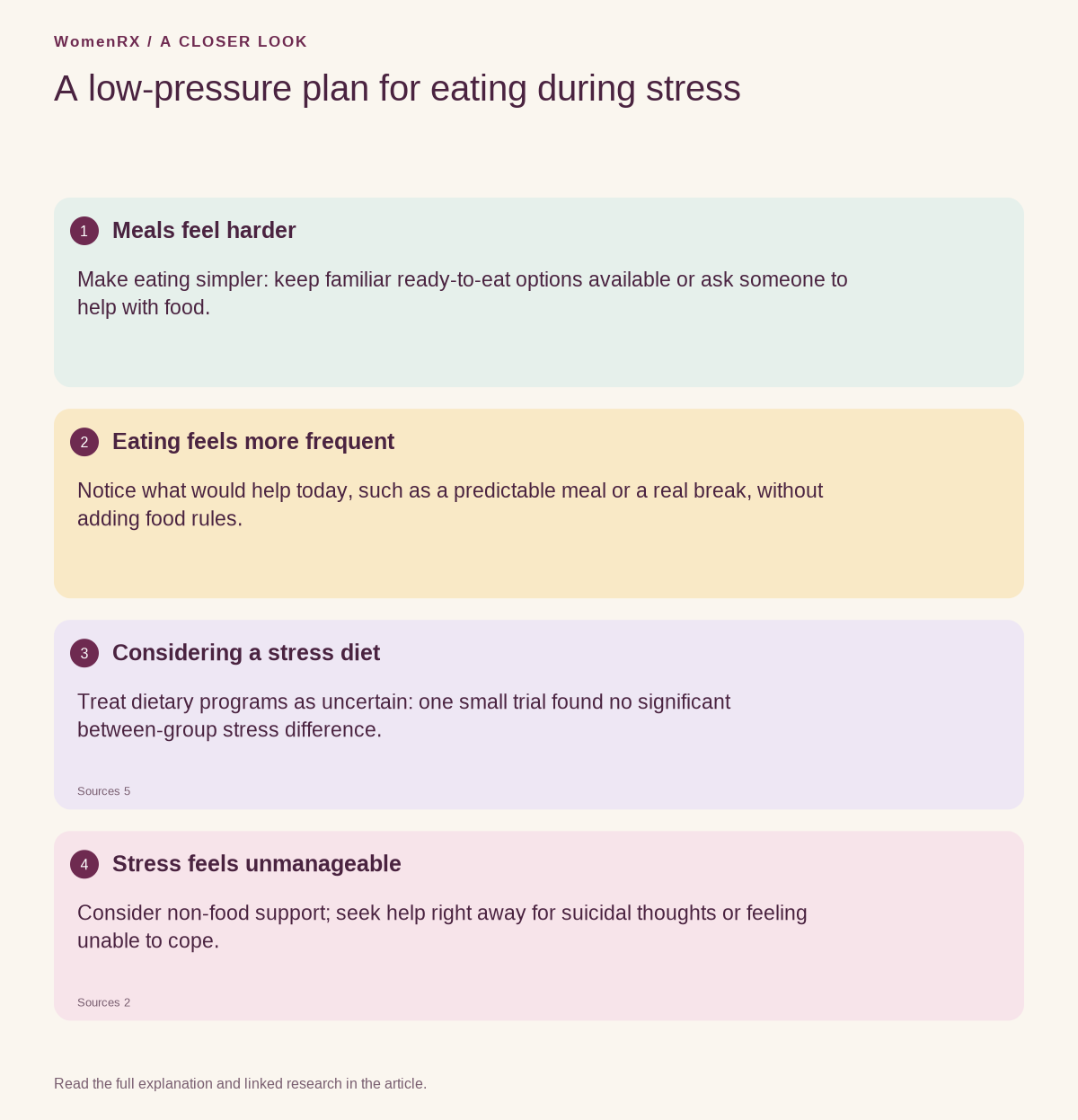
A low-pressure plan for eating during stress
Meals feel harder: Make eating simpler: keep familiar ready-to-eat options available or ask someone to help with food.
Eating feels more frequent: Notice what would help today, such as a predictable meal or a real break, without adding food rules.
Considering a stress diet: Treat dietary programs as uncertain: one small trial found no significant between-group stress difference.5
Stress feels unmanageable: Consider non-food support; seek help right away for suicidal thoughts or feeling unable to cope.2
Read the figure as text
Use the pattern you’re noticing to choose one manageable next step. These are practical options, not a validated test or a promise that food will reduce stress.- Meals feel harder: Make eating simpler: keep familiar ready-to-eat options available or ask someone to help with food.
- Eating feels more frequent: Notice what would help today, such as a predictable meal or a real break, without adding food rules.
- Considering a stress diet: Treat dietary programs as uncertain: one small trial found no significant between-group stress difference.5
- Stress feels unmanageable: Consider non-food support; seek help right away for suicidal thoughts or feeling unable to cope.2
More questions, answered
Is there a best food to lower stress?
These studies don’t establish a particular food as a reliable stress-lowering choice. A dietary program may also include cooking classes, group contact, or other changes, which makes it hard to credit any one food for the outcome. 4 5
Should I change my diet if stress changes how I eat?
You could start by making meals easier to manage rather than taking on a restrictive diet. If you’re losing weight without trying, seek an evaluation instead of assuming stress is the only cause. 1
Sources you can check
- Unintentional weight loss - NHSAccessed 2026-09-25Return to first citation
- Stress: MedlinePlusAccessed 2026-09-25Return to first citation
- Gene × cognition interaction on stress-induced eating: effect of rumination.Schepers R, Markus CR. · Psychoneuroendocrinology · 2015Return to first citation
- Influence of a Virtual Plant-Based Culinary Medicine Intervention on Mood, Stress, and Quality of Life Among Patients at Risk for Cardiovascular Disease.Krenek AM, Aggarwal M, Chung ST, Courville AB, Farmer N, Guo J, Mathews A. · Nutrients · 2025Return to first citation
- Feed your microbes to deal with stress: a psychobiotic diet impacts microbial stability and perceived stress in a healthy adult population.Berding K, Bastiaanssen TFS, Moloney GM, Boscaini S, Strain CR, Anesi A, Long-Smith C, Mattivi F, Stanton C, Clarke G, Dinan TG, Cryan JF. · Molecular psychiatry · 2023Return to first citation