Weight Management When Your Week Is Already Full
The best starting point is a change you can repeat, not a demanding plan that only fits an ideal week.
Choose one adjustment that removes a real obstacle: make a familiar meal easier to assemble, fit movement into time you already have, or look for support that suits your schedule. Lack of time is one of several barriers to lifestyle changes, so the most useful option depends on what is getting in your way. Make a smaller fallback for disrupted days. 3
Start with the bottleneck, not a perfect routine
A packed week doesn’t mean you lack motivation. In a systematic review of adults with obesity, lack of time was one of several barriers to lifestyle change, alongside health limitations, social pressures, mood, and financial constraints. The review recommends tailoring support to the barriers a person actually faces. 3
So ask: What tends to make a healthy choice harder this week? Is it not having food ready, having no predictable time to move, poor sleep, limited money, or a schedule that changes without warning? Choose a response to that specific problem. Eating patterns and physical activity are part of lifestyle approaches to weight management; sleep and stress can also relate to body weight. The scale alone doesn’t tell the whole story. 1 2
Paid work, caregiving, pregnancy or postpartum demands, disability, and access to affordable food or care may shape what’s realistic. Those are circumstances to plan around, not personal failings.
Compare options by effort, cost, and purpose
There’s no single best short habit for every crowded week. The comparisons below are practical examples, not measured clinical rankings. Your effort and cost may differ with your schedule, mobility, food access, and household needs. None of these options guarantees weight loss.
| Starting point | Effort and cost, as a practical estimate | What it may help address |
|---|---|---|
| Make one familiar meal easier to assemble | Little added cost if you use foods you already buy; some planning at the outset | A meal routine that feels hard to organize. Healthy eating patterns are one part of lifestyle approaches to weight management. 1 |
| Attach movement to an existing break or errand | May need no equipment or extra spending; depends on having a safe, accessible opportunity and on your mobility | Finding a way to include physical activity when a separate workout won’t fit. Activity is one part of a healthy lifestyle, not a guaranteed weight-loss dose. 1 |
| Choose a smaller fallback in advance | A little planning; typically no special purchase | Keeping a workable option available when a changing schedule disrupts your usual plan. This is a planning shortcut, not a weight-loss treatment. |
| Ask about structured support | Time and cost depend on what’s available and accessible to you | Getting help tailored to barriers or health needs. A small pilot of group visits for women with weight problems offers preliminary evidence about that format, not a guarantee of results. 4 |
For example, if you already have ingredients for a meal you like, setting them aside together may be easier and less costly than planning an entirely new menu. If you can walk safely and comfortably during a break or part of an errand, that may be simpler than finding a separate workout slot. If neither fits, a fallback or support option may be more relevant than trying harder at the same plan.
Cost and access can matter as much as time. In a qualitative study of 29 low-income women in Saudi Arabia, participants described time, cost, and limited availability of healthier options as barriers. Those findings illustrate how constraints can overlap; they don’t establish what every woman in the US experiences. 5
Make a fallback that survives a disrupted day
A useful fallback is smaller and easier than your usual plan, not an all-or-nothing substitute. Write it as a simple if-then: “If I can’t do my planned activity, I’ll take a short walk when an opening appears.” Or: “If cooking falls apart tonight, I’ll use the easy meal I chose ahead of time.” These are examples of planning, not evidence that a particular shortcut causes weight loss.
If even a small change keeps getting crowded out, that’s useful information. The barrier may be cost, pain, exhaustion, an inflexible schedule, or lack of support rather than a need for more discipline. Lifestyle programs often lose effectiveness when attendance or follow-through is difficult, and the review of adults with obesity identifies several barriers that may need to be addressed early. 3
When personal habits aren’t the whole answer
Weight can be affected by medical conditions and medicines, and obesity care may include nutrition and activity changes, counseling or support, medicines, or procedures, depending on a person’s health and circumstances. 1 If you’re spending effort on changes that don’t feel workable, you can ask what forms of weight-management support are available and whether any health or medication factors deserve attention. That can be a more useful next step than adding another demanding task to your week.
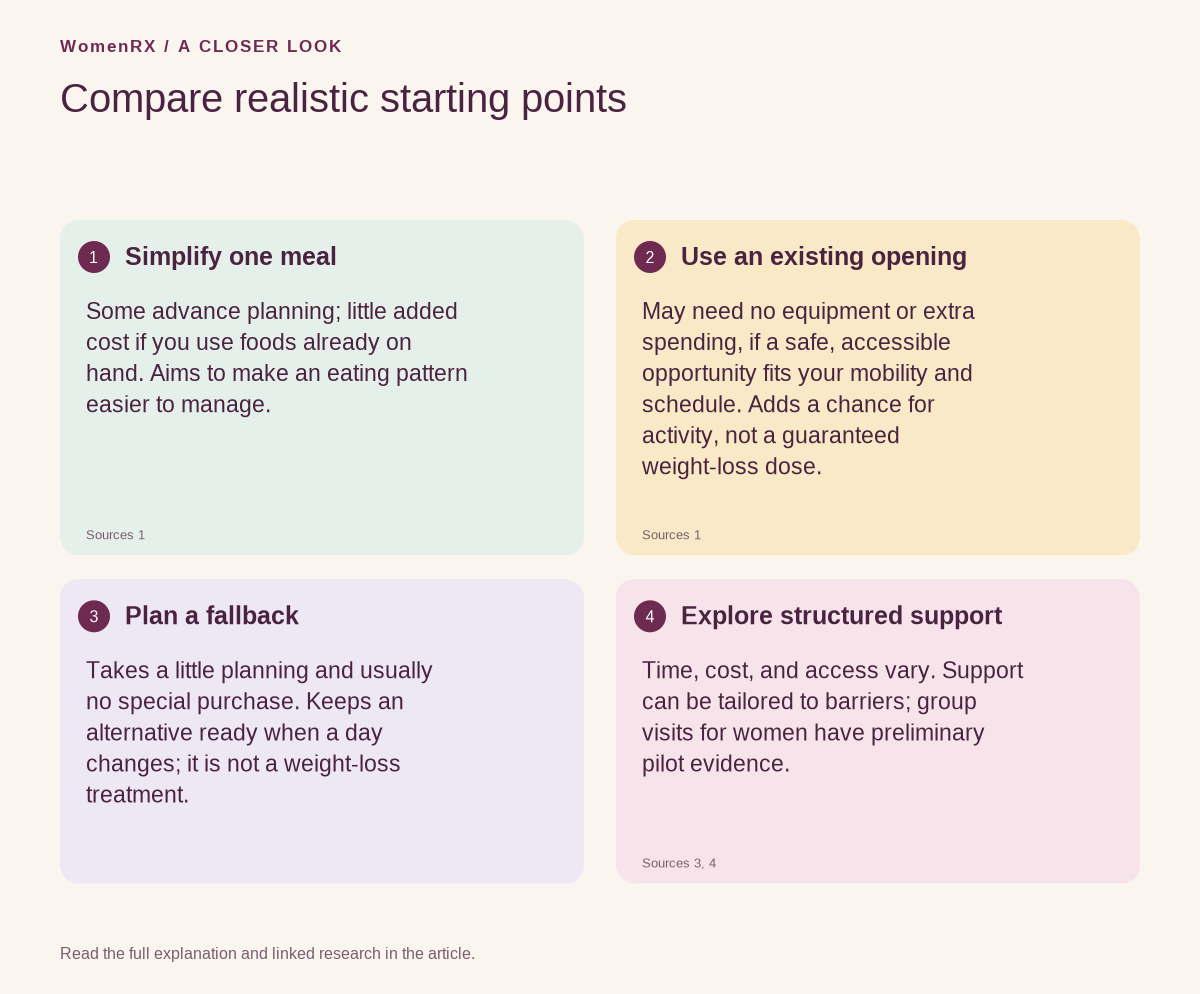
Compare realistic starting points
Simplify one meal: Some advance planning; little added cost if you use foods already on hand. Aims to make an eating pattern easier to manage.1
Use an existing opening: May need no equipment or extra spending, if a safe, accessible opportunity fits your mobility and schedule. Adds a chance for activity, not a guaranteed weight-loss dose.1
Plan a fallback: Takes a little planning and usually no special purchase. Keeps an alternative ready when a day changes; it is not a weight-loss treatment.
Explore structured support: Time, cost, and access vary. Support can be tailored to barriers; group visits for women have preliminary pilot evidence.34
Read the figure as text
Effort and cost are practical estimates that depend on your circumstances, not clinical rankings. Match the option to the barrier you want to reduce.- Simplify one meal: Some advance planning; little added cost if you use foods already on hand. Aims to make an eating pattern easier to manage.1
- Use an existing opening: May need no equipment or extra spending, if a safe, accessible opportunity fits your mobility and schedule. Adds a chance for activity, not a guaranteed weight-loss dose.1
- Plan a fallback: Takes a little planning and usually no special purchase. Keeps an alternative ready when a day changes; it is not a weight-loss treatment.
- Explore structured support: Time, cost, and access vary. Support can be tailored to barriers; group visits for women have preliminary pilot evidence.34
More questions, answered
Do a few minutes of activity guarantee weight loss?
No. Brief movement may be a practical way to fit activity into a busy day, but it shouldn’t be treated as a guaranteed weight-loss dose. Regular physical activity is one component of a healthy lifestyle. 1
What if I can’t keep up with a lifestyle program?
Time is only one possible barrier. Health limitations, mood, social pressures, and financial constraints can also affect participation, so a useful next step is to identify what is getting in the way and look for support designed around it. 3
Sources you can check
- Obesity: MedlinePlusAccessed 2026-09-25Return to first citation
- Body Weight: MedlinePlusAccessed 2026-09-25Return to first citation
- Determinants of adherence to lifestyle intervention in adults with obesity: a systematic review.Burgess E, Hassmén P, Pumpa KL. · Clinical obesity · 2017Return to first citation
- Family Physician-Led Group Visits for Lifestyle Modification in Women with Weight Problems: A Pilot Intervention and Follow-Up Study.Tunay M, Kurdak H, Özcan S, Özdemir Ç, Özer ZY. · Obesity facts · 2018Return to first citation
- Barriers and facilitators to adopting healthier lifestyle among low-income women in Saudi Arabia: A qualitative study.Alageel S, Alhujaili M, Altwaijri Y, Bilal L, Alsukait R. · Health expectations : an international journal of public participation in health care and health policy · 2023Return to first citation