A Flexible Plan for Health Goals That Last
You don’t need constant motivation: a small action, a realistic backup, and a kinder restart can make a health goal easier to return to.
Choose one specific behavior you can picture doing, then link it to a cue and decide on a smaller fallback for difficult days. Motivation is only one part of behavior: capability and opportunity matter too. 2 If you miss a day, treat it as information about the plan, not a verdict on you, and restart with the next available cue.
Make the goal an action, not a verdict
“Lose weight” is an outcome, not a daily instruction. Try choosing one behavior you can actually do, such as taking a short walk after lunch or adding a planned grocery stop to your week. These are examples, not rules. The useful question is: What is one action I’m willing and able to repeat in my current life?
A weight-management study using the COM-B framework describes behavior as the interaction of capability, opportunity, and motivation. In plain language, you need to be able to do the action, have a workable chance to do it, and have enough reason or readiness to try. In an observational study of 139 adults with overweight or obesity, self-efficacy was associated with measured COM-B domains related to behavior change. The study did not track whether participants’ behavior changed over time, so it can’t show that confidence causes lasting change. 2
That distinction matters. When a plan falls apart, the problem may not be weak motivation. The action might be too complicated, the timing might not work, or the needed time, food, space, or support may not be available.
Write a cue and a fallback
A brief plan can make a behavior more concrete. Fill in these lines:
- My action: What small behavior am I trying?
- My cue: When or where will I try it?
- My fallback: What is a smaller version for a difficult day?
- My barrier: What is most likely to get in the way?
For example: “After I get home from my shift, I’ll walk for a few minutes. If I’m exhausted, I’ll stretch at home instead.” The fallback is not a failure or a promise to do the full version later. It gives you a way to keep the behavior connected to a cue when the original plan doesn’t fit.
Action planning and coping planning were part of an intervention studied in people who had undergone bariatric surgery. The trial reported improvements in some planning and self-efficacy measures, but coping-planning scores did not significantly increase. That’s a specific population and setting, and the trial does not establish that a fallback plan improves adherence or produces weight loss for everyone. Planning for an obstacle here is a practical suggestion, not an effect demonstrated by that trial. 3
Check the barrier before blaming yourself
If the action repeatedly doesn’t happen, ask which part of the plan needs attention:
- Capability: Is the action too big, unclear, or difficult right now?
- Opportunity: Does the timing, location, cost, or available support make it hard to do?
- Motivation: Does this action still feel worthwhile, or would another small behavior matter more to you?
These questions follow the COM-B framework. They’re a way to examine the plan, not a test you can pass or fail. 2
The details of a realistic plan will differ. For example, a caregiver might choose an action that fits into an existing errand; someone working shifts might tie it to waking rather than a fixed clock time. Pregnancy or postpartum recovery can bring changing demands and capacity, which may affect what feels workable at a given time. If menopause symptoms make a particular day harder, a smaller fallback may fit better than insisting on the original plan. These are illustrations, not assumptions about what every woman experiences.
Restart at the next useful cue
A missed day doesn’t erase the days you did the behavior. Instead of waiting for Monday or a burst of motivation, use the next suitable cue. If the same barrier keeps appearing, adjust the action, cue, or fallback. The aim is not to prove you can follow a perfect schedule; it’s to make the plan workable enough to return to.
You can also build confidence by making the first version small enough to try. Self-efficacy is about believing you can carry out a specific behavior, not feeling confident about every aspect of weight management. In an observational study of adults with overweight or obesity, self-efficacy was associated with measured COM-B domains related to behavior change. That finding doesn’t show that confidence caused behavior change or guarantees a particular outcome. 2
Notice progress beyond the scale
Weight can be one piece of information, but it can’t tell the whole story: it includes muscle, bone, fat, and water, and everyday factors can affect it. 1 You might also notice whether you carried out the action you chose, whether your fallback helped you restart, or whether the behavior feels more manageable. These are personal ways to track your routine, not clinical measures or promises of weight change.
A scale can’t tell you whether a plan fits your life. A useful goal should leave room for adjustment, including when your schedule, capacity, or priorities change.
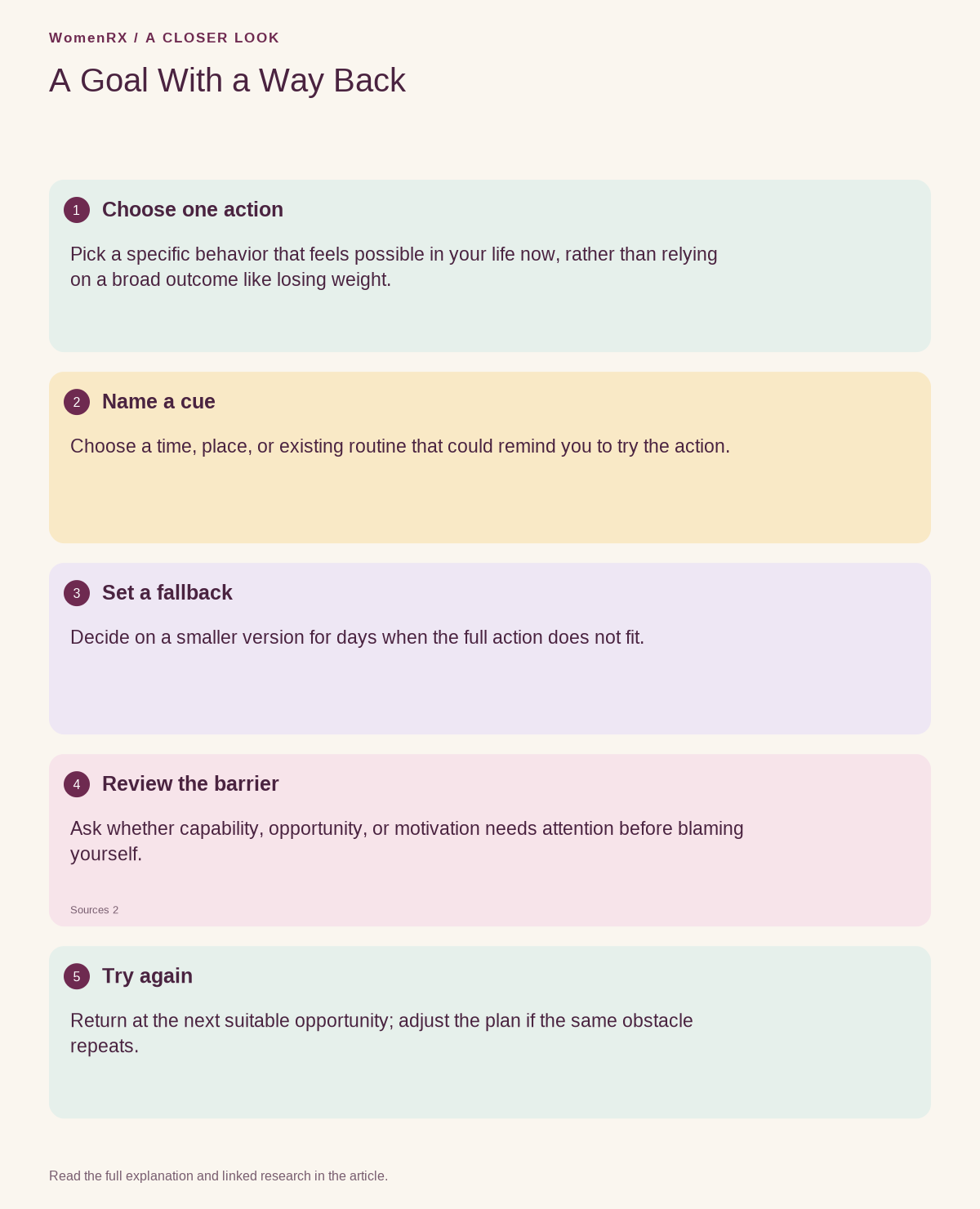
A Goal With a Way Back
Choose one action: Pick a specific behavior that feels possible in your life now, rather than relying on a broad outcome like losing weight.
Name a cue: Choose a time, place, or existing routine that could remind you to try the action.
Set a fallback: Decide on a smaller version for days when the full action does not fit.
Review the barrier: Ask whether capability, opportunity, or motivation needs attention before blaming yourself.2
Try again: Return at the next suitable opportunity; adjust the plan if the same obstacle repeats.
Read the figure as text
A practical sequence for making a health goal more workable. The specific cue, fallback, and restart steps are an editorial planning aid, not tactics proven by the cited studies.- Choose one action: Pick a specific behavior that feels possible in your life now, rather than relying on a broad outcome like losing weight.
- Name a cue: Choose a time, place, or existing routine that could remind you to try the action.
- Set a fallback: Decide on a smaller version for days when the full action does not fit.
- Review the barrier: Ask whether capability, opportunity, or motivation needs attention before blaming yourself.2
- Try again: Return at the next suitable opportunity; adjust the plan if the same obstacle repeats.
More questions, answered
What if I keep losing motivation?
Check whether the action is too difficult or whether something about its timing or setting makes it hard to do. Motivation is only one part of behavior; capability and opportunity matter too. Try revising the plan before deciding you’ve failed. 2
Does a small behavior guarantee weight loss?
No. A small action can make a health routine more manageable, but these behavior-planning approaches do not guarantee a particular change on the scale. Weight is only one part of the picture. 1 3
Sources you can check
- Body Weight: MedlinePlusAccessed 2026-09-25Return to first citation
- Facilitators and barriers to behavior change in overweight and obesity management using the COM-B model.Timkova V, Minarikova D, Fabryova L, Buckova J, Minarik P, Katreniakova Z, Nagyova I. · Frontiers in psychology · 2024Return to first citation
- Effectiveness of an intervention designed based on the Health Action Process Approach on obesity surgery outcomes in patients who have undergone bariatric surgery after one year: A randomized controlled trial.Maghsoodlo M, Shakibazadeh E, Yaseri M, Mokhtari Z, Barzin M, Salimi Y. · PloS one · 2025Return to first citation