Can Oily Fish or Omega-3s Help With Menopause?
A small postmenopausal trial found a difference in overall symptom scores with an omega-3 supplement, but that result alone doesn’t show how large or noticeable the change was.
One 12-week trial in postmenopausal women found a statistically significant difference in overall menopause-symptom scores between an omega-3 supplement and placebo. That overall-score comparison doesn’t establish how large or noticeable the change was, or whether a particular symptom such as hot flashes improved. The trial tested a supplement, not eating oily fish. Research on mood is suggestive but mixed, and heart-health findings answer a different question. 3 4 1
First, separate the fish from the capsule
Salmon, herring, sardines, mackerel, and some tuna contain the long-chain omega-3 fats EPA and DHA. Fish oil and algal oil supplements can provide these fats too. But a capsule study can’t tell you whether a meal of fish changes menopause symptoms. The amount of omega-3 in fish varies, and seafood contains components other than omega-3s. What it replaces in your usual meals may matter as well. 1
That distinction is useful if you already enjoy oily fish. You can choose it as food without expecting it to work like a tested hot-flash treatment. And if you’re considering a supplement specifically for symptoms, the relevant question is what supplement trials measured, not whether fish is generally considered a nutritious choice.
What the menopause-symptom trial found
In a randomized, double-blind trial, 180 postmenopausal women were assigned to an omega-3 supplement, a soybean supplement, or placebo, with 60 in each group, for 12 weeks. The primary outcome was an overall Menopause Rating Scale score. Researchers reported a statistically significant difference between the omega-3 and placebo groups in a post-hoc comparison; the omega-3 and soybean groups did not differ significantly. 3
That’s a reason to keep studying omega-3s, not a reliable prediction that a capsule will stop your hot flashes. A statistically significant overall-score comparison doesn’t, by itself, tell you how large or noticeable a change was, or show how much any particular symptom changed. It can’t establish a hot-flash, sleep, or vaginal-symptom benefit on its own. These participants were postmenopausal; the result also doesn’t establish an effect during perimenopause. 3
If hot flashes or night sweats are disrupting your life, you don’t have to wait on omega-3 research to discuss treatments with stronger symptom evidence. The North American Menopause Society identifies hormone therapy as the most effective treatment for vasomotor symptoms, while emphasizing that its benefits and risks depend on the woman and the treatment. 2
Mood and brain fog are separate questions
A review of omega-3s and emotional or cognitive outcomes around menopause included 11 human studies and six animal studies. It found that many studies linked omega-3 intake with fewer depressive symptoms, but human findings for anxiety and cognition were inconsistent. Results in animals can’t establish that omega-3s improve brain fog or anxiety in women. 4
Another review pooled trials of many different nutritional interventions for depression and anxiety during the menopausal transition and menopause. Its overall results favored nutritional interventions, but the approaches varied substantially; one study paired omega-3 with exercise. The pooled result therefore doesn’t isolate what omega-3 alone might do. 5
If mood is your main concern, that leaves room for interest in the research, but not a clear case for choosing fish oil as a mood treatment. It’s also worth keeping the life stage straight: a finding in postmenopausal women need not describe what happens during the more changeable perimenopausal years. 3 4
Heart-health results aren’t symptom results
Studies of seafood and cardiovascular health often get folded into claims about menopause. Observational links between eating fish and better health can’t reliably tell whether omega-3s caused the difference: other parts of the meal, foods seafood replaced, and related habits may contribute. 1
Supplement trials ask a different question. VITAL included men aged 50 and older and women aged 55 and older; it wasn’t a menopause-symptom trial. An omega-3 supplement did not significantly reduce the combined outcome of heart attack, stroke, and cardiovascular death over a median 5.3 years. The trial did report a 28% relative reduction in total heart attacks among participants taking the supplement. Those are cardiovascular findings, not evidence that a supplement relieves hot flashes, and the combined cardiovascular result should not be described as a clear overall benefit. 1
What a supplement label can tell you
The word “omega-3” doesn’t identify a single formulation. Fish oil and algal oil can supply EPA or DHA; cod liver oil also supplies vitamins A and D. A number on the front describing fish oil isn’t necessarily the amount of EPA and DHA inside. These label distinctions don’t establish symptom benefit or tell you whether a product is safe alongside your medications. 1
Safety findings depend on the product and how it was studied. In STRENGTH, a cardiovascular trial of people at high risk, the group taking a concentrated prescription EPA-and-DHA product had more atrial fibrillation than the placebo group. The trial did not find a significant reduction in its combined cardiovascular outcome. That result is worth knowing, but it doesn’t tell us the risk from an ordinary fish meal or every over-the-counter capsule. 1
Fish and supplements differ in another way: seafood contains varying amounts of methylmercury, while omega-3 supplements have not been found to contain it because processing removes the contaminant. Neither that distinction nor an EPA/DHA amount on a label answers whether a particular supplement fits with medicines you take. If you’re considering capsules and take medication, bring the exact product and your medication list to a pharmacist for an interaction check. 1
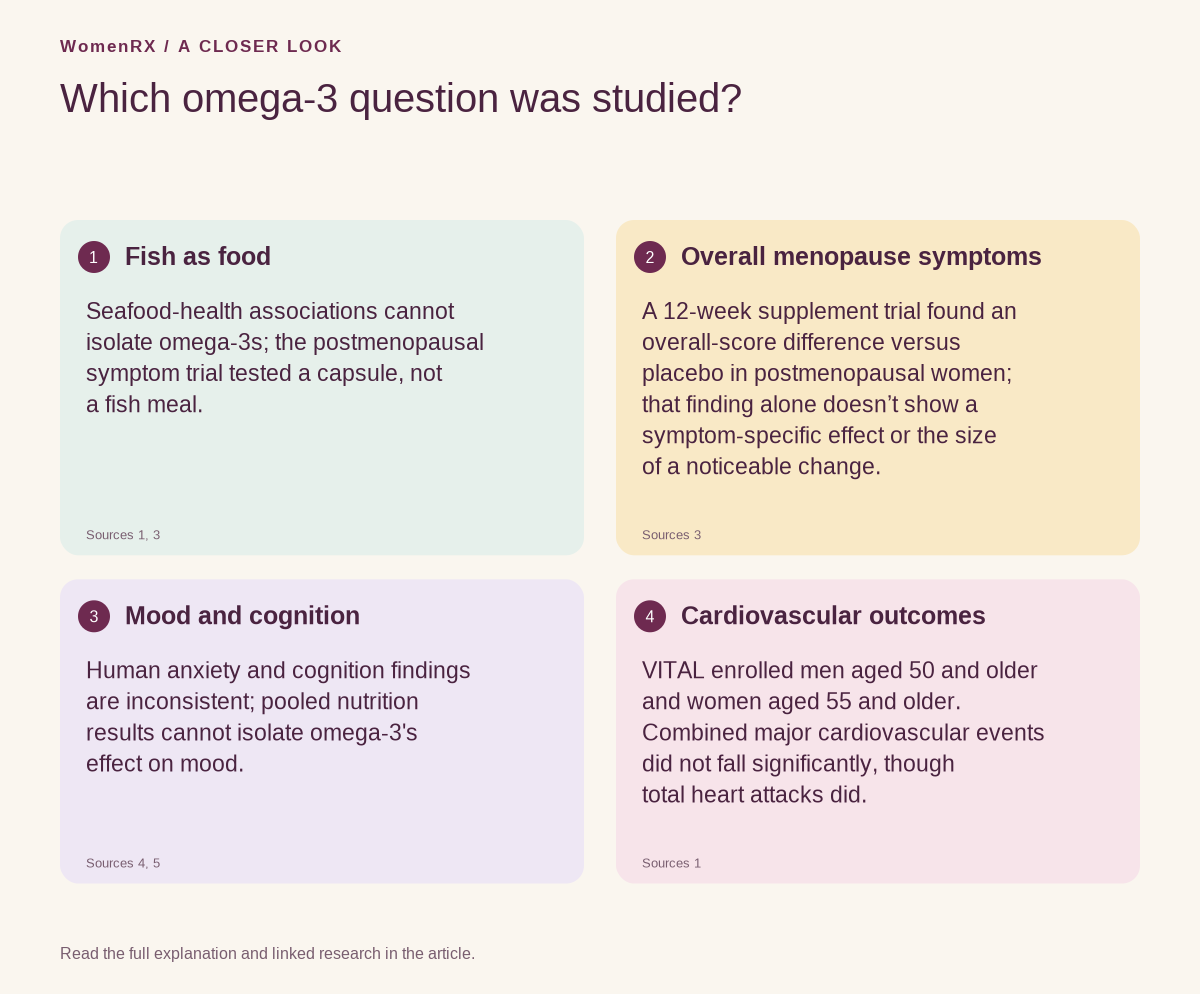
Which omega-3 question was studied?
Fish as food: Seafood-health associations cannot isolate omega-3s; the postmenopausal symptom trial tested a capsule, not a fish meal.13
Overall menopause symptoms: A 12-week supplement trial found an overall-score difference versus placebo in postmenopausal women; that finding alone doesn’t show a symptom-specific effect or the size of a noticeable change.3
Mood and cognition: Human anxiety and cognition findings are inconsistent; pooled nutrition results cannot isolate omega-3's effect on mood.45
Cardiovascular outcomes: VITAL enrolled men aged 50 and older and women aged 55 and older. Combined major cardiovascular events did not fall significantly, though total heart attacks did.1
Read the figure as text
The result changes meaning when the exposure, population, or outcome changes.- Fish as food: Seafood-health associations cannot isolate omega-3s; the postmenopausal symptom trial tested a capsule, not a fish meal.13
- Overall menopause symptoms: A 12-week supplement trial found an overall-score difference versus placebo in postmenopausal women; that finding alone doesn’t show a symptom-specific effect or the size of a noticeable change.3
- Mood and cognition: Human anxiety and cognition findings are inconsistent; pooled nutrition results cannot isolate omega-3's effect on mood.45
- Cardiovascular outcomes: VITAL enrolled men aged 50 and older and women aged 55 and older. Combined major cardiovascular events did not fall significantly, though total heart attacks did.1
Sources you can check
- Omega-3 Fatty Acids - Health Professional Fact SheetAccessed 2026-09-25Return to first citation
- The 2022 hormone therapy position statement of The North American Menopause Society.“The 2022 Hormone Therapy Position Statement of The North American Menopause Society” Advisory Panel. · Menopause (New York, N.Y.) · 2022Return to first citation
- The comparison of the effect of soybean and fish oil on supplementation on menopausal symptoms in postmenopausal women: A randomized, double-blind, placebo-controlled trial.Purzand B, Rokhgireh S, Shabani Zanjani M, Eshraghi N, Mohamadianamiri M, Esmailzadeh A, Alkatout I, Gitas G, Allahqoli L. · Complementary therapies in clinical practice · 2020Return to first citation
- n-3 PUFA Improve Emotion and Cognition during Menopause: A Systematic Review.Decandia D, Landolfo E, Sacchetti S, Gelfo F, Petrosini L, Cutuli D. · Nutrients · 2022Return to first citation
- Effects of nutritional interventions on the severity of depressive and anxiety symptoms of women in the menopausal transition and menopause: a systematic review, meta-analysis, and meta-regression.Grigolon RB, Ceolin G, Deng Y, Bambokian A, Koning E, Fabe J, Lima M, Gerchman F, Soares CN, Brietzke E, Gomes FA. · Menopause (New York, N.Y.) · 2023Return to first citation