Salmon: Protein, Omega-3s, and Which Type to Choose
Salmon brings protein and omega-3 fats to the table, but the choice depends on how it’s prepared and whether you’re pregnant.
Salmon provides protein and the omega-3 fats EPA and DHA. A 3-ounce portion of cooked, farmed Atlantic salmon has about 19 grams of protein. Canned salmon is convenient; smoked salmon may have more sodium, so compare labels. The FDA/EPA weekly fish target applies to pregnancy and breastfeeding, not every adult. Check local advisories for fish caught by family or friends. 14568
What you get from a serving
Salmon earns its place in a meal for two straightforward reasons: it supplies protein, and, as a fatty fish, it supplies EPA and DHA, the long-chain omega-3 fats found in fish. Protein helps your body build and maintain muscle, bones, and skin. The amount of omega-3 in salmon varies, including with what the fish ate, so one nutrition number won’t describe every fillet. 12
For a concrete example, USDA reference data put 3 ounces (85 grams) of farmed Atlantic salmon cooked with dry heat at about 175 calories, 19 grams of protein, and 10.5 grams of fat. That’s a description of one cooked food, not a target portion or a promise about the package in your cart. 4
What about the heart-health reputation? EPA and DHA have been studied extensively. Research on omega-3 supplements has had mixed cardiovascular results, but those trials don’t establish whether eating salmon as part of a meal changes the risk of a heart attack or stroke. Choose it because it’s a useful food you enjoy, not because a supplement result promises an outcome from a salmon dinner. 1
Fresh, canned, or smoked: what changes?
All three can provide protein. To make the differences visible, USDA reference entries list per 100 grams of cooked farmed Atlantic salmon, canned sockeye salmon with the liquid drained, and smoked chinook salmon, respectively: 22.1, 23.6, and 18.3 grams of protein. Their listed sodium amounts are 61, 408, and 672 milligrams per 100 grams. These are different species as well as different preparations, so the numbers don’t show what canning or smoking alone does to the same fish. They also aren’t current product labels. 5
That gives you a practical way to shop. If you’re choosing canned or smoked salmon and sodium matters to you, compare the labels on the products you’re actually buying rather than assuming every can or smoked package matches a reference entry. Canned salmon is still a protein choice, and research on selected canned fish in brine found that its fatty-acid composition was similar to fresh fish. That study doesn’t establish the EPA and DHA content of every canned salmon product. 53
For fresh or thawed salmon, keep raw-fish utensils and surfaces separate from ready-to-eat food, and cook the fish thoroughly. CDC gives 145°F, or flesh that is opaque and separates easily with a fork, as its cooking guidance. Smoking isn’t a substitute for checking whether a product needs refrigeration or further cooking, especially during pregnancy. 87
How often should you serve it?
There isn’t a salmon-specific weekly target in the FDA/EPA advice below. Its 8-to-12-ounce recommendation is for a variety of lower-mercury fish during pregnancy or breastfeeding, not an amount of salmon for every adult to eat. If that guidance doesn’t apply to you, choose how often salmon fits your meals rather than treating the pregnancy target as your quota. If the fish was caught by family or friends, check advisories for the waters where it was caught. 68
If you’re pregnant or breastfeeding
The fish-frequency advice here is for a particular life stage, not a rule to apply to everyone. FDA and EPA advise people who are pregnant or breastfeeding to eat 8 to 12 ounces a week of a variety of lower-mercury fish. Salmon is on their “Best Choices” list. The point is to include suitable fish while limiting mercury exposure, not to eat all of that weekly amount as salmon. 86
Fish caught by family or friends needs an extra check: look for an advisory for the place it was caught. Under FDA and EPA guidance for this group, if there’s no advisory, eat one serving of that fish and no other fish that week. A store-bought salmon label doesn’t answer a question about contaminants in a locally caught fish. 68
Pregnancy also changes the smoked-salmon decision for a reason separate from mercury. CDC lists refrigerated smoked seafood, including products labeled “lox” or “nova-style,” among foods to avoid during pregnancy unless it’s in a cooked dish. Canned fish and shelf-stable smoked seafood in sealed packaging are listed as safer choices. These pregnancy food-safety precautions shouldn’t be silently extended to breastfeeding; the pregnancy-and-breastfeeding fish guidance above addresses fish choice and mercury. 78
For an everyday decision, start with the form you’ll use: a cooked fillet for a meal, canned salmon when convenience helps, or smoked salmon when its label and food-safety considerations fit your situation. Check the product label for sodium, and check the catch location if the fish came from local waters. Those details tell you more than a blanket claim that one kind of salmon is always best. 567
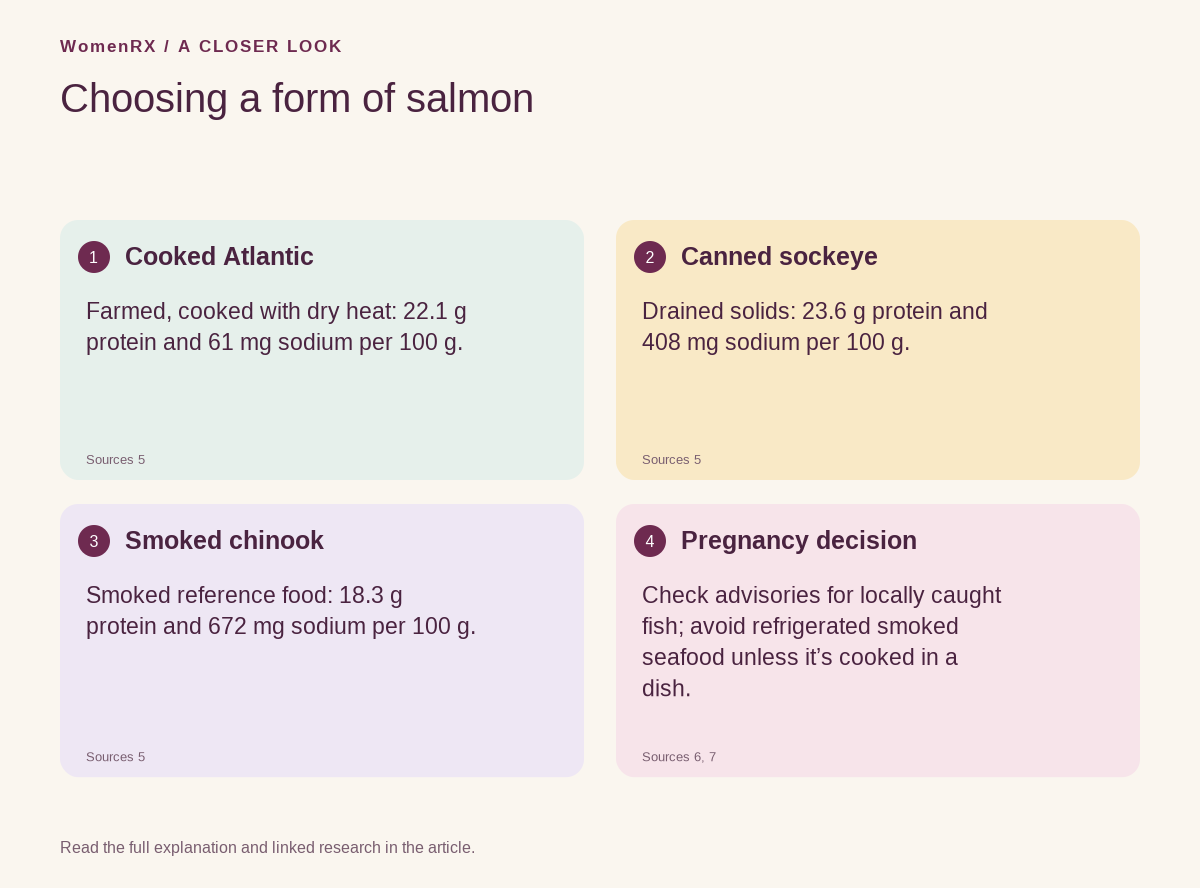
Choosing a form of salmon
Cooked Atlantic: Farmed, cooked with dry heat: 22.1 g protein and 61 mg sodium per 100 g.5
Canned sockeye: Drained solids: 23.6 g protein and 408 mg sodium per 100 g.5
Smoked chinook: Smoked reference food: 18.3 g protein and 672 mg sodium per 100 g.5
Pregnancy decision: Check advisories for locally caught fish; avoid refrigerated smoked seafood unless it’s cooked in a dish.67
Read the figure as text
These are different reference foods, not the same salmon tested after three processing methods.- Cooked Atlantic: Farmed, cooked with dry heat: 22.1 g protein and 61 mg sodium per 100 g.5
- Canned sockeye: Drained solids: 23.6 g protein and 408 mg sodium per 100 g.5
- Smoked chinook: Smoked reference food: 18.3 g protein and 672 mg sodium per 100 g.5
- Pregnancy decision: Check advisories for locally caught fish; avoid refrigerated smoked seafood unless it’s cooked in a dish.67
Sources you can check
- Omega-3 Fatty Acids - Health Professional Fact SheetAccessed 2026-09-25Return to first citation
- Dietary Proteins: MedlinePlusAccessed 2026-09-25Return to first citation
- Canned Fish in Brine-Variability in Macronutrient and Fatty Acid Composition.Chrpová D, Ilko V, Růžičková M, Potůčková M, Kouřimská L, Kohout P, Pánek J, Doležal M. · Biology · 2026Return to first citation
- USDA SR Legacy: Fish, salmon, Atlantic, farmed, cooked, dry heat (FDC 175168)Accessed 2026-09-25Return to first citation
- USDA SR Legacy: salmon reference food comparisonAccessed 2026-09-25Return to first citation
- Advice about Eating Fish | FDAAccessed 2026-09-25Return to first citation
- Safer Food Choices for Pregnant Women | Food Safety | CDCAccessed 2026-09-25Return to first citation
- Selecting and Serving Fresh and Frozen Seafood Safely | FDAAccessed 2026-09-25Return to first citation