Omega-3 Supplements for Skin: What the Evidence Shows
Possible benefits are condition-specific, and evidence for everyday dryness or better-looking skin is much thinner than broad “skin health” claims suggest.
Omega-3 supplements aren’t a proven all-purpose fix for dry, inflamed, or aging skin. Research on inflammatory skin conditions is mixed, and a promising trial in children tested omega-3s alongside other ingredients, so it can’t show that omega-3 alone caused the improvement. Topical products are a separate question: much of their evidence comes from skin models, not established clinical treatments. 2 3 4
Start with the skin concern, not the supplement claim
Omega-3s include several fatty acids, including ALA, EPA, and DHA. They’re involved in processes related to inflammation, which gives researchers a reason to study them in skin conditions. But a plausible mechanism doesn’t tell you whether a capsule will improve a particular symptom, or how much improvement to expect. 1 2 4
That distinction matters because “skin health” can mean very different things: eczema itch, psoriasis plaques, acne breakouts, ordinary dryness, or appearance changes associated with aging. Evidence for one concern doesn’t automatically apply to the others.
For inflammatory conditions, results are still uncertain
Atopic dermatitis (eczema) and psoriasis have been studied as inflammatory conditions, but findings from omega-3 research aren’t consistent. A 2025 systematic review covered inflammatory skin diseases including atopic dermatitis, psoriasis, and acne. It described some promising intervention findings, while also emphasizing limited human evidence, small studies, varied methods, and outcomes that aren’t always standardized. That makes it hard to know who might benefit or how reliably. 4
One randomized trial offers a useful example of why the details matter. It studied 52 children with atopic dermatitis. The active product combined fish-oil omega-3s with gamma-linolenic acid from blackcurrant seed oil and vitamin D. Symptoms improved during the trial, but because the ingredients were combined, the results don’t establish that omega-3 alone produced the change. The study was in children, and it doesn’t tell us whether women respond differently. 3
For acne, the review included research on the condition, but its overall conclusion was that the evidence base remains limited and heterogeneous. Current evidence doesn’t establish omega-3 supplements as a reliable acne treatment. If breakouts seem to track your menstrual cycle, that pattern alone doesn’t tell you whether omega-3s will help; the evidence cited here doesn’t establish a benefit specifically for cycle-related acne. 4
Dryness and appearance are different claims
Severe essential-fatty-acid deficiency can cause rough, scaly skin and dermatitis. That is not the same as showing that extra omega-3 improves common dry skin in someone who isn’t deficient. The NIH Office of Dietary Supplements notes that classical essential-fatty-acid deficiency is virtually nonexistent in healthy people in the United States. 1
The findings discussed here don’t establish that omega-3 supplements make skin look younger, clearer, or more hydrated in otherwise healthy adults. If your main concern is ordinary dryness or appearance, don’t assume a supplement will address it just because omega-3s are involved in inflammatory pathways. 1 4
A capsule and a topical product aren’t interchangeable
Oral supplements and products applied to the skin deliver omega-3s by different routes, so results from one can’t simply be transferred to the other. A systematic review of topical omega-3s found beneficial effects in skin models involving conditions such as psoriasis, wounds, and dermatitis. The review also said that more clinical studies are needed and that there isn’t agreement on the best molecules, formulation, or delivery method. Those findings make topical omega-3s an area of investigation, not an established stand-alone treatment. 2
For oral products, formulations vary. The NIH fact sheet describes fish oil, krill oil, cod liver oil, and algal-oil products as sources of long-chain omega-3s, and notes that labels can differ in the types and amounts they contain. That variation is another reason a result from one specific product or combination may not apply to every supplement. 1
What’s a reasonable takeaway?
If you’re considering omega-3s for a specific skin problem, ask what outcome you’re hoping for and whether the evidence tested that same concern, route, and product. For eczema, psoriasis, or acne, research on these conditions is not strong enough to promise a dependable benefit from an oral supplement. For everyday dryness or general appearance, the findings above don’t establish a benefit. 1 2 4
These studies also don’t provide a reliable women-specific estimate of benefit. One relevant clinical trial studied children, while the broader evidence cited here doesn’t establish a distinct effect for women or for skin changes tied to hormonal cycles. A supplement may be a personal choice, but it shouldn’t be mistaken for a proven skin treatment or a substitute for care that’s working for your condition. 3 4
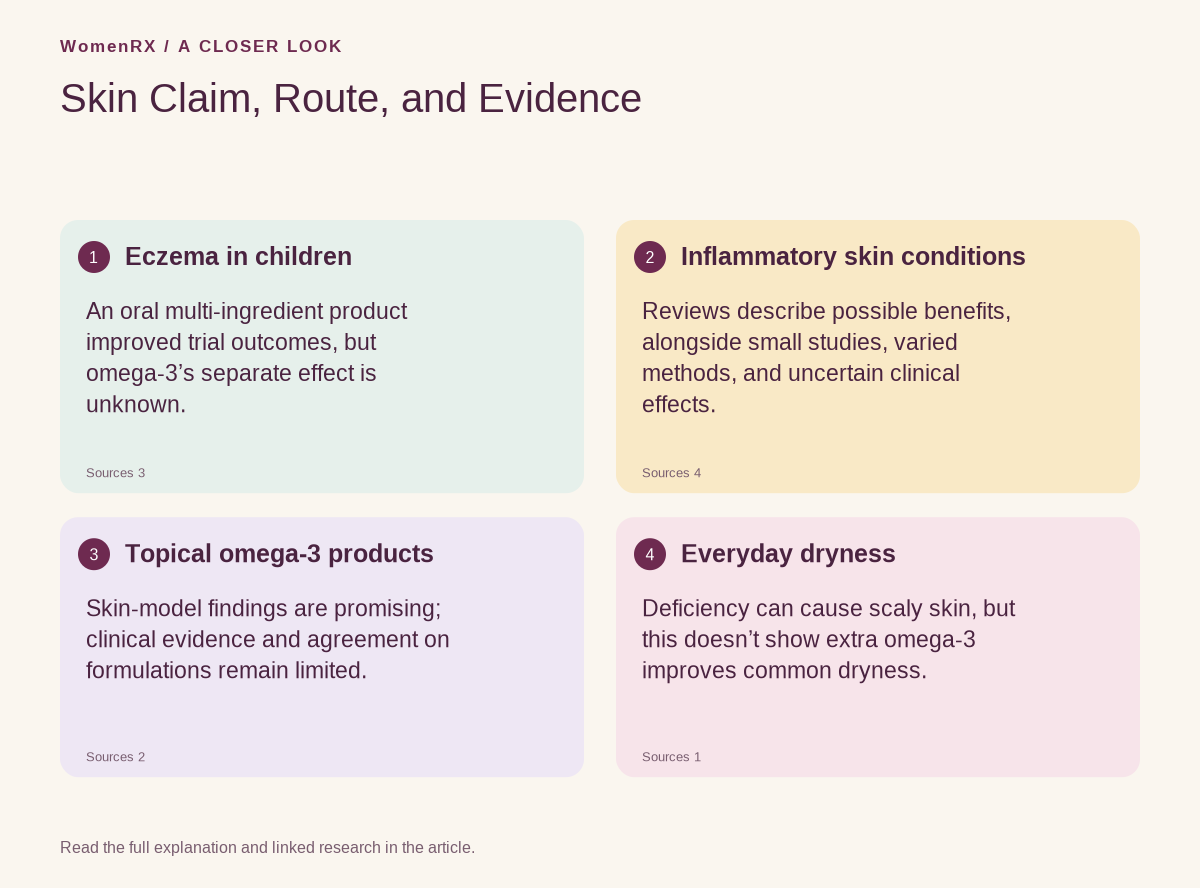
Skin Claim, Route, and Evidence
Eczema in children: An oral multi-ingredient product improved trial outcomes, but omega-3’s separate effect is unknown.3
Inflammatory skin conditions: Reviews describe possible benefits, alongside small studies, varied methods, and uncertain clinical effects.4
Topical omega-3 products: Skin-model findings are promising; clinical evidence and agreement on formulations remain limited.2
Everyday dryness: Deficiency can cause scaly skin, but this doesn’t show extra omega-3 improves common dryness.1
Read the figure as text
Compare the skin concern with the route actually studied and what the evidence can support.- Eczema in children: An oral multi-ingredient product improved trial outcomes, but omega-3’s separate effect is unknown.3
- Inflammatory skin conditions: Reviews describe possible benefits, alongside small studies, varied methods, and uncertain clinical effects.4
- Topical omega-3 products: Skin-model findings are promising; clinical evidence and agreement on formulations remain limited.2
- Everyday dryness: Deficiency can cause scaly skin, but this doesn’t show extra omega-3 improves common dryness.1
More questions, answered
Does a skin benefit from omega-3 mean I should take more?
Not necessarily. Skin studies don’t establish a general-purpose dose, and the products and combinations studied vary. The NIH fact sheet also notes that supplement formulations differ, so check what a product contains rather than assuming all omega-3 supplements are equivalent. 1 4
Is there evidence that omega-3 helps women’s hormone-related skin changes?
The eczema trial involved children. The evidence cited here doesn’t establish a separate benefit for women or for cycle-related acne. A pattern around your cycle doesn’t tell you whether a supplement will work for that concern. 3 4
Sources you can check
- Omega-3 Fatty Acids - Health Professional Fact SheetAccessed 2026-09-25Return to first citation
- Therapeutic Benefits of Topical Omega-3 Polyunsaturated Fatty Acids in Skin Diseases and Cosmetics: An Updated Systematic Review.Mateu-Arrom L, Mora I, Garrote L. · Journal of cosmetic dermatology · 2025Return to first citation
- Effect of Omega-3 Polyunsaturated Fatty Acid Supplementation on Clinical Outcome of Atopic Dermatitis in Children.Niseteo T, Hojsak I, Ožanić Bulić S, Pustišek N. · Nutrients · 2024Return to first citation
- Specialized Pro-Resolving Lipid Mediators and Dietary Omega-3/6 Fatty Acids in Selected Inflammatory Skin Diseases: A Systematic Review.Biełach-Bazyluk A, Jakubowicz-Zalewska O, Myśliwiec H, Flisiak I. · Antioxidants (Basel, Switzerland) · 2025Return to first citation