Omega-3 for Depression: What It May and May Not Do
Omega-3 has some promising depression-treatment findings, but the evidence is mixed and doesn’t show that it can replace established care or prevent depression.
Omega-3 supplements may help some adults with diagnosed depression, but results vary, and a small trial of omega-3 alone isn’t enough to make it a dependable stand-alone treatment. Research on adding it to other depression care is also mixed. The adult findings don’t establish a separate benefit for women, or answer whether omega-3 treats perinatal depression, PMDD, or prevents depression. 4 5
Omega-3 supplements are not a proven all-purpose mood booster. For adults with diagnosed major depression, some studies suggest a benefit, but results differ across trials. That makes omega-3 a possible topic to discuss as an add-on to care, not a reason to stop or delay treatment that’s helping you.
Treatment, add-on, and prevention are different questions
A supplement can be studied on its own, alongside treatment, or as a way to prevent a condition. Evidence for one use doesn’t establish the others.
For treatment, a 2023 review of meta-analyses of randomized trials found that omega-3 showed mostly small to medium effects in adults with major depressive disorder. But results varied substantially, some meta-analyses did not find a significant benefit, and the reviewers said the evidence did not support clear treatment recommendations. 4
A 2024 randomized, double-blind pilot trial tested omega-3 alone in 60 adults with major depression over 12 weeks. The group taking omega-3 had lower depression-rating scores than the placebo group at several follow-ups. At week 12, however, differences in remission and response rates were not statistically significant. One small trial is a signal worth studying, not proof that a supplement can reliably treat depression on its own. 5
Adding omega-3 to other care is another possibility, but it shouldn’t be treated as a settled solution. Research reviews describe mixed findings and substantial differences among studies, including the types of participants, supplement formulations, and whether supplements were used alone or alongside other treatment. 4 6 The practical tradeoff is that trying a supplement without coordination could distract from care with clearer evidence. Keep taking prescribed medication as directed unless the person who prescribed it helps you make a change.
Prevention is different again. Treatment studies in people who already have depression don’t show that taking omega-3 prevents depression. Don’t start a supplement on the assumption that it will prevent a future episode. 4 5
What changes for women?
The adult depression findings don’t establish a separate effect for women. They also don’t tell us whether results apply during pregnancy or after birth. Those are distinct periods, and general adult trial results shouldn’t be assumed to apply to perinatal depression.
Perinatal depression can begin during pregnancy or after childbirth. Treatment may include medication and talk therapy; if you’re breastfeeding, tell your care team so they can consider that when discussing treatment. Omega-3 shouldn’t take the place of that conversation or established care. 2
There’s also a difference between general premenstrual symptoms and PMDD, which can cause severe emotional and physical symptoms that recur before a period and disrupt daily life. One review mentions omega-3 trials for premenstrual symptoms and pain, but that doesn’t establish that omega-3 treats PMDD or its mood symptoms. 1 7 If symptoms are severe or interfering with work, relationships, or daily activities, PMDD merits attention in its own right; options described in NHS guidance include talking therapy. 1
If you’re considering a supplement
Use the evidence to frame a conversation, not to self-prescribe a treatment. You might ask: “Could omega-3 fit alongside the care I’m already using?” and “How would we tell whether it’s helping?” That keeps the focus on your symptoms and your treatment plan, rather than assuming a supplement is a substitute.
Products also differ. Omega-3 supplements may contain EPA, DHA, or both, and the amounts vary, so the label matters if you’re discussing a specific product. 3 Don’t infer that a product is an effective depression treatment just because it contains omega-3.
If you’re pregnant, recently gave birth, or breastfeeding, bring the supplement question into your care conversation before making changes. And if you have thoughts of harming yourself or your baby, seek urgent help now; MedlinePlus advises calling 911 or going to an emergency room. 2
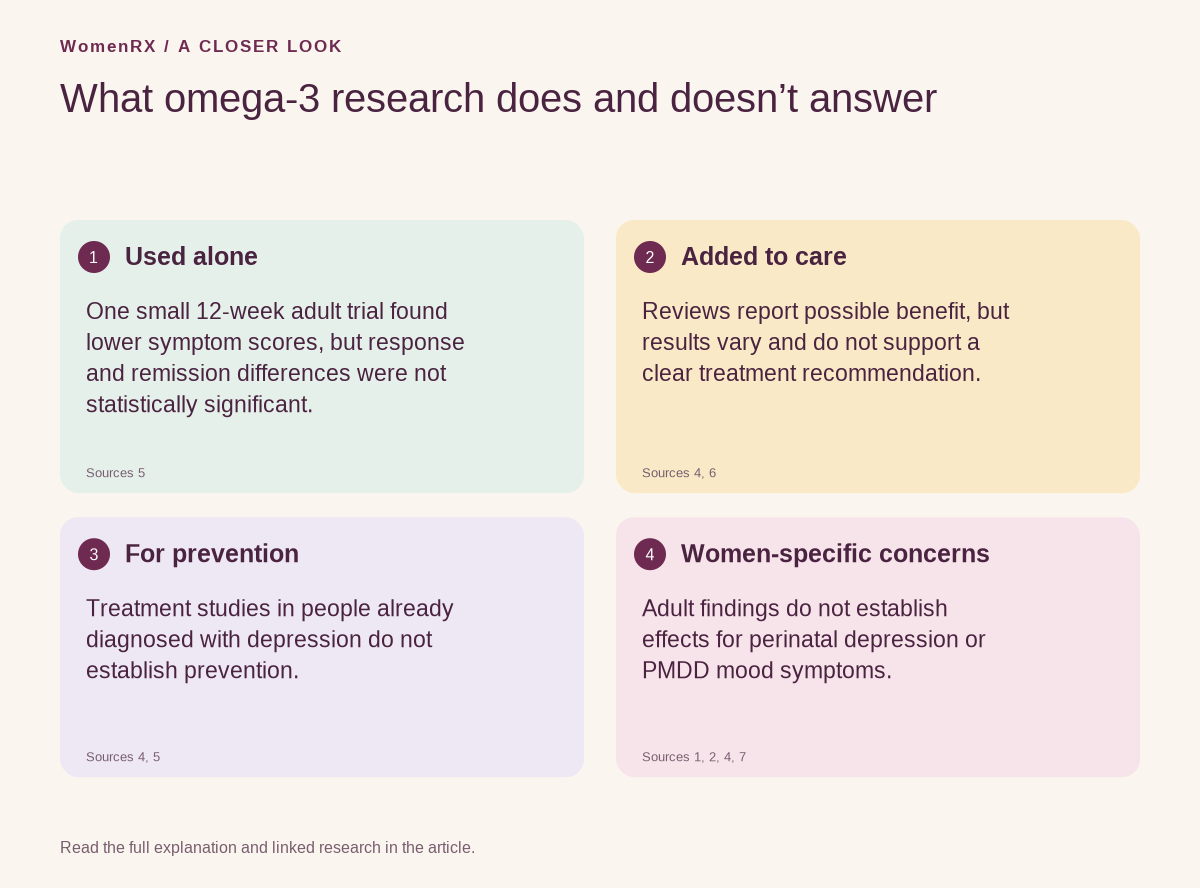
What omega-3 research does and doesn’t answer
Used alone: One small 12-week adult trial found lower symptom scores, but response and remission differences were not statistically significant.5
Added to care: Reviews report possible benefit, but results vary and do not support a clear treatment recommendation.46
For prevention: Treatment studies in people already diagnosed with depression do not establish prevention.45
Women-specific concerns: Adult findings do not establish effects for perinatal depression or PMDD mood symptoms.1247
Read the figure as text
The same supplement can be studied for different purposes. Evidence about treating existing depression does not automatically answer questions about add-on care, prevention, or women-specific conditions.- Used alone: One small 12-week adult trial found lower symptom scores, but response and remission differences were not statistically significant.5
- Added to care: Reviews report possible benefit, but results vary and do not support a clear treatment recommendation.46
- For prevention: Treatment studies in people already diagnosed with depression do not establish prevention.45
- Women-specific concerns: Adult findings do not establish effects for perinatal depression or PMDD mood symptoms.1247
More questions, answered
Can I take omega-3 instead of an antidepressant?
The evidence doesn’t establish omega-3 as a reliable stand-alone replacement for depression treatment. Don’t stop or change a prescribed antidepressant on your own; discuss any change with the person who prescribed it. 4 5
Does omega-3 prevent postpartum depression?
The adult depression-treatment findings don’t establish prevention of postpartum depression. Perinatal depression has its own care considerations, including discussing medication and talk therapy, and telling your care team if you’re breastfeeding. 2 4
Sources you can check
- PMDD (premenstrual dysphoric disorder) - NHSAccessed 2026-09-25Return to first citation
- Postpartum Depression: MedlinePlusAccessed 2026-09-25Return to first citation
- Omega-3 Fatty Acids - Health Professional Fact SheetAccessed 2026-09-25Return to first citation
- Anti-Inflammatory Treatment Efficacy in Major Depressive Disorder: A Systematic Review of Meta-Analyses.Simon MS, Arteaga-Henríquez G, Fouad Algendy A, Siepmann T, Illigens BMW. · Neuropsychiatric disease and treatment · 2023Return to first citation
- The Efficacy of Omega-3 Fatty Acids as the Monotherapy for Depression: A Randomized, Double-Blind, Placebo-Controlled Pilot Study.Wu SK, Yang KJ, Liu WC, Malau IA, Zailani H, Chang CH, Huang SY, Chang JP, Chiu WC, Su KP. · Nutrients · 2024Return to first citation
- Trim the fat: the role of omega-3 fatty acids in psychopharmacology.Nasir M, Bloch MH. · Therapeutic advances in psychopharmacology · 2019Return to first citation
- Omega-3 DHA and EPA for cognition, behavior, and mood: clinical findings and structural-functional synergies with cell membrane phospholipids.Kidd PM. · Alternative medicine review : a journal of clinical therapeutic · 2007Return to first citation