Omega-3 for Dry Eye: What the Trials Show
Omega-3 supplements haven’t reliably relieved dry-eye symptoms, though some smaller trials have found benefits in selected groups.
Omega-3 isn’t a dependable treatment for dry-eye symptoms. Across trials, symptom results are uncertain and inconsistent, even though some smaller studies have reported benefits in particular groups. If your eyes remain uncomfortable, an eye-care assessment can look at symptoms, tear-film stability and gland findings, then help you consider eye-directed care rather than relying on a supplement alone. 56
A prevention result isn’t a treatment result
You may see two seemingly conflicting claims: omega-3 didn’t work in a large trial, yet it helped in a smaller one. The first question is what each trial was trying to do.
In a U.S. trial of 23,523 adults who had no previous dry-eye diagnosis or severe symptoms, new dry-eye diagnoses occurred in 2.0% of those assigned marine omega-3 and 2.0% of those assigned placebo over a median 5.3 years. This is useful evidence against taking omega-3 to prevent dry eye. It doesn’t directly answer whether a supplement eases symptoms you already have. Participants included women aged 55 and older, but the reported result wasn’t broken out for women. 3
For treatment, a Cochrane review brought together trials involving adults with dry eye of varying severity and causes. In its comparison of long-chain omega-3, meaning EPA and DHA, against placebo or no treatment, the review found low-certainty evidence of little or no reduction in symptoms. A small improvement in measured tear production was not judged clinically meaningful by the reviewers. That distinction matters: a test can change without your eyes feeling noticeably better. 5
Why a promising smaller study doesn’t settle it
Dry-eye trials don’t all test the same supplement or enroll people with the same findings. For example, a three-month trial of 50 people with moderate-to-severe dry eye tested a product combining omega-3 and omega-6 fatty acids. Symptoms improved from baseline in both the supplement and placebo groups. Among 13 supplement-group participants who began with especially high symptom scores, symptoms also improved from baseline. The reported subgroup result does not establish that they improved more than a comparable placebo subgroup. None of the measured eye signs changed significantly during the trial. 2
Another randomized trial reported improvements in symptoms and eye measures among people with rosacea and dry-eye symptoms who took omega-3. A separate small trial in people with meibomian gland dysfunction found better tear-film breakup time and gland scores than placebo after eight weeks, although symptom scores improved in both groups. These findings are reasons to keep studying particular dry-eye patterns, not proof that a supplement will help everyone with a gritty or dry feeling. 47
There’s also a useful check on the idea that we’ve already found a clear “responder” type. In a secondary analysis of a larger trial, researchers grouped 535 people with moderate-to-severe dry eye into five profiles based on symptoms and eye findings. Omega-3 was not significantly better than placebo in any profile. A small positive trial and a larger negative subgroup analysis can coexist; together, they don’t give you a reliable way to predict your own response. 6
What to do with symptoms that persist
An eye-care assessment offers something a supplement label can’t: a look at whether your symptoms line up with findings such as tear production, how quickly the tear film breaks up, surface staining or meibomian gland changes. Dry-eye symptoms and measured signs don’t always line up neatly. That’s one reason a persistent problem deserves more than a guess about which capsule to buy. 56
Ask about eye-directed options, including whether artificial tears make sense for your situation, and explain what you’ve already tried. Artificial tears were among the comparison treatments in trials included in the Cochrane review, but that review does not establish which drops or other conventional care would be best for an individual. It found only low-certainty symptom evidence from two small trials of omega-3 added to conventional therapy. A supplement shouldn’t stand in for working out what care your eyes need. 5
If you wear contact lenses, or symptoms arose around pregnancy, postpartum changes or the menopause transition, mention that context during an assessment. The trials above don’t show that any of those circumstances predicts a better response to omega-3. And “omega-3” isn’t one uniform ingredient: supplements may contain different fatty acids, while some dry-eye trials tested combinations with omega-6. A result for one formulation shouldn’t be read as a promise for another. 125
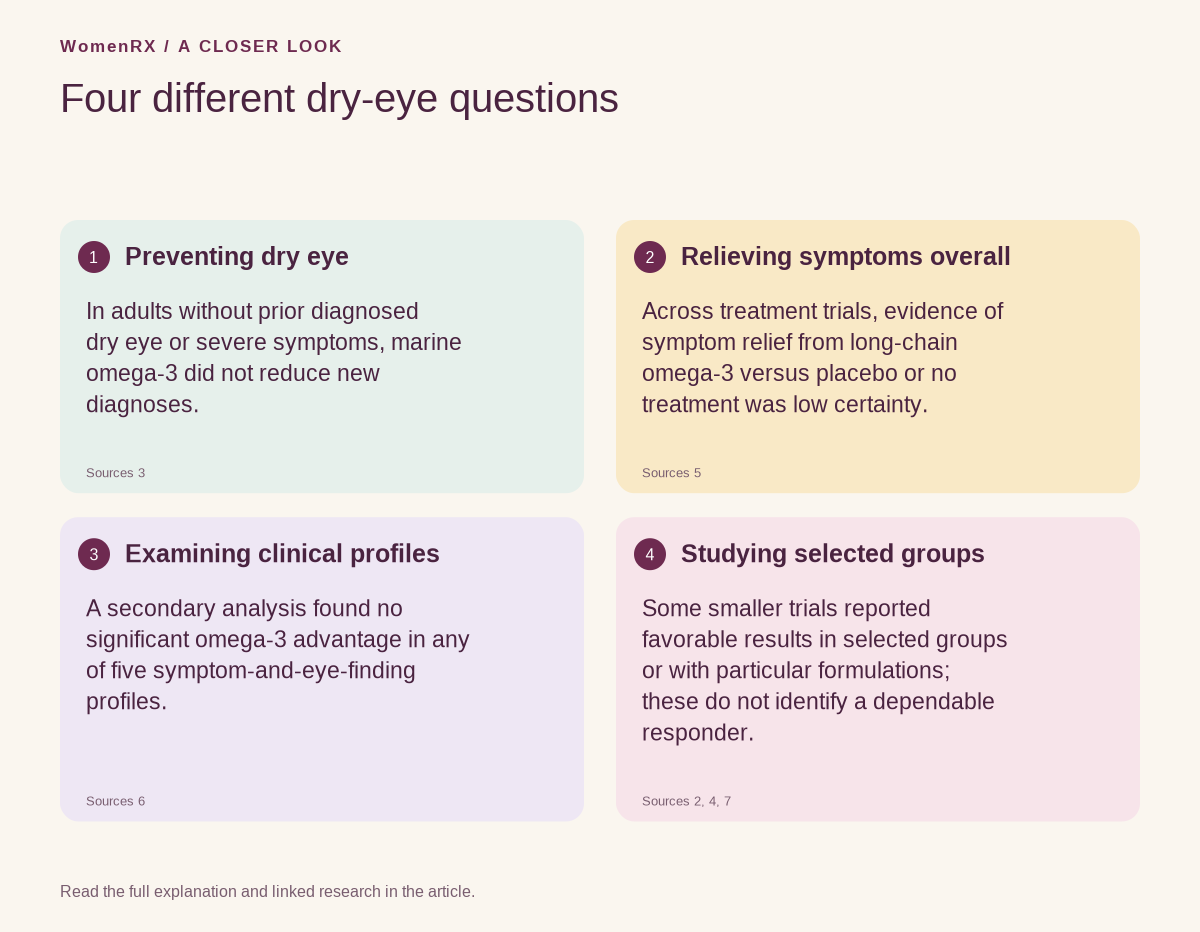
Four different dry-eye questions
Preventing dry eye: In adults without prior diagnosed dry eye or severe symptoms, marine omega-3 did not reduce new diagnoses.3
Relieving symptoms overall: Across treatment trials, evidence of symptom relief from long-chain omega-3 versus placebo or no treatment was low certainty.5
Examining clinical profiles: A secondary analysis found no significant omega-3 advantage in any of five symptom-and-eye-finding profiles.6
Studying selected groups: Some smaller trials reported favorable results in selected groups or with particular formulations; these do not identify a dependable responder.247
Read the figure as text
A trial result is most useful when you know who was studied and what outcome was measured.- Preventing dry eye: In adults without prior diagnosed dry eye or severe symptoms, marine omega-3 did not reduce new diagnoses.3
- Relieving symptoms overall: Across treatment trials, evidence of symptom relief from long-chain omega-3 versus placebo or no treatment was low certainty.5
- Examining clinical profiles: A secondary analysis found no significant omega-3 advantage in any of five symptom-and-eye-finding profiles.6
- Studying selected groups: Some smaller trials reported favorable results in selected groups or with particular formulations; these do not identify a dependable responder.247
Sources you can check
- Omega-3 Fatty Acids - Health Professional Fact SheetAccessed 2026-09-25Return to first citation
- Effect of a Novel Omega-3 and Omega-6 Fatty Acid Supplement on Dry Eye Disease: A 3-month Randomized Controlled Trial.Ng A, Woods J, Jahn T, Jones LW, Sullivan Ritter J. · Optometry and vision science : official publication of the American Academy of Optometry · 2022Return to first citation
- Efficacy of Marine ω-3 Fatty Acid Supplementation vs Placebo in Reducing Incidence of Dry Eye Disease in Healthy US Adults: A Randomized Clinical Trial.Christen WG, Cook NR, Manson JE, Buring JE, Lee IM, Bubes V, Friedenberg G, Dushkes R, Smith D, Schaumberg DA, VITAL Research Group. · JAMA ophthalmology · 2022Return to first citation
- A Randomized Controlled Trial of Omega 3 Fatty Acids in Rosacea Patients with Dry Eye Symptoms.Bhargava R, Chandra M, Bansal U, Singh D, Ranjan S, Sharma S. · Current eye research · 2016Return to first citation
- Omega-3 and omega-6 polyunsaturated fatty acids for dry eye disease.Downie LE, Ng SM, Lindsley KB, Akpek EK. · The Cochrane database of systematic reviews · 2019Return to first citation
- Dry Eye Subtypes in the Dry Eye Assessment and Management (DREAM) Study: A Latent Profile Analysis.Yu K, Asbell PA, Shtein RM, Ying GS, for Dry Eye Assessment and Management Study Research Group. · Translational vision science & technology · 2022Return to first citation
- Effects of dietary high dose DHA omega-3 supplement in dry eye with meibomian gland dysfunction.Jo YJ, Lee JS. · International journal of ophthalmology · 2021Return to first citation