Dry Eyes Around Menopause: What Omega-3 Can and Can't Do
Omega-3 studies give mixed results, and the reported findings don’t show whether benefits differ by menopausal status.
Omega-3 supplements haven’t shown a consistent benefit for dry eye. Some small trials found symptom improvements with particular formulas or in specific groups, while a large prevention trial found no reduction in new diagnoses. The reported findings don’t show whether results differ by menopausal status. Eye drops, simple eyelid care and an examination for persistent or concerning symptoms may be more useful next steps. 1 4 5 7
Gritty, burning or watery eyes can be frustrating, especially when other changes are happening around menopause. Omega-3 is sometimes suggested for dry eye, but studies haven’t reached a consistent answer. And the reported findings don’t show whether supplements work differently during perimenopause or after menopause.
Why omega-3 studies seem to disagree
Dry eye can happen when the eyes don’t make enough tears or when tears dry up too quickly. The condition can have different patterns, so a symptom score, a tear test and a count of new diagnoses are not interchangeable measures of whether a treatment helps. 1 8
Some smaller trials offer a possible signal for symptom relief. In a three-month randomized trial, 50 people with moderate-to-severe dry eye took either a combination of EPA, DHA and an omega-6 fatty acid or a placebo. Symptoms improved from the start of the study in both groups. In a subgroup of 13 participants with especially high symptom scores at the beginning, scores improved from baseline in the supplement group; that finding alone doesn’t show that the supplement outperformed placebo in that subgroup. The study found no significant changes in its measured eye assessments. 4
A Cochrane review of 34 trials involving 4,314 adults found a mixed picture. Compared with placebo, long-chain omega-3 may make little or no difference to dry-eye symptoms, based on low-certainty evidence. It probably increased tear production on one test, but reviewers judged that difference not clinically meaningful. Trials of combined omega-3 and omega-6 supplements had unclear results for some outcomes. 7
A large US trial addressed a different question: prevention, not relief for people who already have dry eye. Among 23,523 adults who did not have a previous diagnosis or severe symptoms at the start, new diagnoses occurred in 2.0% of each group over a median 5.3 years. Marine omega-3 did not reduce the risk of a new diagnosis. 5
So the results aren’t necessarily contradictory: one study may measure symptoms in people who already have dry eye, while another measures tear production or whether new cases develop. A secondary analysis of 535 people with moderate-to-severe dry eye identified five patterns of symptoms and signs, but found no significant omega-3 benefit in any of them. 7 8
What this means if symptoms start around menopause
The reported trial findings don’t show whether omega-3’s effects differ by menopausal status. The large prevention trial included women aged 55 and older, but its reported results don’t establish an effect specific to perimenopause or postmenopause. The other findings described here likewise don’t establish a menopause-specific treatment effect. 4 5 7 8
If your eyes start feeling dry around menopause, the timing is worth noticing, but it doesn’t by itself identify the cause or point to a particular supplement. An eye examination can help assess what’s behind the irritation and whether the problem is dry eye or something else. 1
Try practical eye care before a general supplement
Options for everyday relief include lubricating eye drops, gels or ointments; taking breaks from screens; using a humidifier if the air is dry; and gently cleaning the eyelids. A warm, not hot, compress followed by gentle eyelid massage may help loosen oils from glands around the eyes. If you wear contact lenses, resting your eyes in glasses may help. 1
If you’re considering omega-3, check what a product actually contains. Supplements vary in their fatty acids and amounts, so a result from one specific combination doesn’t automatically apply to a different product. One small trial in people with rosacea and dry-eye symptoms reported improvements with omega-3, but that particular group and result may not represent everyone with dry eye. 2 4 6
Vitamin A is needed for normal vision, but that doesn’t make vitamin A supplements a proven treatment for ordinary dry eye. High-dose supplements combining vitamin A and beta-carotene caused harm in a trial involving smokers and former smokers. Avoid self-treating with high-dose vitamin A products. 3
If you suspect a prescribed medicine may be contributing to dryness, don’t stop it on your own. Ask the person who prescribed it or an eye-care professional whether it could be involved and what options make sense. 1
When to get your eyes checked
Arrange an eye examination if symptoms continue after a few weeks of home care or if your eyelids change shape. Seek prompt advice for pain when looking at light, a very red eye, a severe headache with nausea, or an eye injury. 1
The practical choice isn’t simply “supplement or no supplement.” It’s whether a specific product has evidence for the problem you have, and whether direct care for the eye surface or an examination could help more.
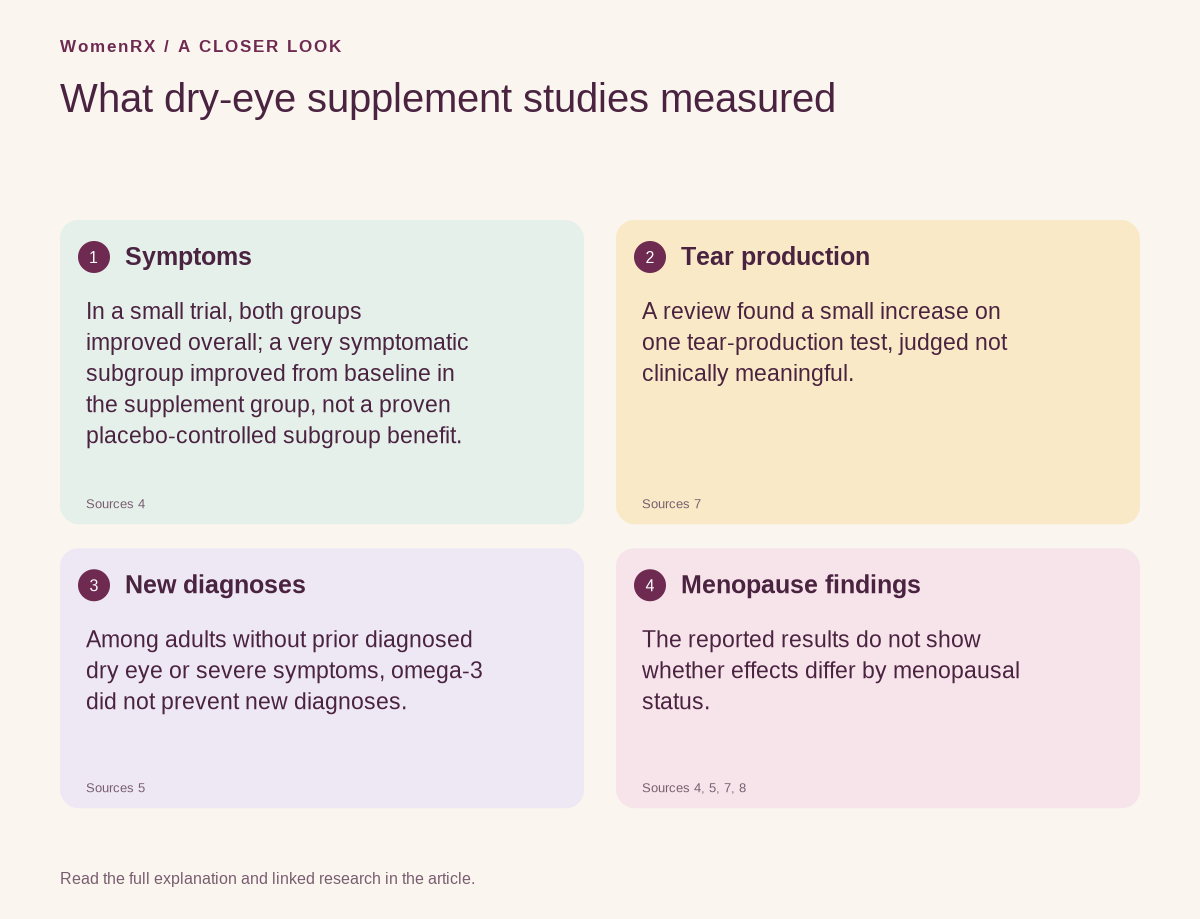
What dry-eye supplement studies measured
Symptoms: In a small trial, both groups improved overall; a very symptomatic subgroup improved from baseline in the supplement group, not a proven placebo-controlled subgroup benefit.4
Tear production: A review found a small increase on one tear-production test, judged not clinically meaningful.7
New diagnoses: Among adults without prior diagnosed dry eye or severe symptoms, omega-3 did not prevent new diagnoses.5
Menopause findings: The reported results do not show whether effects differ by menopausal status.4578
Read the figure as text
Symptoms, tear-test findings and prevention answer different questions. Comparing them helps explain why omega-3 results vary.- Symptoms: In a small trial, both groups improved overall; a very symptomatic subgroup improved from baseline in the supplement group, not a proven placebo-controlled subgroup benefit.4
- Tear production: A review found a small increase on one tear-production test, judged not clinically meaningful.7
- New diagnoses: Among adults without prior diagnosed dry eye or severe symptoms, omega-3 did not prevent new diagnoses.5
- Menopause findings: The reported results do not show whether effects differ by menopausal status.4578
More questions, answered
Can symptoms feel severe even when eye-test findings are less marked?
Yes. In an analysis of people with moderate-to-severe dry eye, one identified pattern had especially severe symptoms relative to measured signs. Symptoms matter, but their intensity alone may not reveal the underlying pattern. 8
Sources you can check
- Dry eyes - NHSAccessed 2026-09-25Return to first citation
- Omega-3 Fatty Acids - Health Professional Fact SheetAccessed 2026-09-25Return to first citation
- Vitamin A and Carotenoids - Health Professional Fact SheetAccessed 2026-09-25Return to first citation
- Effect of a Novel Omega-3 and Omega-6 Fatty Acid Supplement on Dry Eye Disease: A 3-month Randomized Controlled Trial.Ng A, Woods J, Jahn T, Jones LW, Sullivan Ritter J. · Optometry and vision science : official publication of the American Academy of Optometry · 2022Return to first citation
- Efficacy of Marine ω-3 Fatty Acid Supplementation vs Placebo in Reducing Incidence of Dry Eye Disease in Healthy US Adults: A Randomized Clinical Trial.Christen WG, Cook NR, Manson JE, Buring JE, Lee IM, Bubes V, Friedenberg G, Dushkes R, Smith D, Schaumberg DA, VITAL Research Group. · JAMA ophthalmology · 2022Return to first citation
- A Randomized Controlled Trial of Omega 3 Fatty Acids in Rosacea Patients with Dry Eye Symptoms.Bhargava R, Chandra M, Bansal U, Singh D, Ranjan S, Sharma S. · Current eye research · 2016Return to first citation
- Omega-3 and omega-6 polyunsaturated fatty acids for dry eye disease.Downie LE, Ng SM, Lindsley KB, Akpek EK. · The Cochrane database of systematic reviews · 2019Return to first citation
- Dry Eye Subtypes in the Dry Eye Assessment and Management (DREAM) Study: A Latent Profile Analysis.Yu K, Asbell PA, Shtein RM, Ying GS, for Dry Eye Assessment and Management Study Research Group. · Translational vision science & technology · 2022Return to first citation