Frozen Shoulder Around Menopause: Do Supplements Help?
A study has linked some dietary nutrients with fewer frozen-shoulder symptoms, but it didn’t test supplements or show they treat the condition.
A small observational study found that higher vitamin D intake was associated with less pain and disability, particularly among women, but it did not test vitamin D supplements or show they cause improvement. It also cannot tell us whether omega-3 supplements help frozen shoulder. Menopause timing alone doesn’t confirm the cause of shoulder stiffness, so persistent movement limits deserve attention beyond supplements. 7 6
What the nutrition research can, and can’t, tell you
Frozen shoulder involves inflammation and tightening of the tissue around the shoulder joint, which can make movement painful and restricted for months. It’s understandable to wonder whether a supplement could calm that process. 1
A 2026 cross-sectional study of 57 people with frozen shoulder, including 44 women, found that higher intake of vitamin D and some other micronutrients was associated with lower pain and disability, particularly in women. But researchers measured diet and symptoms at one point in time. They didn’t assign people to take vitamin D, and the study can’t show whether nutrient intake caused the difference. 7
That distinction matters: a dietary association is not evidence that a vitamin D supplement improves shoulder pain or range of motion. The same study doesn’t establish that omega-3 supplements treat frozen shoulder either. General information about omega-3s or vitamin D and health doesn’t answer whether either improves this specific condition. 3 4 7
If you take a supplement for another reason, such as a separately identified nutritional need, that’s a different decision from using it as frozen-shoulder treatment. Don’t let a supplement trial at home take the place of getting ongoing shoulder stiffness assessed.
Shoulder symptoms near menopause have more than one explanation
Frozen shoulder is more prevalent among people aged 40 to 60, but shoulder pain around menopause isn’t proof that hormones caused it. In one study of participants with shoulder pain, adhesive capsulitis was diagnosed in 35.4% of the perimenopausal group and 31.8% of the premenopausal group; the difference wasn’t statistically significant. The study also found other shoulder conditions, including synovitis, so pain and stiffness need not have one explanation. 7 6
A small pilot study of postmenopausal women also didn’t find a statistically significant difference in frozen-shoulder odds between those prescribed hormone therapy and those who weren’t. Its results don’t establish that hormone therapy prevents frozen shoulder, and they don’t support starting it as shoulder treatment. 5
Put movement and pain, not supplement claims, at the center
The outcomes that matter are whether pain eases and whether you can move your shoulder more comfortably. Clinical research on frozen-shoulder care has examined options such as physical therapy, injections, and other procedures using those kinds of outcomes. A systematic review and network meta-analysis of 66 studies found that different approaches ranked better for different outcomes; no single treatment was best for pain, movement, and function all at once. 8
Guidance for frozen shoulder includes gentle shoulder movement and exercises, with physical therapy to help restore movement. Pain relief or an injection may also be considered depending on how painful and stiff the shoulder is. Those options are separate from supplement evidence: they’re clinical care choices, not proof that a nutrient treats the condition. 1
If shoulder pain and stiffness aren’t going away, or the pain makes it hard to move your arm, arrange an assessment rather than assuming it’s menopause or trying to solve it with supplements alone. Sudden severe pain, inability to move the arm, or pain after an injury calls for more urgent help. 1 2
The practical takeaway: this evidence does not show that vitamin D or omega-3 supplements treat frozen shoulder. Get the shoulder assessed, then weigh care options by how they may affect pain and movement.
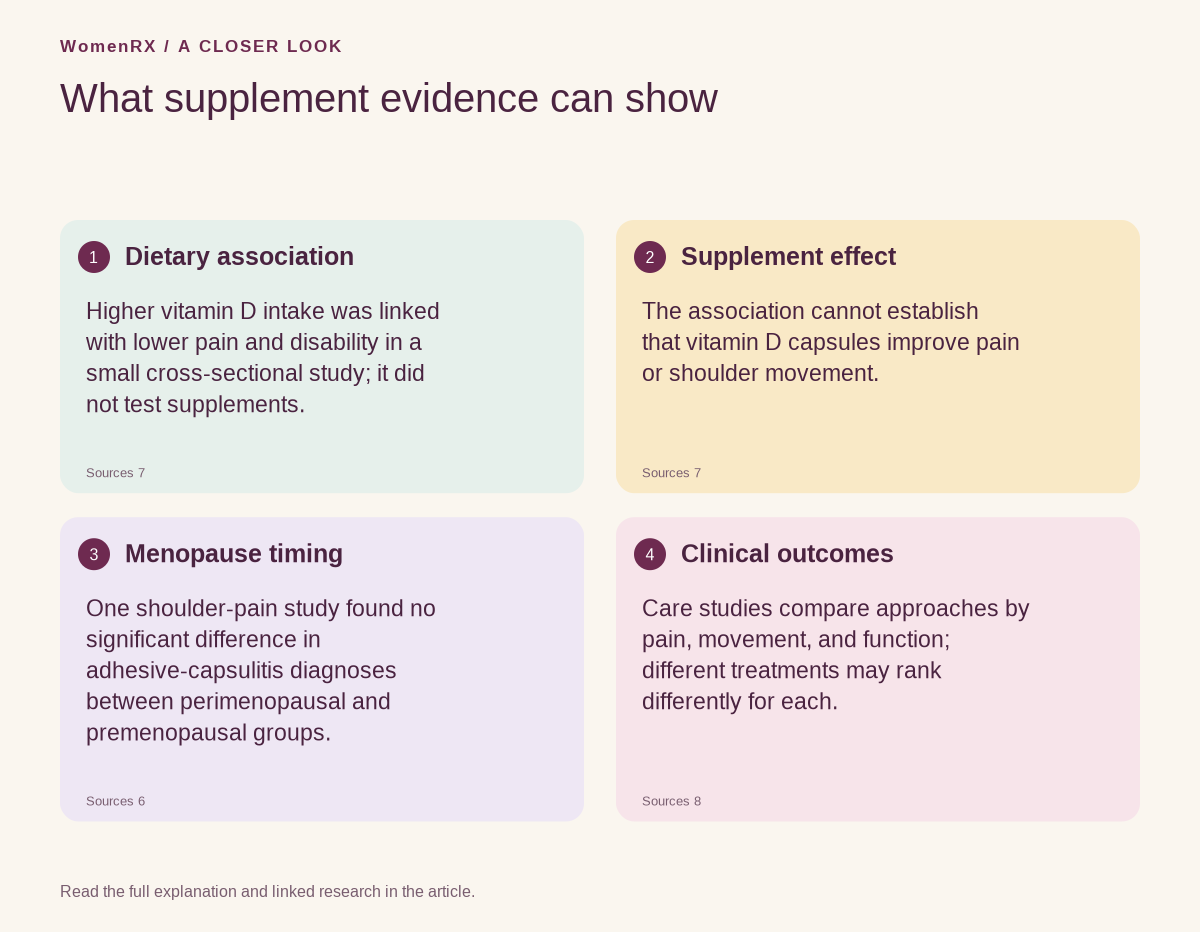
What supplement evidence can show
Dietary association: Higher vitamin D intake was linked with lower pain and disability in a small cross-sectional study; it did not test supplements.7
Supplement effect: The association cannot establish that vitamin D capsules improve pain or shoulder movement.7
Menopause timing: One shoulder-pain study found no significant difference in adhesive-capsulitis diagnoses between perimenopausal and premenopausal groups.6
Clinical outcomes: Care studies compare approaches by pain, movement, and function; different treatments may rank differently for each.8
Read the figure as text
These distinctions separate a dietary association from a treatment test, then place supplement claims beside outcomes and care options relevant to frozen shoulder.- Dietary association: Higher vitamin D intake was linked with lower pain and disability in a small cross-sectional study; it did not test supplements.7
- Supplement effect: The association cannot establish that vitamin D capsules improve pain or shoulder movement.7
- Menopause timing: One shoulder-pain study found no significant difference in adhesive-capsulitis diagnoses between perimenopausal and premenopausal groups.6
- Clinical outcomes: Care studies compare approaches by pain, movement, and function; different treatments may rank differently for each.8
Sources you can check
- Frozen shoulder - NHSAccessed 2026-09-25Return to first citation
- Shoulder pain - NHSAccessed 2026-09-25Return to first citation
- Omega-3 Fatty Acids - Health Professional Fact SheetAccessed 2026-09-25Return to first citation
- Vitamin D - Health Professional Fact SheetAccessed 2026-09-25Return to first citation
- A preliminary pilot study to address design issues related to research on potential association of hormone therapy and adhesive capsulitis.Reinke EK, Ford AC, Wahl E, Kennedy J, Poehlein E, Green CL, Saltzman E, Wittstein JR. · Climacteric : the journal of the International Menopause Society · 2026Return to first citation
- Perimenopausal arthralgia in the shoulder.Yoon S, Lee DH, Bang J. · Menopause (New York, N.Y.) · 2018Return to first citation
- Impact of nutritional profile on pain and functionality in patients with frozen shoulder: a cross-sectional observational study.Hamed-Hamed D, Rangel-Huerta OD, Casas-Albertos E, Rodríguez-Pérez C, Navarro-Ledesma S. · Frontiers in medicine · 2026Return to first citation
- Efficacy of Arthroscopic Surgery in the Management of Adhesive Capsulitis: A Systematic Review and Network Meta-analysis of Randomized Controlled Trials.Forsythe B, Lavoie-Gagne O, Patel BH, Lu Y, Ritz E, Chahla J, Okoroha KR, Allen AA, Nwachukwu BU. · Arthroscopy : the journal of arthroscopic & related surgery : official publication of the Arthroscopy Association of North America and the International Arthroscopy Association · 2021Return to first citation