Frozen Shoulder Around Menopause: What’s the Connection?
Frozen shoulder may appear during the menopausal years, but the timing alone doesn’t tell you what caused your shoulder pain.
Frozen shoulder causes pain and a gradual loss of shoulder movement that can last months or longer. Female sex and ages 40 to 65 are reported risk factors, but that doesn’t establish a link to perimenopause or postmenopause specifically. If pain and stiffness persist, or pain makes it very hard to move your arm, have the shoulder assessed rather than assuming it’s menopause-related. 1 3
What makes a shoulder “frozen”?
Frozen shoulder, also called adhesive capsulitis, involves pain and stiffness around the shoulder joint. Pain can be worse at night and disturb sleep. The tissue around the joint becomes inflamed, then tightens and shrinks, making movement harder. Symptoms can last for months and sometimes years. 1
That loss of movement is the key distinction to understand. You might notice it when trying to reach behind your back, for example. In studies reviewed in 2026, clinicians commonly identified frozen shoulder when movement was restricted both as a person moved her own arm and as someone else moved it for her. Turning the arm outward was often especially limited. Diagnostic criteria varied across studies, though, so this pattern is something to assess, not a test to perform on yourself. 3
Where menopause fits, and where it doesn’t
Reported risk factors include female sex and ages 40 to 65. Those years overlap with perimenopause and postmenopause for many women. But these findings don’t show whether frozen-shoulder risk differs between those menopause stages. They also can’t tell us whether the menopause transition itself changes risk, or whether a hormone change caused an individual woman’s shoulder problem. 3
Other factors may matter, too. The same review found substantially higher odds of frozen shoulder in people with diabetes than in people without it, while noting that other differences between the groups could influence the association. Diabetes doesn’t explain every case, and a risk factor isn’t a diagnosis. 3
If you’re also considering hormone therapy for menopause symptoms, keep the two decisions separate. The North American Menopause Society’s 2022 hormone therapy statement addresses menopause symptoms and prevention of bone loss; it doesn’t establish hormone therapy as a frozen-shoulder treatment or prevention strategy. 2
Why an assessment is worth it
Stiffness alone doesn’t confirm frozen shoulder. A clinician can check which movements are limited, including whether the shoulder remains restricted when your arm is moved for you. Other shoulder problems can be present at the same time: an orthopedic editorial specifically discusses rotator cuff tears alongside adhesive capsulitis. That’s a reason to avoid deciding from age or symptoms alone what’s happening inside the shoulder. 3 4
Arrange an assessment if shoulder pain and stiffness aren’t going away, or if pain makes moving your arm and shoulder very difficult. You don’t need to settle the menopause question first. The useful question is what’s limiting this shoulder and what care fits that finding. 1 3
What care may look like
When frozen shoulder is the diagnosis, care commonly starts with pain relief and gentle movement. A physical therapist can assess your movement and guide exercises to help you regain it. Making up strenuous exercises on your own may worsen pain, so more force isn’t necessarily more progress. Recovery often takes patience because symptoms can last months or longer. 1
The distinction to hold onto is this: midlife timing may raise the question of menopause, but the shoulder’s movement pattern guides assessment and care. 1 3
Reading the frozen-shoulder clues
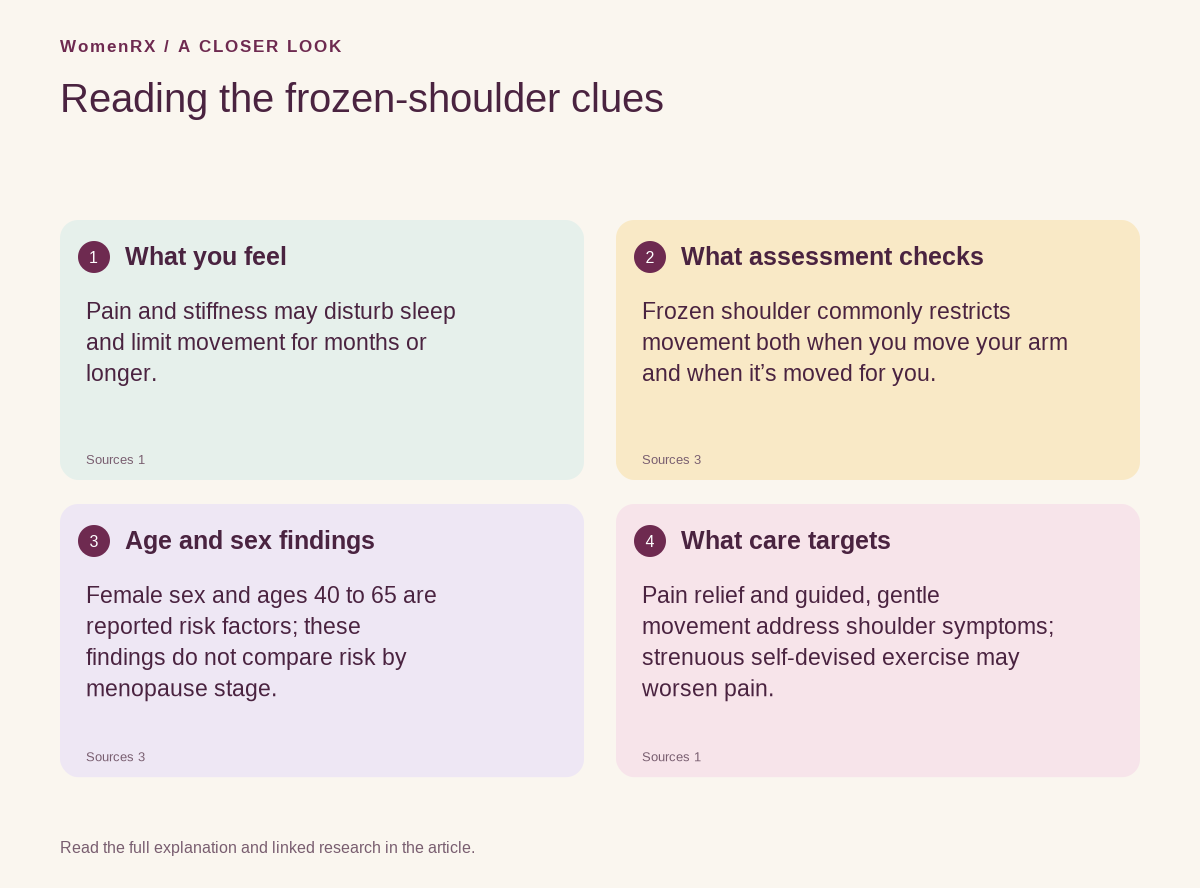
What you feel: Pain and stiffness may disturb sleep and limit movement for months or longer.1
What assessment checks: Frozen shoulder commonly restricts movement both when you move your arm and when it’s moved for you.3
Age and sex findings: Female sex and ages 40 to 65 are reported risk factors; these findings do not compare risk by menopause stage.3
What care targets: Pain relief and guided, gentle movement address shoulder symptoms; strenuous self-devised exercise may worsen pain.1
Read the figure as text
The overlap with menopause raises a reasonable question, but symptoms, movement findings, and risk research answer different parts of it.- What you feel: Pain and stiffness may disturb sleep and limit movement for months or longer.1
- What assessment checks: Frozen shoulder commonly restricts movement both when you move your arm and when it’s moved for you.3
- Age and sex findings: Female sex and ages 40 to 65 are reported risk factors; these findings do not compare risk by menopause stage.3
- What care targets: Pain relief and guided, gentle movement address shoulder symptoms; strenuous self-devised exercise may worsen pain.1
Sources you can check
- Frozen shoulder - NHSAccessed 2026-09-25Return to first citation
- The 2022 hormone therapy position statement of The North American Menopause Society.“The 2022 Hormone Therapy Position Statement of The North American Menopause Society” Advisory Panel. · Menopause (New York, N.Y.) · 2022Return to first citation
- The diabetic shoulder: association between diabetes mellitus and adhesive capsulitis - a systematic review and meta-analysis.Hernigou P, Scarlat MM. · International orthopaedics · 2026Return to first citation
- Editorial Commentary: Stiff Patients After Rotator Cuff Repair: How Many Had Underrecognized Preoperative Adhesive Capsulitis?Shi BY, Amini MH. · Arthroscopy : the journal of arthroscopic & related surgery : official publication of the Arthroscopy Association of North America and the International Arthroscopy Association · 2026Return to first citation