Frozen Shoulder and Menopause: What the Evidence Shows
Frozen shoulder can happen during the menopause transition, but current studies haven’t shown that menopause itself causes it.
Research hasn’t established that perimenopause or postmenopause raises a woman’s chance of developing frozen shoulder. In one study of women already experiencing shoulder pain, frozen shoulder was not significantly more common in the perimenopausal group than in the premenopausal group. A small hormone-therapy study and lab research offer clues, not proof. If your shoulder is painful and stiff, get it assessed rather than assuming menopause is the cause. 234
What the research actually found
The most directly relevant comparison looked at 197 perimenopausal and 113 premenopausal women who already had shoulder pain. Frozen shoulder, also called adhesive capsulitis, was diagnosed in 35.4% of the perimenopausal group and 31.8% of the premenopausal group. That difference was not statistically significant. Because everyone in the study had shoulder pain, these percentages describe diagnoses within that group, not each group’s chance of developing frozen shoulder in the general population. 2
The same study found more shoulder synovitis, or inflammation around the joint, in the perimenopausal group: 25.1% compared with 6.2% in the premenopausal group. That doesn’t show that menopause caused the inflammation. It does underline why new shoulder pain shouldn’t automatically be labeled frozen shoulder or written off as a menopause symptom. 2
A separate pilot study reviewed medical records for 1,952 postmenopausal women aged 40 to 60. Frozen shoulder was recorded in 3.95% of those prescribed hormone therapy and 7.65% of those not prescribed it. The difference was not statistically significant, and the study’s confidence interval was wide. Since this was a medical-record study, it cannot show that hormone therapy prevents frozen shoulder. 3
Taken together, these studies don’t establish that the menopause transition increases frozen-shoulder risk, or that hormone therapy protects against it. They also don’t settle whether any relationship differs between perimenopause and postmenopause.
A possible hormone link isn’t proof
Frozen shoulder involves inflammation and tightening of tissue around the shoulder joint. Researchers have proposed that estrogen changes could affect processes involved in tissue scarring, but a biological explanation is not the same as evidence that menopause causes the condition. 14
One 2025 study explored estrogen-related effects using a rat model and fibroblast cells taken from people with frozen shoulder. Its findings offer a possible mechanism for further study, but they don’t demonstrate that falling estrogen causes frozen shoulder in women or that estrogen treatment improves it in patients. 4
What to do if your shoulder is stiff and painful
Frozen shoulder typically causes both pain and stiffness, making it difficult to move the shoulder. Symptoms can last for months or sometimes years. But other shoulder problems can also cause pain or restrict movement, so the timing of your symptoms alone can’t identify the cause. 12
If the pain and stiffness aren’t going away, or it’s becoming hard to move your arm, arrange an assessment with a clinician. A useful question is: “Does this look like frozen shoulder, or could another shoulder problem explain it?” The perimenopause study’s finding about synovitis is a reminder that more than one diagnosis may be considered. 12
While you’re sorting it out, avoid forcing painful movement or starting strenuous exercises on your own. Gentle movement and exercises recommended for your situation may help preserve or regain motion; physiotherapy can also help with movement. Your care plan may include pain relief, depending on what’s suitable for you. 1
The practical takeaway: menopause and frozen shoulder can coincide, but that timing doesn’t prove one caused the other. Get persistent pain and stiffness assessed, and base treatment on the shoulder problem identified rather than on a presumed hormone explanation.
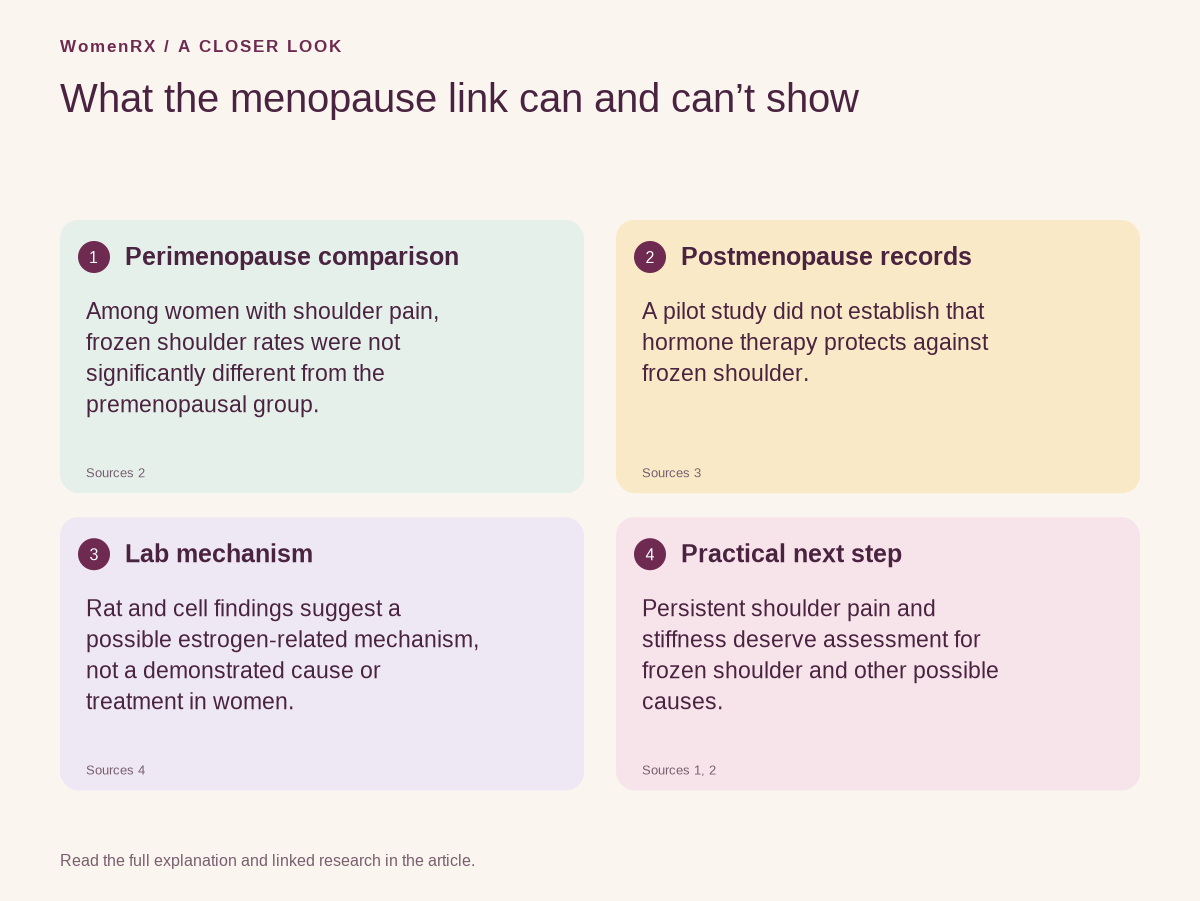
What the menopause link can and can’t show
Perimenopause comparison: Among women with shoulder pain, frozen shoulder rates were not significantly different from the premenopausal group.2
Postmenopause records: A pilot study did not establish that hormone therapy protects against frozen shoulder.3
Lab mechanism: Rat and cell findings suggest a possible estrogen-related mechanism, not a demonstrated cause or treatment in women.4
Practical next step: Persistent shoulder pain and stiffness deserve assessment for frozen shoulder and other possible causes.12
Read the figure as text
These findings answer different questions: diagnoses among women who already have shoulder pain, hormone-therapy records, and possible biological mechanisms.- Perimenopause comparison: Among women with shoulder pain, frozen shoulder rates were not significantly different from the premenopausal group.2
- Postmenopause records: A pilot study did not establish that hormone therapy protects against frozen shoulder.3
- Lab mechanism: Rat and cell findings suggest a possible estrogen-related mechanism, not a demonstrated cause or treatment in women.4
- Practical next step: Persistent shoulder pain and stiffness deserve assessment for frozen shoulder and other possible causes.12
More questions, answered
Should I take hormone therapy to prevent frozen shoulder?
The small medical-record study described here did not show a statistically significant difference in frozen-shoulder odds between women prescribed hormone therapy and those who weren’t. It doesn’t establish hormone therapy as a way to prevent or treat frozen shoulder. 3
Does shoulder pain during perimenopause mean I have frozen shoulder?
No. Frozen shoulder is one possible cause of shoulder pain and stiffness, but the study of women with shoulder pain also identified synovitis and other shoulder conditions. An assessment can help distinguish them. 12
Sources you can check
- Frozen shoulder - NHSAccessed 2026-09-25Return to first citation
- Perimenopausal arthralgia in the shoulder.Yoon S, Lee DH, Bang J. · Menopause (New York, N.Y.) · 2018Return to first citation
- A preliminary pilot study to address design issues related to research on potential association of hormone therapy and adhesive capsulitis.Reinke EK, Ford AC, Wahl E, Kennedy J, Poehlein E, Green CL, Saltzman E, Wittstein JR. · Climacteric : the journal of the International Menopause Society · 2026Return to first citation
- Mechanistic insights into the anti-fibrotic effects of estrogen via the PI3K-Akt pathway in frozen shoulder.Wang Z, Li X, Liu X, Yang Y, Yan Y, Cui D, Meng C, Ali MI, Zhang J, Yao Z, Long Y, Yang R. · The Journal of steroid biochemistry and molecular biology · 2025Return to first citation