Frozen Shoulder During Menopause: What the Evidence Says
Frozen shoulder is reported more often in midlife and in women, but those patterns alone don’t show that menopause causes it.
Frozen shoulder is more common in midlife and is reported more often in women than men, but that doesn’t establish menopause as the cause. In one study of people who already had shoulder pain, frozen shoulder was not significantly more common in the perimenopausal group than in the premenopausal group. Diagnosis depends on the shoulder’s symptoms and movement, not menopausal status. 2 3
Midlife overlap isn’t proof of a hormone cause
Frozen shoulder, also called adhesive capsulitis, often develops between ages 40 and 65. It’s reported more often in women than men. Those patterns overlap with the menopause years, but they don’t tell us whether menopause itself raises risk. Age, sex, and menopausal stage are different factors, and an association with one doesn’t establish a cause in another. 3
A small clinical comparison offers a useful, but limited, clue. Researchers assessed 197 people with perimenopausal shoulder pain and 113 with premenopausal shoulder pain. Frozen shoulder was diagnosed in 35.4% of the perimenopausal group and 31.8% of the premenopausal group. The difference wasn’t statistically significant. These figures describe people who already had shoulder pain, not the chance of developing frozen shoulder among all people in either menopause group. The study therefore can’t show that menopause raises population risk, or separate a possible menopause effect from age and other influences. 2
The same study found shoulder synovitis more often in its perimenopausal group than in its premenopausal group. That’s another reason not to assume that shoulder pain during perimenopause is frozen shoulder. The finding doesn’t establish why synovitis was more common in that group. 2
What the hormone question can and can’t tell you
Frozen shoulder involves inflammation and tightening of the tissue around the shoulder joint. The precise causes aren’t fully understood. The reported findings from the clinical comparison do not include estrogen measurements or a test of menopausal hormone therapy, so those findings cannot establish an estrogen cause or a hormone-therapy benefit. An overlap in age or sex is not evidence of a hormone treatment effect. 2
That distinction matters if you’re considering hormone therapy for other reasons. These shoulder findings don’t provide a reason to start, change, or stop it. The shoulder question should be considered separately from the reasons you might use menopausal hormone therapy.
How a clinician checks for frozen shoulder
Frozen shoulder typically causes shoulder pain and stiffness, sometimes with pain that disturbs sleep. A key part of assessment is how much the shoulder moves when you move it yourself and when someone else moves it during an examination. Diagnosis is mainly clinical; imaging can be used as an additional tool when the presentation is atypical or another cause needs to be considered. 1 3
This is useful because several shoulder problems can hurt and limit movement. In the perimenopause study, researchers also identified synovitis, rotator cuff disorders, arthritis, and other conditions among people with shoulder pain. Menopause alone can’t distinguish these from frozen shoulder. 2
Persistent shoulder pain and stiffness, or pain so severe that moving your arm is difficult, are good reasons to seek an assessment. That assessment can help identify the problem rather than treating every midlife shoulder ache as frozen shoulder. 1
Let the diagnosis guide the next step
If frozen shoulder is diagnosed, care focuses on pain and movement, not on changing hormones. Exercises recommended for you by a clinician or physical therapist may help restore movement. Keep movement gentle and avoid inventing strenuous exercises that aggravate pain. A clinical guideline also describes non-surgical options, including exercise and physical therapy, while noting that treatment should be guided by clinical judgment. 1 3
The practical takeaway: being in perimenopause or postmenopause doesn’t confirm frozen shoulder, and it doesn’t identify its cause. Symptoms and examination guide the diagnosis. The reported menopause comparison did not test hormone therapy as a shoulder treatment. 2
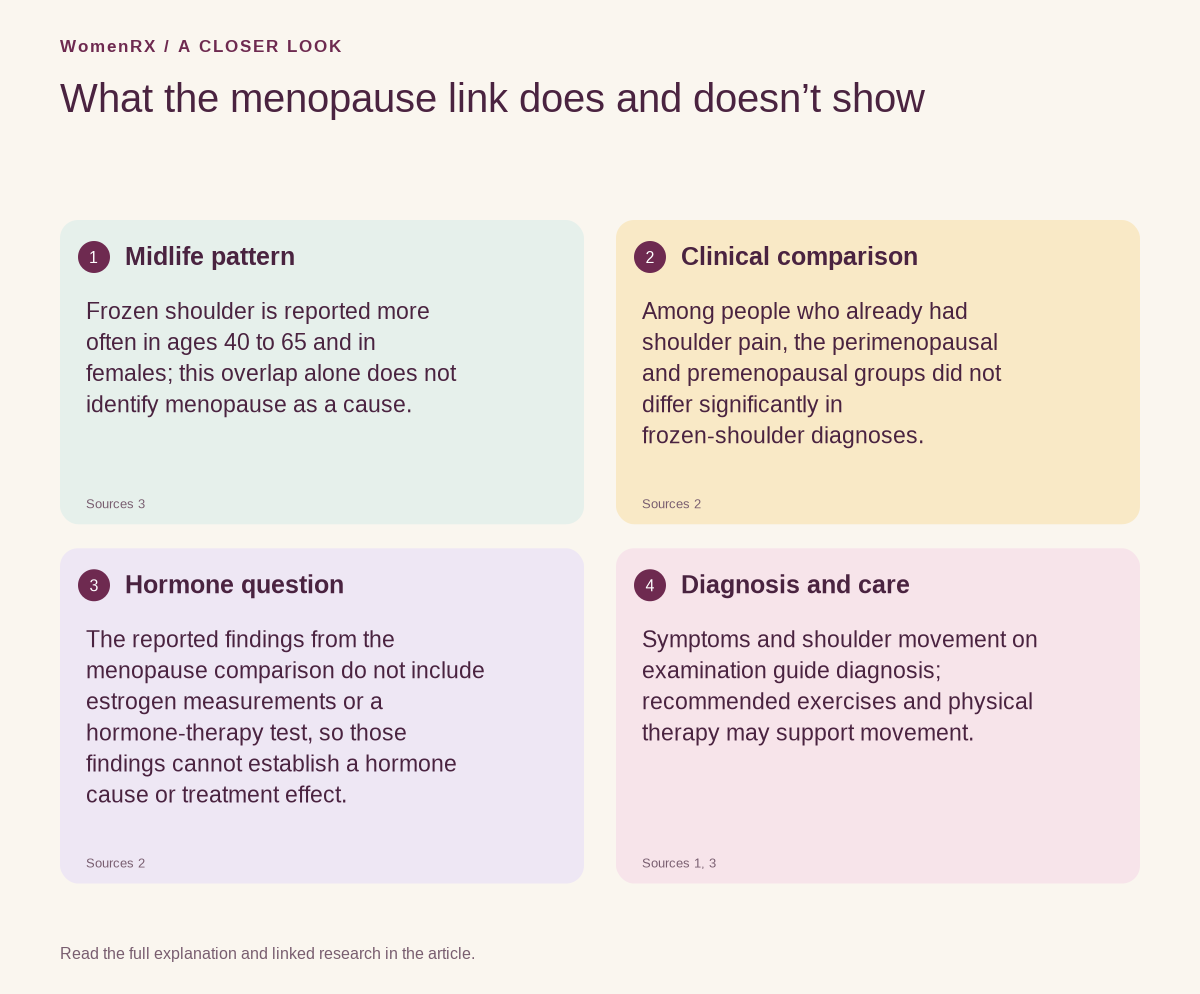
What the menopause link does and doesn’t show
Midlife pattern: Frozen shoulder is reported more often in ages 40 to 65 and in females; this overlap alone does not identify menopause as a cause.3
Clinical comparison: Among people who already had shoulder pain, the perimenopausal and premenopausal groups did not differ significantly in frozen-shoulder diagnoses.2
Hormone question: The reported findings from the menopause comparison do not include estrogen measurements or a hormone-therapy test, so those findings cannot establish a hormone cause or treatment effect.2
Diagnosis and care: Symptoms and shoulder movement on examination guide diagnosis; recommended exercises and physical therapy may support movement.13
Read the figure as text
Separate the observed midlife pattern from evidence about menopausal stage, hormone causes, and how a shoulder problem is actually assessed.- Midlife pattern: Frozen shoulder is reported more often in ages 40 to 65 and in females; this overlap alone does not identify menopause as a cause.3
- Clinical comparison: Among people who already had shoulder pain, the perimenopausal and premenopausal groups did not differ significantly in frozen-shoulder diagnoses.2
- Hormone question: The reported findings from the menopause comparison do not include estrogen measurements or a hormone-therapy test, so those findings cannot establish a hormone cause or treatment effect.2
- Diagnosis and care: Symptoms and shoulder movement on examination guide diagnosis; recommended exercises and physical therapy may support movement.13
Sources you can check
- Frozen shoulder - NHSAccessed 2026-09-25Return to first citation
- Perimenopausal arthralgia in the shoulder.Yoon S, Lee DH, Bang J. · Menopause (New York, N.Y.) · 2018Return to first citation
- Clinical Practice Guidelines for Diagnosis and Non-Surgical Treatment of Primary Frozen Shoulder.Lee BC, Kim BS, Lee BJ, Moon CW, Park CH, Kim DH, Yun DH, Park D, Kim DY, Kim DH, Kim GW, Kim HJ, Jung IY, Kim IJ, Park JH, Lee JH, Ahn J, Lim JY, Yoon JA, Lee JH, Hwang JM, Kim K,... · Annals of rehabilitation medicine · 2025Return to first citation