Frozen Shoulder in Midlife: Is Menopause a Risk Factor?
One study of people with shoulder pain found no significant difference in frozen-shoulder diagnoses between perimenopausal and premenopausal groups.
Menopause and frozen shoulder can overlap in time, but one study of women who already had shoulder pain did not find a significant difference between perimenopausal and premenopausal groups. That doesn’t settle whether menopause affects risk in the wider population. Frozen shoulder is more suggested by ongoing pain with stiffness that makes the shoulder difficult to move than by menopause stage alone. 3 1
What one menopause-related study found
A study compared 197 perimenopausal and 113 premenopausal participants who had shoulder pain. Frozen shoulder, also called adhesive capsulitis, was diagnosed in 35.4% of the perimenopausal group and 31.8% of the premenopausal group. The difference was not statistically significant. 3
Those percentages describe diagnoses among people in the study who already had shoulder pain. They aren’t estimates of frozen-shoulder risk for all women, and the study can’t show that menopause causes the condition or changes a person’s chance of developing it. It also doesn’t prove there’s no connection. 3
The study found shoulder synovitis more often in its perimenopausal group than its premenopausal group. That finding is a reason not to assume every midlife shoulder problem is frozen shoulder, not a diagnosis for any individual. Shoulder pain can have different causes. 3 2
The symptom pattern is more useful than the timing
Frozen shoulder typically causes persistent pain and stiffness that make it difficult to move the shoulder. The pain can be worse at night and disturb sleep, and symptoms may last for months or longer. 1
Other patterns can point toward other possibilities. Pain that is often worse when you use the arm can occur with tendon, bursa, or impingement problems. Tingling, numbness, or weakness can suggest other causes. These are clues to discuss, not a way to diagnose yourself. 2
A practical distinction to describe is whether you mainly have continuing stiffness and trouble moving the shoulder, or pain that is especially tied to using your arm. Menopause stage by itself can’t tell you which problem is responsible.
What to ask about your shoulder
If pain and stiffness persist, or it’s become very difficult to move your arm, ask to have the shoulder evaluated rather than writing it off as a menopause symptom. An examination can help assess the cause; a clinician may consider tests such as an X-ray. 1 2
You might ask: “Does my ongoing stiffness and difficulty moving fit frozen shoulder, or does the pattern suggest another cause?” Mention whether pain is worse at night, whether it’s tied to using your arm, and whether you have tingling, numbness, or weakness. Those details help explain the pattern, but they don’t settle the diagnosis on their own. 1 2
Sudden severe shoulder pain, being unable to move your arm, or pain that starts after an injury warrants prompt medical attention. 2
Don’t treat the timing as proof
The study compared shoulder diagnoses; it did not test hormone therapy as a way to prevent or treat frozen shoulder. Its findings therefore don’t show that hormone therapy would help shoulder stiffness. The useful next step is to work out what is causing the shoulder problem and discuss care for that cause. 3
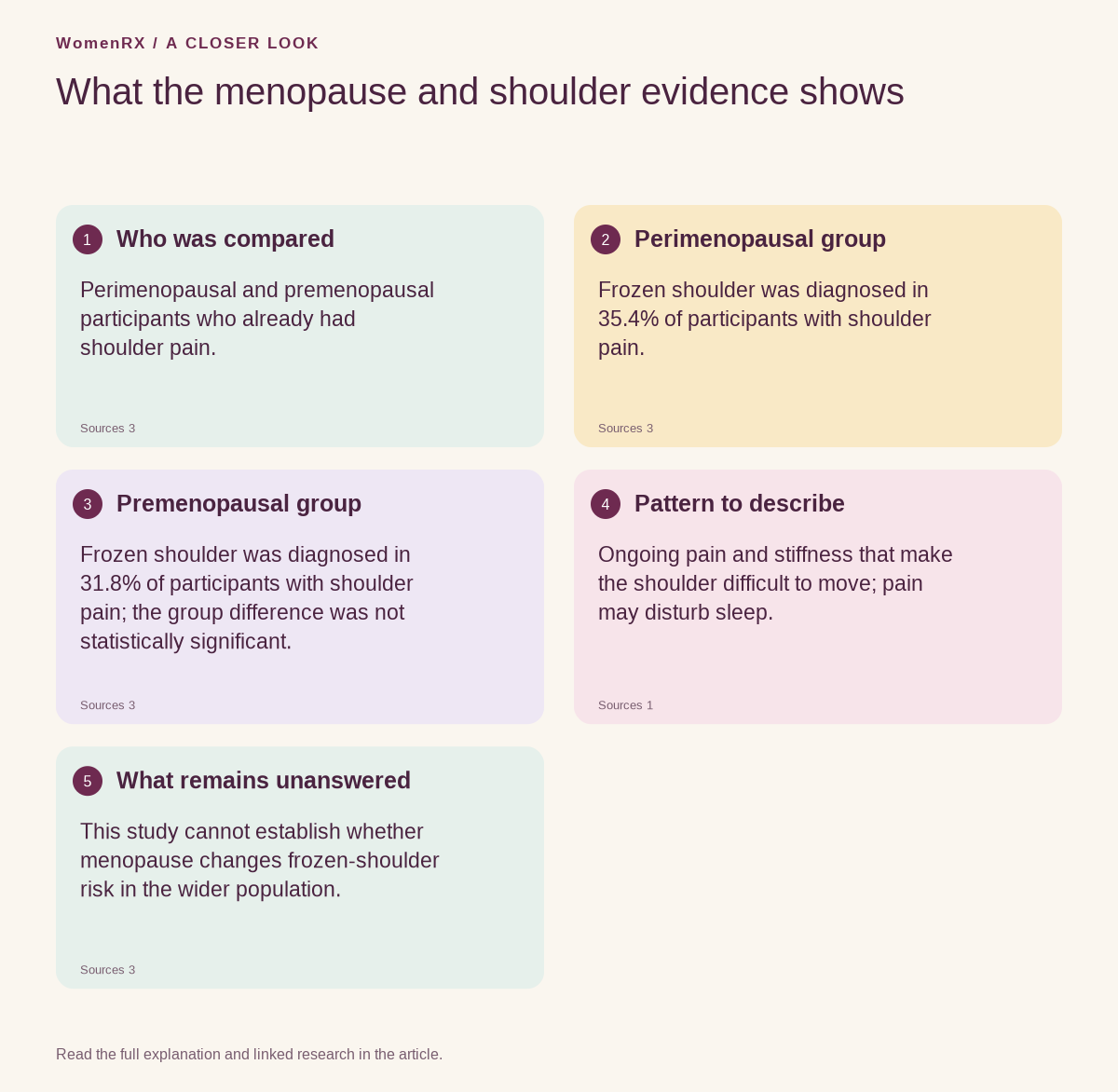
What the menopause and shoulder evidence shows
Who was compared: Perimenopausal and premenopausal participants who already had shoulder pain.3
Perimenopausal group: Frozen shoulder was diagnosed in 35.4% of participants with shoulder pain.3
Premenopausal group: Frozen shoulder was diagnosed in 31.8% of participants with shoulder pain; the group difference was not statistically significant.3
Pattern to describe: Ongoing pain and stiffness that make the shoulder difficult to move; pain may disturb sleep.1
What remains unanswered: This study cannot establish whether menopause changes frozen-shoulder risk in the wider population.3
Read the figure as text
Separate the study’s finding among people with shoulder pain from the symptom pattern and questions it cannot answer.- Who was compared: Perimenopausal and premenopausal participants who already had shoulder pain.3
- Perimenopausal group: Frozen shoulder was diagnosed in 35.4% of participants with shoulder pain.3
- Premenopausal group: Frozen shoulder was diagnosed in 31.8% of participants with shoulder pain; the group difference was not statistically significant.3
- Pattern to describe: Ongoing pain and stiffness that make the shoulder difficult to move; pain may disturb sleep.1
- What remains unanswered: This study cannot establish whether menopause changes frozen-shoulder risk in the wider population.3
Sources you can check
- Frozen shoulder - NHSAccessed 2026-09-25Return to first citation
- Shoulder pain - NHSAccessed 2026-09-25Return to first citation
- Perimenopausal arthralgia in the shoulder.Yoon S, Lee DH, Bang J. · Menopause (New York, N.Y.) · 2018Return to first citation