Frozen Shoulder in Midlife: What to Ask About Diagnosis and Recovery
The pattern of restricted movement can help guide an examination, but neither menopause nor an MRI alone explains every stiff shoulder.
Frozen shoulder, or adhesive capsulitis, often causes pain and restricted movement, especially when turning the arm outward or lifting it. An examination helps a clinician judge whether that pattern fits and consider other shoulder problems that may coexist. Treatment can focus on pain and movement, with options ranging from physical therapy and pain-relief medicines to injections or procedures. Recovery varies, so ask how progress will be assessed. 1 3 4

What the movement pattern can tell you
Frozen shoulder involves pain and a progressive loss of shoulder movement. Turning the arm outward and lifting it away from your body are often particularly limited. These features can make adhesive capsulitis a possibility, but they don’t prove it: other shoulder problems can cause symptoms too, and more than one problem may be present. In a study of 100 people diagnosed with frozen shoulder, rotator cuff and biceps tendon problems were also seen. 1 3 4
An examination helps put the pattern in context. Your clinician can assess which directions are restricted, how pain relates to movement, and whether the findings fit frozen shoulder or suggest another explanation. You can make that discussion more concrete by describing what’s become difficult, such as reaching a shelf, getting dressed, or sleeping comfortably on that side. Those examples describe how the problem affects you; they aren’t diagnostic tests.
Useful questions include:
- Which movements are most limited, and does that pattern fit frozen shoulder?
- Could another shoulder problem be contributing to my pain or stiffness?
- What findings would make you reconsider the diagnosis?
- Would imaging change what you recommend?
When imaging helps, and what it can’t settle
Imaging can add information, but it should be interpreted with the examination. A small study of people already diagnosed with frozen shoulder found that thickening in parts of the joint capsule was associated with more restricted movement. The study’s authors say MRI findings should be considered alongside clinical evaluation; the study did not establish MRI as a standalone test that distinguishes every cause of shoulder stiffness. 1
A clinical review says plain X-rays are often unremarkable, while MRI may show capsule thickening or other changes. So it’s reasonable to ask what a scan is meant to clarify and whether its result would change the plan. 4
Menopause may overlap with the timing
Frozen shoulder is often discussed in midlife and is reported more often in women, so it can arise around the same years as perimenopause or menopause. That timing does not show that hormonal changes caused an individual case. A preliminary medical-record pilot looked at postmenopausal women aged 40 to 60. It included 152 women using hormone therapy and 1,800 who weren’t; the difference in frozen-shoulder diagnoses wasn’t statistically significant. The study doesn’t establish whether hormone therapy prevents the condition, and it doesn’t answer why one person’s shoulder became stiff. 2 3 4
If hormone therapy is part of a separate conversation for you, this pilot isn’t evidence to start or change it for shoulder stiffness. 2
Match the care discussion to your main problem
Treatment discussions can focus on two related goals: easing pain and improving movement. Reviews describe physical therapy, oral anti-inflammatory medicines, and corticosteroid injections among nonsurgical options. They also discuss hydrodilatation, which expands the joint capsule with fluid, as well as procedures such as manipulation under anesthesia or arthroscopic capsular release for more persistent symptoms. These are options to discuss, not a required sequence; what makes sense depends on your examination, symptoms, and priorities. 3 4
A 2025 review reports that early corticosteroid injections are associated with shorter symptom duration and improved function, but that does not guarantee a particular result for you. Ask what the proposed treatment is intended to improve, how you’ll judge whether it’s helping, and what alternatives fit your situation. 4
A practical way to prepare is to name your biggest current difficulty, then ask:
- Is the immediate goal to reduce pain, improve movement, or both?
- What change in daily activity or movement would count as progress?
- How should I approach movement or physical therapy when pain is limiting me?
- When should we review the plan if pain, movement, or function isn’t improving?
- If nonsurgical care isn’t helping enough, what would make another option worth considering?
Most patients are reported to improve without surgery. One review says surgery is typically considered after 9 to 12 months of unsuccessful nonsurgical management, but that is a broad summary, not a deadline you must wait for or a prediction of your recovery. Ask how persistent pain, restricted movement, and your day-to-day function affect the timing in your case. 4
Think in phases, not a promised recovery date
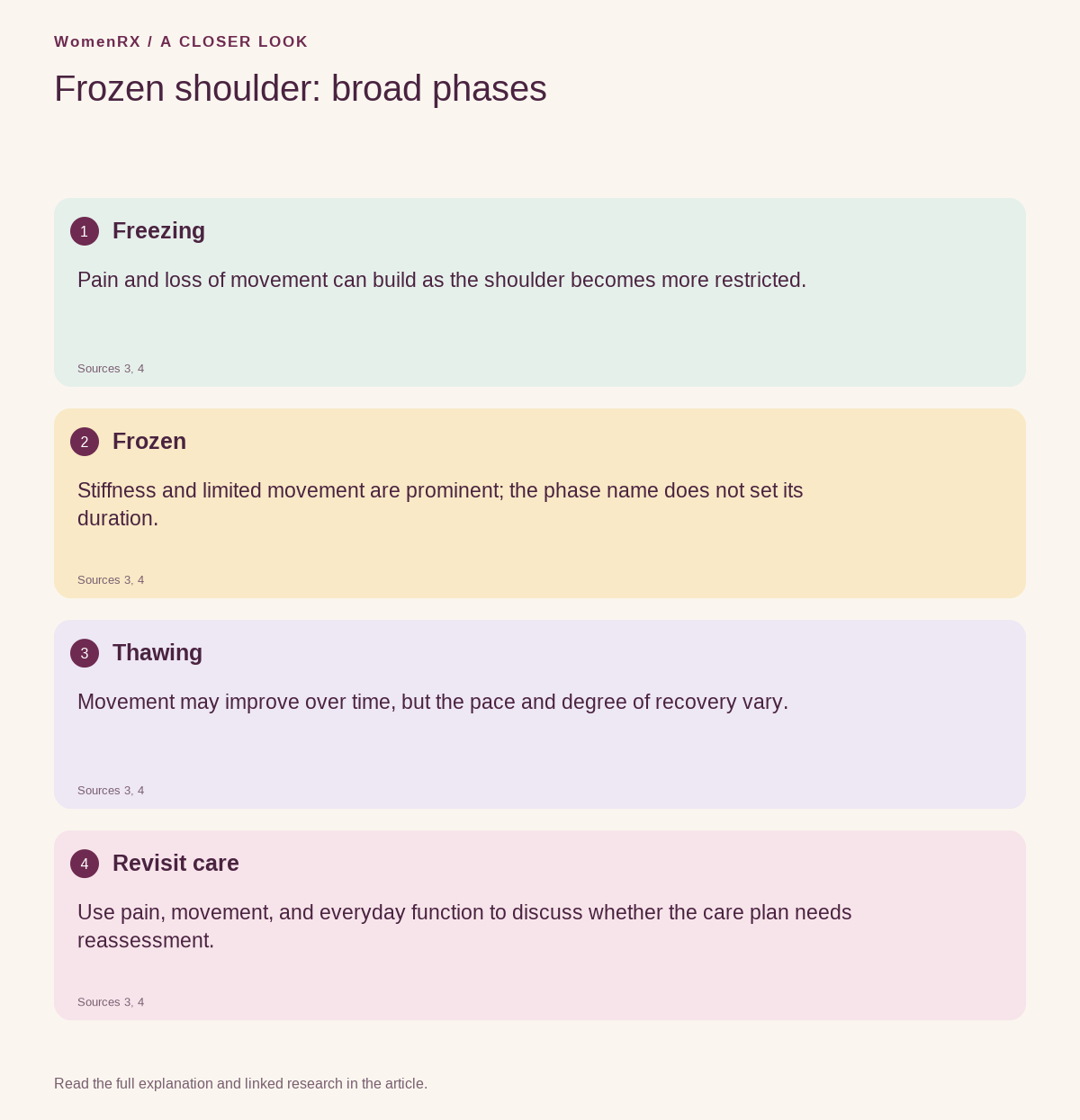
Reviews describe a broad course often called freezing, frozen, and thawing. Pain and movement loss can build, stiffness can become prominent, and movement may improve over time. These names describe phases, not a dependable calendar: they don’t tell you exactly how long your symptoms will last or which treatment you’ll need. 3 4
At follow-up, bring specific examples of what has changed, such as reaching, dressing, or sleeping. Then ask: “What progress are we looking for, and when should we revisit the plan if it isn’t happening?” That keeps the next decision grounded in your symptoms and function rather than a fixed recovery promise.
Frozen shoulder: broad phases
Freezing: Pain and loss of movement can build as the shoulder becomes more restricted.34
Frozen: Stiffness and limited movement are prominent; the phase name does not set its duration.34
Thawing: Movement may improve over time, but the pace and degree of recovery vary.34
Revisit care: Use pain, movement, and everyday function to discuss whether the care plan needs reassessment.34
Read the figure as text
These phase names describe a common pattern of symptoms, not how long your recovery will take or what treatment you’ll need.- Freezing: Pain and loss of movement can build as the shoulder becomes more restricted.34
- Frozen: Stiffness and limited movement are prominent; the phase name does not set its duration.34
- Thawing: Movement may improve over time, but the pace and degree of recovery vary.34
- Revisit care: Use pain, movement, and everyday function to discuss whether the care plan needs reassessment.34
More questions, answered
Does frozen shoulder always require surgery?
No. A clinical review reports that most patients achieve symptom resolution without surgery. Procedures are options for persistent symptoms when nonsurgical care has not been enough, rather than an automatic next step. 4
Sources you can check
- Quantitative MRI Evaluation of Coracohumeral Ligament and Inferior Glenohumeral Capsule Thickening in Adhesive Capsulitis: Correlation with Range of Motion and Edema Patterns.Soğukpınar Karaağaç S, Yeşilmen N. · The Eurasian journal of medicine · 2026Return to first citation
- A preliminary pilot study to address design issues related to research on potential association of hormone therapy and adhesive capsulitis.Reinke EK, Ford AC, Wahl E, Kennedy J, Poehlein E, Green CL, Saltzman E, Wittstein JR. · Climacteric : the journal of the International Menopause Society · 2026Return to first citation
- Adhesive Capsulitis: A Comprehensive Review of Pathogenesis, Diagnosis, and Clinical Management.Diekemper A, Martinez A, Gibbs H, Cruz C, Zhou L, Song DJ. · The Iowa orthopaedic journal · 2026Return to first citation
- Adhesive Capsulitis of the Shoulder.Mullen JP, Hauer TM, Lau EN, Lin A. · Arthroscopy : the journal of arthroscopic & related surgery : official publication of the Arthroscopy Association of North America and the International Arthroscopy Association · 2025Return to first citation