Shoulder Stiffness in Your 40s: Could It Be Frozen Shoulder?
A gradually painful, stiff shoulder can fit frozen shoulder, but your age or menopause stage can’t identify the cause on its own.
Frozen shoulder is more likely when pain builds gradually and the shoulder loses movement in many directions, including when someone else gently moves your arm. That pattern matters more than being in your 40s. Frozen shoulder is common in middle-aged women, but that doesn’t prove perimenopause caused your symptoms; several other shoulder and neck conditions can look similar. 3 4 5 6
The movement pattern matters more than your age
Frozen shoulder, or adhesive capsulitis, develops when tissue around the shoulder joint becomes inflamed and tightens. The typical experience is a painful, increasingly stiff shoulder. Pain may be worse at night, and everyday movements can become difficult. 1 3
A clinician looks at how much movement you can do yourself and how much the shoulder moves when they gently move your arm for you. A broad loss of both active and passive movement, often with pain near the limit in several directions, is a recognized pattern for adhesive capsulitis. It can be difficult to identify early, so one symptom or one visit may not settle the question. 4
That examination helps distinguish a stiff joint from pain that limits movement for another reason. It does not mean every other condition has one neat, opposite movement pattern. Rotator cuff problems, bursitis, biceps tendon problems, arthritis, and other conditions can also cause shoulder pain and restricted movement, and more than one problem can be present. 5
What else may be behind the pain?
A clinician may consider several possibilities:
- Rotator cuff or biceps tendon problems, or bursitis: These are among the conditions that can cause shoulder pain and limited movement. The exam helps assess the overall pattern rather than relying on the location of pain alone. 5
- Arthritis or calcific tendinitis: These can resemble frozen shoulder. A 2024 review describes X-rays as part of basic assessment to help rule out these and other alternatives. 3
- Pain referred from the neck: Shoulder and neck problems can mimic one another, so the clinician may consider both. 6
- More than one condition: Frozen shoulder can occur alongside rotator cuff tendinopathy or bursitis, among other conditions. 5
Frozen shoulder is primarily diagnosed from the clinical picture. Imaging may help check for another explanation; it is not automatically needed to establish the diagnosis. A small MRI study of 24 people with adhesive capsulitis who went on to surgery found tissue changes that corresponded with findings at surgery, but that selected group does not make MRI a stand-alone test for everyone with shoulder stiffness. 2 3
Where perimenopause fits, and where it doesn’t
Frozen shoulder is described as affecting middle-aged women particularly often. That is an age-and-sex pattern, not proof that changing hormones cause a particular person’s shoulder problem. The research summarized here does not establish that perimenopause causes adhesive capsulitis or provide a way to diagnose it from menopause symptoms. 3
So if you’re in your 40s, perimenopause may be part of your broader health context, but it shouldn’t replace an assessment of the shoulder itself. A gradually worsening shoulder with restricted movement in several directions deserves attention whether or not you’re also having hot flashes, cycle changes, or other menopause symptoms.
A useful next step
If pain and stiffness are persisting, worsening, disturbing sleep, or making it hard to move your arm, arrange an evaluation. You can describe what has changed over time and which movements are difficult; the clinician can compare your own movement with gentle movement of the arm, consider other causes, and decide whether imaging would help. 1 4
If frozen shoulder is the diagnosis, the condition can take months or longer to improve. Gentle movement and exercises recommended for your situation may help maintain or regain movement; forcing strenuous movements can make pain worse. 1 3
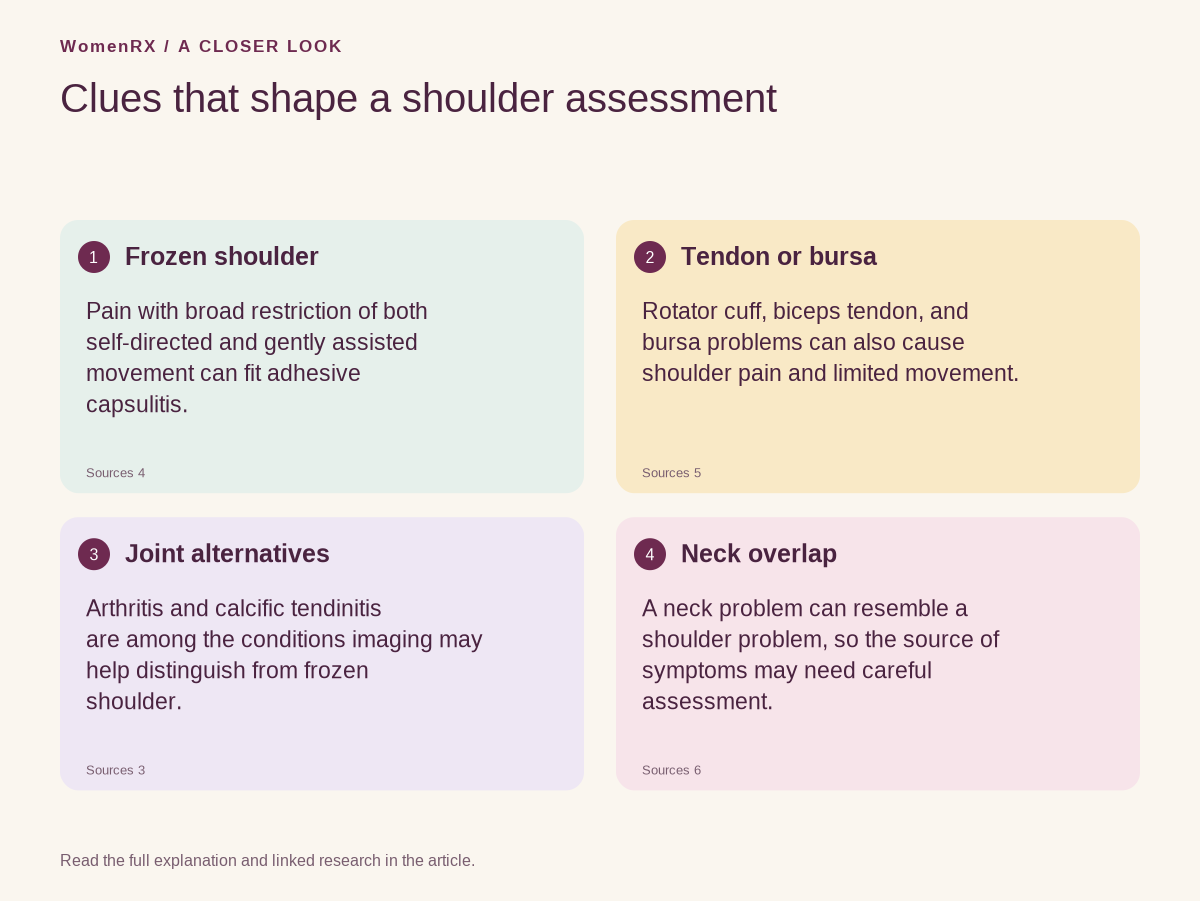
Clues that shape a shoulder assessment
Frozen shoulder: Pain with broad restriction of both self-directed and gently assisted movement can fit adhesive capsulitis.4
Tendon or bursa: Rotator cuff, biceps tendon, and bursa problems can also cause shoulder pain and limited movement.5
Joint alternatives: Arthritis and calcific tendinitis are among the conditions imaging may help distinguish from frozen shoulder.3
Neck overlap: A neck problem can resemble a shoulder problem, so the source of symptoms may need careful assessment.6
Read the figure as text
These patterns can guide what a clinician considers, but none diagnoses the cause on its own.- Frozen shoulder: Pain with broad restriction of both self-directed and gently assisted movement can fit adhesive capsulitis.4
- Tendon or bursa: Rotator cuff, biceps tendon, and bursa problems can also cause shoulder pain and limited movement.5
- Joint alternatives: Arthritis and calcific tendinitis are among the conditions imaging may help distinguish from frozen shoulder.3
- Neck overlap: A neck problem can resemble a shoulder problem, so the source of symptoms may need careful assessment.6
More questions, answered
Does frozen shoulder usually affect just one shoulder?
The review describes adhesive capsulitis as usually unilateral, meaning it typically affects one shoulder. That pattern can be useful context, but it doesn’t confirm the diagnosis. 3
Does a scan confirm frozen shoulder?
Usually the diagnosis is made from symptoms and examination. Imaging can help assess or rule out other causes, such as arthritis or calcific tendinitis; MRI findings may add information but are not, by themselves, a diagnosis for every person. 2 3
Sources you can check
- Frozen shoulder - NHSAccessed 2026-09-25Return to first citation
- Adhesive capsulitis: role of MR imaging in differential diagnosis.Connell D, Padmanabhan R, Buchbinder R. · European radiology · 2002Return to first citation
- [Adhesive capsulitis].Kuhn I, Erber B, Goller SS. · Radiologie (Heidelberg, Germany) · 2024Return to first citation
- Adhesive capsulitis: establishing consensus on clinical identifiers for stage 1 using the DELPHI technique.Walmsley S, Rivett DA, Osmotherly PG. · Physical therapy · 2009Return to first citation
- Adhesive capsulitis: a review.Ewald A. · American family physician · 2011Return to first citation
- Cervical spondylosis: recognition, differential diagnosis, and management.Voorhies RM. · Ochsner journal · 2001Return to first citation