Frozen Shoulder Around Menopause: What Can Help?
A shoulder that hurts and gradually becomes hard to move may be frozen shoulder, but menopause alone doesn’t explain it.
Frozen shoulder, or adhesive capsulitis, causes shoulder pain and a gradual loss of movement; it can make dressing and sleep difficult. It’s assessed mainly through your history and a movement exam, since other shoulder problems can look similar. Menopause hasn’t been established as the cause. Gentle movement, pain relief, physical therapy, and sometimes a steroid injection are options to discuss. 1 2 5
When shoulder stiffness may be frozen shoulder
Frozen shoulder usually brings two problems together: pain and increasing stiffness. The pain can be worse at night, while limited movement may make it hard to reach overhead, behind your back, or into a sleeve. The shoulder capsule, the tissue surrounding the joint, becomes inflamed and then tighter, restricting movement. Symptoms can last for months or longer, and recovery may be gradual. 1 5
A key clue is that movement is restricted both when you move your arm yourself and when someone else moves it for you. Clinicians assess this pattern, often paying particular attention to outward rotation. Frozen shoulder is a clinical diagnosis: your history and physical exam are central, while ultrasound or MRI may help as supporting tests or help distinguish other problems. Imaging alone doesn’t establish the diagnosis. 4 5
Other shoulder conditions can cause pain, but their patterns may differ. Pain that’s especially noticeable when you use the arm can occur with tendon or bursa problems. Tingling, numbness, or weakness may point toward another issue; sudden severe pain, major difficulty moving the arm, or a changed shoulder shape can occur with an injury such as a dislocation or fracture. These clues don’t diagnose the cause, but they’re reasons not to assume every painful shoulder is frozen shoulder. 2
What menopause does, and doesn’t, explain
Frozen shoulder is often seen in adults in midlife, and a review reports higher incidence in women than in men. That does not show that the menopausal transition causes the condition: the review does not report a menopause-specific risk estimate. Diabetes is a more clearly identified risk factor; clinical guidelines also name thyroid disease and dyslipidemia. 4 5
Some recent laboratory and animal research has explored how estrogen might affect fibrosis in frozen shoulder. Those findings are not proof that falling estrogen causes frozen shoulder in women, or that hormone therapy treats shoulder pain or stiffness. The research described used an animal model and cells from people with frozen shoulder, not a clinical trial showing that hormone therapy improves symptoms. 3
Choosing a first step
Gentle movement and watchful waiting: Frozen shoulder often improves over time, but waiting doesn’t have to mean stopping all movement. Keep the shoulder moving gently within what you can tolerate, and avoid repeatedly forcing a movement that causes pain. If symptoms persist or interfere substantially with daily activities, get assessed rather than relying on time alone. 1 5
Pain relief: Managing pain may make everyday movement more manageable. Over-the-counter pain relievers are among the options described in general frozen-shoulder guidance, but the right choice depends on your health and other medicines. A clinician or pharmacist can help you weigh options; don’t exceed package directions. 1
Physical therapy: A physical therapist can assess how the shoulder moves and help you work toward restoring motion. Therapy and exercise may help reduce pain and improve function, though the best approach depends on your symptoms. The aim is supported movement, not pushing through sharp or worsening pain. 1 5
Steroid injection: An injection into the shoulder joint is a treatment option recommended in clinical guidelines. It may be discussed when pain and stiffness remain troublesome. The guidelines also identify physical therapy or hydrodilatation combined with a steroid injection as possible approaches. Which option makes sense depends on your situation and a clinician’s assessment. 5
Specialist assessment: If symptoms remain limiting despite initial care, ask what other options are appropriate and what tradeoffs they involve. A large UK trial, described in a later implementation paper, found improvement with several treatment approaches but no overall clinically superior option among those compared. That finding supports discussing benefits and downsides rather than assuming one procedure is best for everyone; it doesn’t determine which treatment is right for you. 6
When to get assessed
Arrange a routine assessment if shoulder pain and stiffness aren’t going away or make it very difficult to move your arm. Seek prompt evaluation for sudden severe pain, especially after an injury, or if the shoulder looks out of shape or you can’t move the arm. Those features can signal a problem other than frozen shoulder that needs different care. 1 2
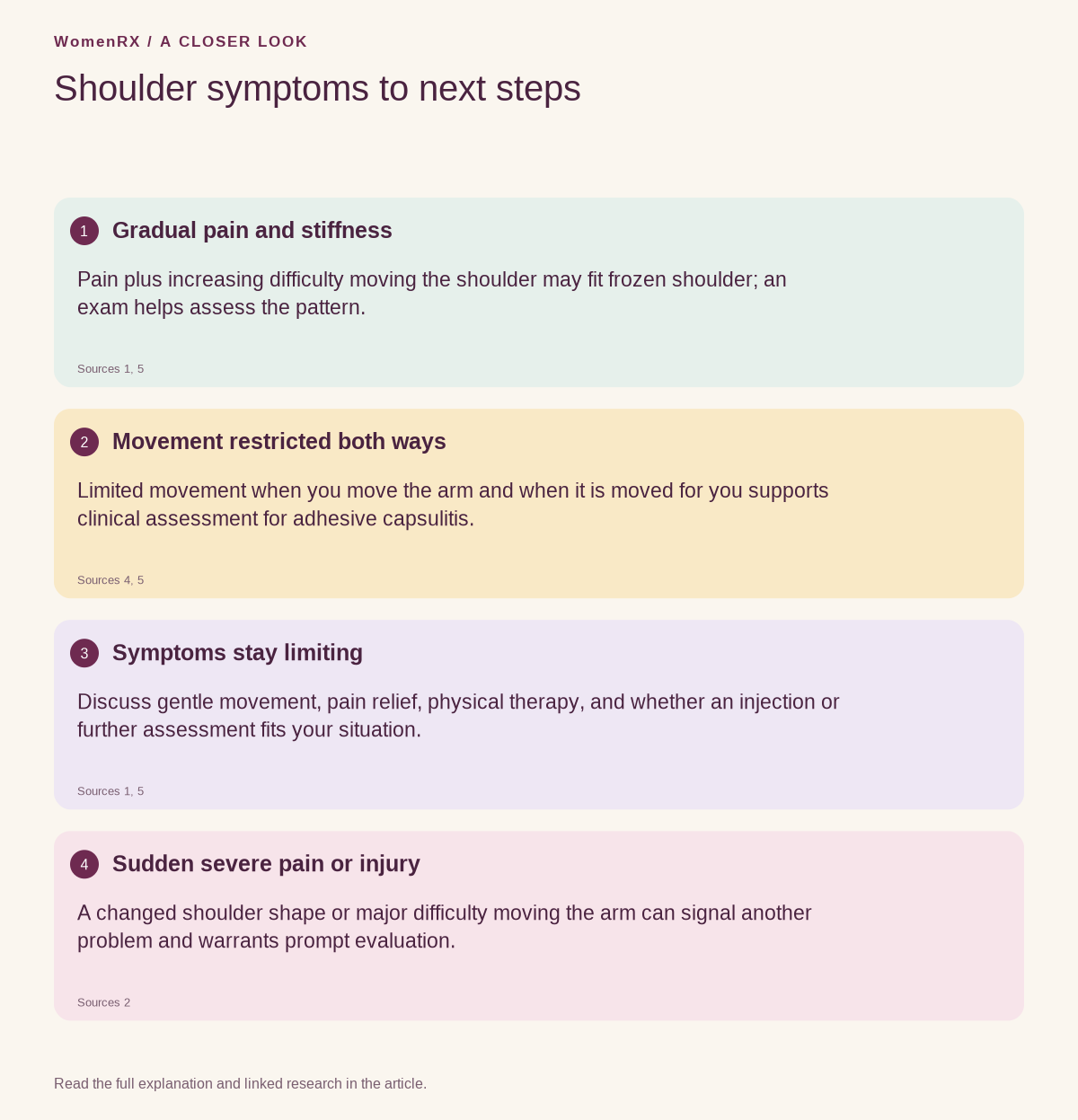
Shoulder symptoms to next steps
Gradual pain and stiffness: Pain plus increasing difficulty moving the shoulder may fit frozen shoulder; an exam helps assess the pattern.15
Movement restricted both ways: Limited movement when you move the arm and when it is moved for you supports clinical assessment for adhesive capsulitis.45
Symptoms stay limiting: Discuss gentle movement, pain relief, physical therapy, and whether an injection or further assessment fits your situation.15
Sudden severe pain or injury: A changed shoulder shape or major difficulty moving the arm can signal another problem and warrants prompt evaluation.2
Read the figure as text
A simple route from the pattern of shoulder symptoms to the kind of assessment or care to consider.- Gradual pain and stiffness: Pain plus increasing difficulty moving the shoulder may fit frozen shoulder; an exam helps assess the pattern.15
- Movement restricted both ways: Limited movement when you move the arm and when it is moved for you supports clinical assessment for adhesive capsulitis.45
- Symptoms stay limiting: Discuss gentle movement, pain relief, physical therapy, and whether an injection or further assessment fits your situation.15
- Sudden severe pain or injury: A changed shoulder shape or major difficulty moving the arm can signal another problem and warrants prompt evaluation.2
More questions, answered
Should I ask about hormone therapy for frozen shoulder?
The estrogen-related research described so far is experimental, not evidence that hormone therapy improves frozen shoulder in women. If you use or are considering hormone therapy for menopause symptoms, discuss that for its established menopause-related reasons rather than expecting it to treat shoulder stiffness. 3 7
Does having diabetes change the conversation?
Yes. Diabetes is identified as a risk factor for frozen shoulder, so mention it during an assessment. It doesn’t confirm the diagnosis, and shoulder stiffness still needs to be considered alongside other possible causes. 5
Sources you can check
- Frozen shoulder - NHSAccessed 2026-09-25Return to first citation
- Shoulder pain - NHSAccessed 2026-09-25Return to first citation
- Mechanistic insights into the anti-fibrotic effects of estrogen via the PI3K-Akt pathway in frozen shoulder.Wang Z, Li X, Liu X, Yang Y, Yan Y, Cui D, Meng C, Ali MI, Zhang J, Yao Z, Long Y, Yang R. · The Journal of steroid biochemistry and molecular biology · 2025Return to first citation
- Ultrasound in Adhesive Capsulitis: A Narrative Exploration from Static Imaging to Contrast-Enhanced, Dynamic and Sonoelastographic Insights.Wu WT, Chang KV, Mezian K, Ricci V, Gonzalez-Suarez CB, Özçakar L. · Diagnostics (Basel, Switzerland) · 2025Return to first citation
- Clinical Practice Guidelines for Diagnosis and Non-Surgical Treatment of Primary Frozen Shoulder.Lee BC, Kim BS, Lee BJ, Moon CW, Park CH, Kim DH, Yun DH, Park D, Kim DY, Kim DH, Kim GW, Kim HJ, Jung IY, Kim IJ, Park JH, Lee JH, Ahn J, Lim JY, Yoon JA, Lee JH, Hwang JM, Kim K,... · Annals of rehabilitation medicine · 2025Return to first citation
- Implementing evidence into practice for the management of frozen shoulder: engaging with key stakeholders and evaluating barriers and facilitators using the Consolidated Framework for Implementation Research.Clark NL, Johnson M, Kottam L, Brealey S, Adamson J, Rangan A, UK FROST Stakeholder Group. · Health research policy and systems · 2025Return to first citation
- The 2022 hormone therapy position statement of The North American Menopause Society.“The 2022 Hormone Therapy Position Statement of The North American Menopause Society” Advisory Panel. · Menopause (New York, N.Y.) · 2022Return to first citation