Frozen Shoulder Around Menopause: What Helps and When to Get Assessed
Frozen shoulder can cause deep aching and steadily limited movement, but gentle guided motion and the right assessment can help you choose a sensible next step.
Frozen shoulder usually causes shoulder pain, sometimes worse at night, along with stiffness that makes the arm harder to move. Gentle movement is preferable to forcing painful stretches; a physical therapist can guide exercises, and a clinician may discuss pain relief or a steroid injection. Seek assessment if the stiffness persists, limits arm movement, or the pain is sudden or severe. 12
The pattern matters more than the label
Frozen shoulder, also called adhesive capsulitis, happens when tissue around the shoulder joint becomes inflamed, then tightens and shrinks. That can cause pain and a gradual loss of movement. A common clue is stiffness that affects ordinary movements, such as reaching up or behind you, often alongside pain that may disturb sleep. In adhesive capsulitis, both your own movement and the movement possible when someone else moves your arm can be limited. 14
Frozen shoulder is reported more often in women and is common in midlife, but that association doesn’t show that menopause itself causes it. Shoulder symptoms around menopause still deserve an assessment based on their pattern, not an assumption that they are hormonal. 4
Keep movement gentle, not forceful
The aim is to keep the shoulder moving without provoking a major pain flare. Avoid movements that hurt, and try only gentle movement or exercises recommended for you. Strenuous exercises you make up yourself, including using gym equipment to push through stiffness, can make the pain worse. A physical therapist can check your range of motion and tailor movement to your shoulder. 1
That’s a different approach from either forcing a stretch or avoiding all movement. If pain is making it hard to move, ask about ways to ease it enough to stay gently active. NHS guidance lists pain relief first, then stronger relief or a shoulder steroid injection for some people, with exercises and physiotherapy to work on movement. The right mix depends on how painful and stiff the shoulder is. 1
What physiotherapy and injections may offer
Physiotherapy focuses on getting movement back, with exercises selected after checking how the shoulder moves. If pain and stiffness continue, a clinician may discuss an injection as part of the plan rather than as a substitute for movement work. 1
A 2026 meta-analysis of five randomized trials, involving 198 adults, compared physiotherapy alone with physiotherapy plus an injection of corticosteroid into the shoulder joint. At follow-up periods of 6 to 24 weeks, the combined approach showed greater improvement in function and some measures of range of motion. It did not show a significant advantage for pain scores or internal rotation. This suggests the combination may help some short-term movement and function outcomes, but it doesn’t promise pain relief or establish which approach is best for every person. 3
An injection is a clinician-delivered option to weigh against its likely benefits and limitations. If it comes up, ask what improvement is realistic in your case and how it fits with a movement plan. Don’t take a result from a group of trial participants as a guarantee of your own recovery.
Recovery can take a while
Frozen shoulder often improves eventually, but pain and stiffness may take months or years to settle. Progress may feel slow, so a few difficult days don’t necessarily mean movement work has failed. If you finish a course of physiotherapy and still have significant pain, the next step may be reassessing the shoulder and considering whether more therapy or another treatment makes sense. 1
There isn’t a supported basis here for promising that a natural remedy will restore shoulder motion. Gentle movement is not the same as an untested remedy: it is part of the care guidance, ideally adapted to your symptoms. 1
When it may be something else
Not every stiff or painful shoulder is frozen shoulder. Pain that is especially worse when using the arm can have other causes, including tendon or bursa problems. Tingling, numbness, or weakness may point toward a different issue. Sudden, very severe pain or being unable to move the arm needs urgent assessment, especially after an injury. 2
If your shoulder stays painful and stiff or the pain is making it hard to move your arm, arrange an assessment rather than trying to diagnose it yourself. A clinician can examine the movement pattern and decide whether another cause needs to be considered. 12
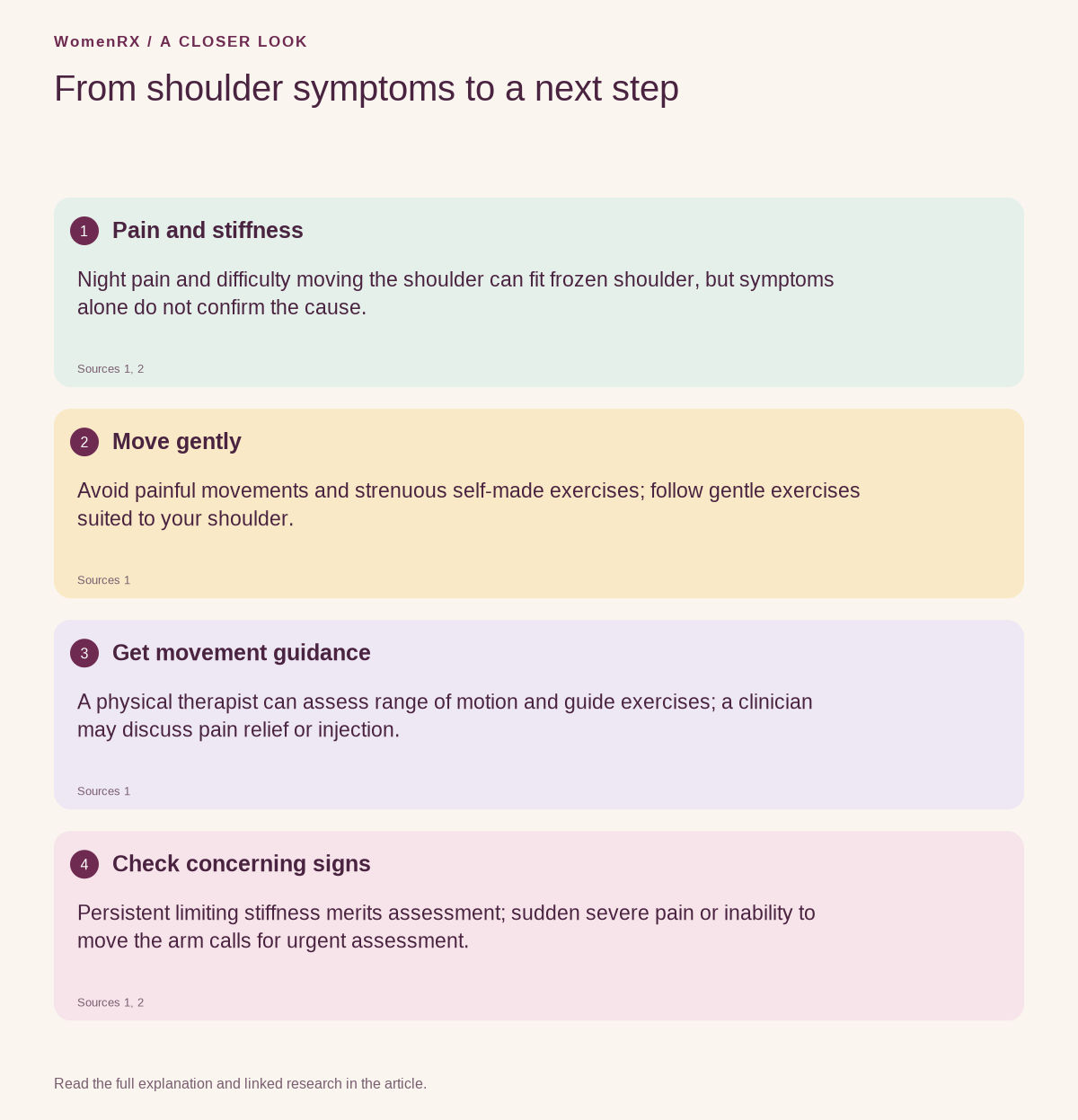
From shoulder symptoms to a next step
Pain and stiffness: Night pain and difficulty moving the shoulder can fit frozen shoulder, but symptoms alone do not confirm the cause.12
Move gently: Avoid painful movements and strenuous self-made exercises; follow gentle exercises suited to your shoulder.1
Get movement guidance: A physical therapist can assess range of motion and guide exercises; a clinician may discuss pain relief or injection.1
Check concerning signs: Persistent limiting stiffness merits assessment; sudden severe pain or inability to move the arm calls for urgent assessment.12
Read the figure as text
A simple path separates a common frozen-shoulder pattern from signs that call for assessment and shows where gentle movement and clinical options fit.- Pain and stiffness: Night pain and difficulty moving the shoulder can fit frozen shoulder, but symptoms alone do not confirm the cause.12
- Move gently: Avoid painful movements and strenuous self-made exercises; follow gentle exercises suited to your shoulder.1
- Get movement guidance: A physical therapist can assess range of motion and guide exercises; a clinician may discuss pain relief or injection.1
- Check concerning signs: Persistent limiting stiffness merits assessment; sudden severe pain or inability to move the arm calls for urgent assessment.12
Sources you can check
- Frozen shoulder - NHSAccessed 2026-09-25Return to first citation
- Shoulder pain - NHSAccessed 2026-09-25Return to first citation
- Intra-articular corticosteroid Injection combined with physical therapy versus physical therapy alone for adhesive capsulitis: a meta-analysis of randomized controlled trials.Boutros M, Awad G, Adio A, Lawand J, Z Khan A, W Hill B, G Horneff J, A Abboud J. · European journal of orthopaedic surgery & traumatology : orthopedie traumatologie · 2026Return to first citation
- Efficacy of ultrasound-guided intra-articular hyaluronic acid injection in the management of adhesive capsulitis: a randomized controlled trial.Chang CY, Chen CT, Lin YH, Chiang CF, Mao YW, Chou LW. · Journal of rehabilitation medicine · 2026Return to first citation