Itchy Skin Around Menopause: Do Supplements Help?
Dry skin may respond to simple care, but a supplement can’t tell you why an itch keeps coming back.
Itching is common after menopause, but its timing doesn’t tell you the cause. Gentle skin care may ease itching from dry or irritated skin. Studies of supplements for eczema don’t establish that supplements relieve menopause-related itch. If itching is severe, widespread, unexplained, or lasts for weeks, checking the cause is more useful than trying a supplement. 1 2 5 6
Start with where and how you itch
An itchy, dry-looking patch is a different question from itching all over with no obvious skin change. Dry or irritated skin can itch, and so can eczema, allergies, hives, infections, and reactions to medicines. Less commonly, thyroid, liver, or kidney problems can be involved. Itching after menopause is common and often improves over time, but menopause doesn’t rule out another cause. 1 2
If your skin looks dry or irritated, you can start by avoiding perfumed soaps and moisturizers, irritating fabrics, and high heat. Patting instead of scratching and using a cool compress may make the itch easier to bear. These steps can soothe skin; they won’t explain an itch that spreads, persists, or has no apparent skin trigger. 1 2
A rash or hives changes the picture, too. They can offer clues about a skin condition or reaction, though their appearance alone doesn’t identify the cause. If itching began around the time you started a medicine, bring that timing and the medicine’s name to an assessment. Medicines are among the possible causes of itching. 1 2
What vitamin D and omega-3s can, and can’t, tell you
Vitamin D: Treating a vitamin D deficiency is a reason to use a supplement, but itching by itself doesn’t establish that you’re deficient. If you’re at risk, a blood test can measure your vitamin D level. Research on vitamin D in atopic dermatitis, a form of eczema, cannot show that it treats itching that begins around menopause. 3 5 6
Omega-3s: A deficiency of essential fatty acids can cause rough, scaly skin and dermatitis. But classical essential-fatty-acid deficiency is virtually nonexistent in healthy people in the United States. Those deficiency-related skin signs aren’t evidence that a fish-oil supplement will relieve an otherwise unexplained itch. 4
Even in eczema, supplement findings call for care. A systematic review covering 18 studies and 881 people with atopic dermatitis found weak evidence for any one nutritional supplement. A separate meta-analysis of 18 randomized trials involving 763 people with atopic dermatitis found that antioxidant interventions improved overall eczema-severity scores, but did not significantly improve itch scores overall. It included different interventions, including oral vitamins and topical vitamin B12; the severity benefit reported in a subgroup analysis was seen in children, not adults. Neither analysis establishes a benefit for menopause-related itching. 5 6
The useful distinction is between addressing a demonstrated deficiency and using a supplement as a treatment for itch. The first has its own reason and assessment. The second can leave the cause of a persistent symptom unanswered. 3 4 5
When skin care isn’t enough
Arrange an assessment if itching is severe, affects daily life, has no apparent cause, or hasn’t gone away after a few weeks. Widespread itching, especially without an obvious dry or irritated area, is another reason to look beyond skin care rather than assume it’s menopause. A clinician may examine your skin, ask about symptoms and medicines, and use blood tests when needed to help find the cause. 1 2
If there’s a rash or hives, describe where they appeared and whether they came with other symptoms. If you suspect a medicine, include when you started it relative to the itch. Those details may help distinguish a skin condition or reaction from itching that needs a broader assessment. 1 2
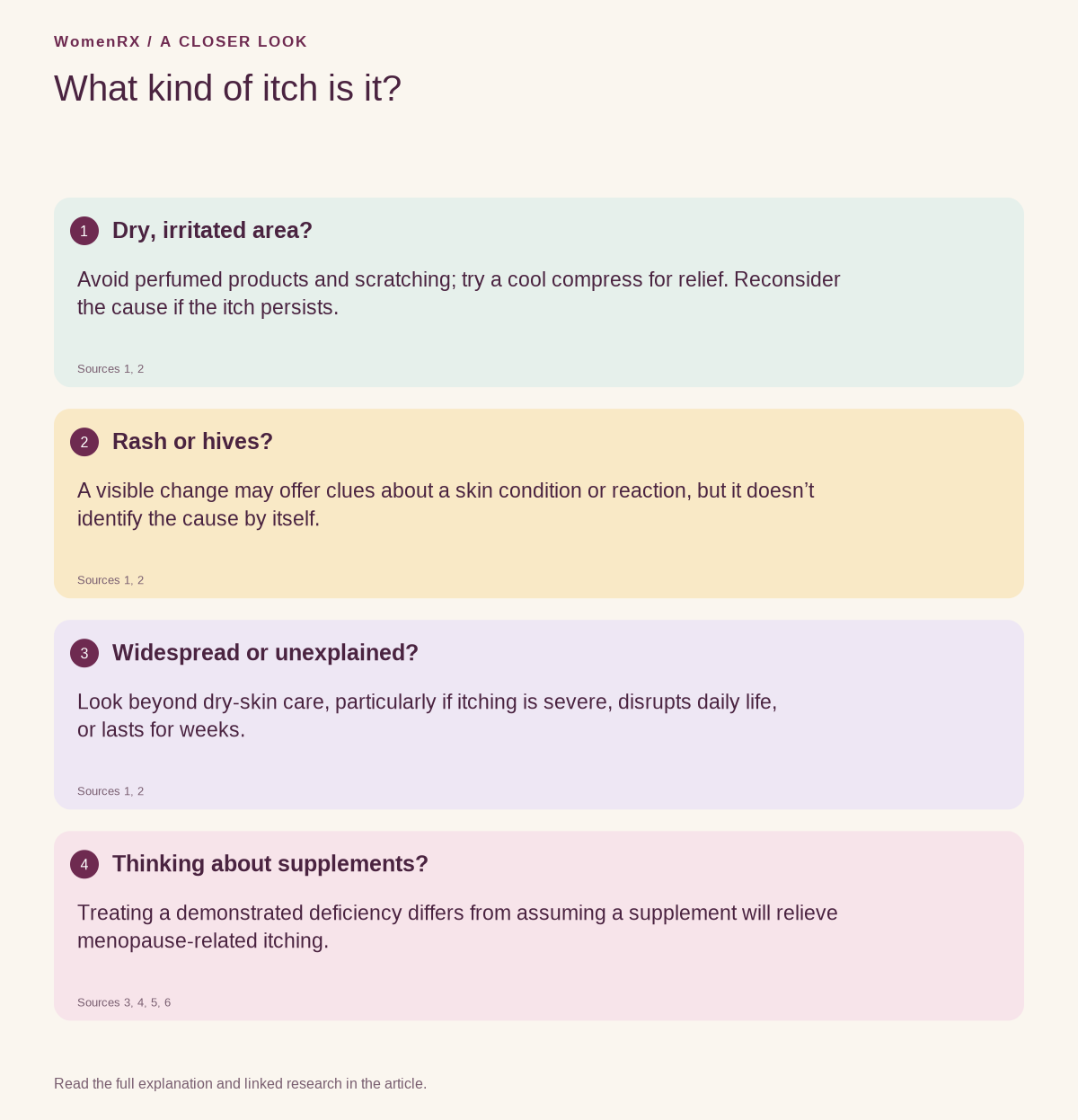
What kind of itch is it?
Dry, irritated area?: Avoid perfumed products and scratching; try a cool compress for relief. Reconsider the cause if the itch persists.12
Rash or hives?: A visible change may offer clues about a skin condition or reaction, but it doesn’t identify the cause by itself.12
Widespread or unexplained?: Look beyond dry-skin care, particularly if itching is severe, disrupts daily life, or lasts for weeks.12
Thinking about supplements?: Treating a demonstrated deficiency differs from assuming a supplement will relieve menopause-related itching.3456
Read the figure as text
The pattern helps you choose between a skin-care first step and an assessment of possible causes.- Dry, irritated area?: Avoid perfumed products and scratching; try a cool compress for relief. Reconsider the cause if the itch persists.12
- Rash or hives?: A visible change may offer clues about a skin condition or reaction, but it doesn’t identify the cause by itself.12
- Widespread or unexplained?: Look beyond dry-skin care, particularly if itching is severe, disrupts daily life, or lasts for weeks.12
- Thinking about supplements?: Treating a demonstrated deficiency differs from assuming a supplement will relieve menopause-related itching.3456
Sources you can check
- Itching | Pruritus | Itchy skin | MedlinePlusAccessed 2026-09-25Return to first citation
- Itchy skin - NHSAccessed 2026-09-25Return to first citation
- Vitamin D Deficiency: MedlinePlusAccessed 2026-09-25Return to first citation
- Omega-3 Fatty Acids - Health Professional Fact SheetAccessed 2026-09-25Return to first citation
- Clinical Efficacy of Nutritional Supplements in Atopic Dermatitis: Systematic Review.Weber I, Woolhiser E, Keime N, Wasvary M, Adelman MJ, Sivesind TE, Dellavalle RP. · JMIR dermatology · 2023Return to first citation
- Efficacy and safety profile of antioxidants in the treatment of atopic dermatitis: A systematic review and meta-analysis of randomized controlled trials.Yang H, Chen JS, Luo XY, Wang H. · Dermatologic therapy · 2022Return to first citation