Skin Supplements for Women: What Sex-Specific Evidence Shows
A study that includes women can suggest a benefit, but it doesn’t show that sex or life stage changes the result.
A review of 10 randomized trials found improvements in skin hydration and elasticity with collagen supplements, and its authors said the findings were more applicable to females. That isn’t the same as showing women respond differently from men. The review abstract doesn’t report results by menstrual status, pregnancy, lactation, or menopause, so it can’t answer whether the effect changes at those stages. 4
Included in a study doesn’t mean studied separately
If a skin supplement is marketed “for women,” look for two different things: whether women took part in the research, and whether researchers compared results by sex or hormonal life stage. A study can include many women and still leave the second question unanswered.
For collagen, a systematic review and meta-analysis combined 10 randomized trials with 646 participants. The authors reported statistical improvements in skin hydration and elasticity. They also said the findings were more applicable to females. But the abstract doesn’t describe a direct comparison of treatment effects in women versus men. “More applicable to females” is a reason to pay attention to who was studied, not proof that women benefit more. 4
There are other reasons to be measured about what that result means for you. The review reports moderate variation across the trials and generally unclear risk of bias. Its abstract doesn’t establish that every collagen product has the same effect, or that the results apply to every skin concern. 4
Life stage is a separate question
The collagen review abstract doesn’t report results for people by menstrual status, pregnancy, lactation, or menopause. That doesn’t prove no such research exists; it means this review’s reported findings don’t tell you whether collagen works differently at those stages. A result in a group described as female shouldn’t be treated as a result specific to a particular hormonal situation. 4
Pregnancy is especially worth separating from a cosmetic claim. Nutrient needs change during pregnancy to support maternal health and fetal development, and pregnancy guidance discusses nutrients such as zinc and omega-3 fatty acids in that context. That guidance does not establish a skin benefit from taking either nutrient as a supplement. A skin-focused claim and a pregnancy nutrition need are different questions. 1
A nutrient’s role isn’t proof of a skin treatment
Zinc deficiency can affect skin, but that fact alone doesn’t show that zinc supplements improve skin in someone who isn’t deficient. The zinc fact sheet also notes that serum zinc measurements have limitations and can vary with age, sex, time of day, and changes in steroid hormones. A biological difference in a measurement is not evidence that a skin supplement works differently by sex. 2
Omega-3 deficiency can cause rough, scaly skin and dermatitis. But the NIH fact sheet says clinical signs of essential-fatty-acid deficiency are usually found in people receiving nutrition without adequate polyunsaturated fats. That deficiency-related finding is not evidence that omega-3 supplements improve ordinary dryness, wrinkles, or another skin concern in people without a deficiency. 3
A practical test for “made for women” claims
When you’re weighing a supplement claim, ask what the study actually tested:
- Was a skin outcome measured? A study of nutrient levels or general health doesn’t by itself show a skin benefit.
- Were women included, and were results compared by sex? The first tells you who participated; the second can help show whether effects differed.
- Was your life stage reported? Findings in a broad female group don’t automatically apply to menstruation, pregnancy, lactation, or menopause.
- Was the supplement tested for your concern? Hydration and elasticity results don’t establish effects on every skin issue.
For collagen, there is a reported signal for hydration and elasticity, with limits in how specifically the findings apply. For zinc and omega-3s, the skin connection described in these references is about deficiency, not a demonstrated routine cosmetic benefit. Those distinctions are more useful than a women-focused label on its own. 2 3 4
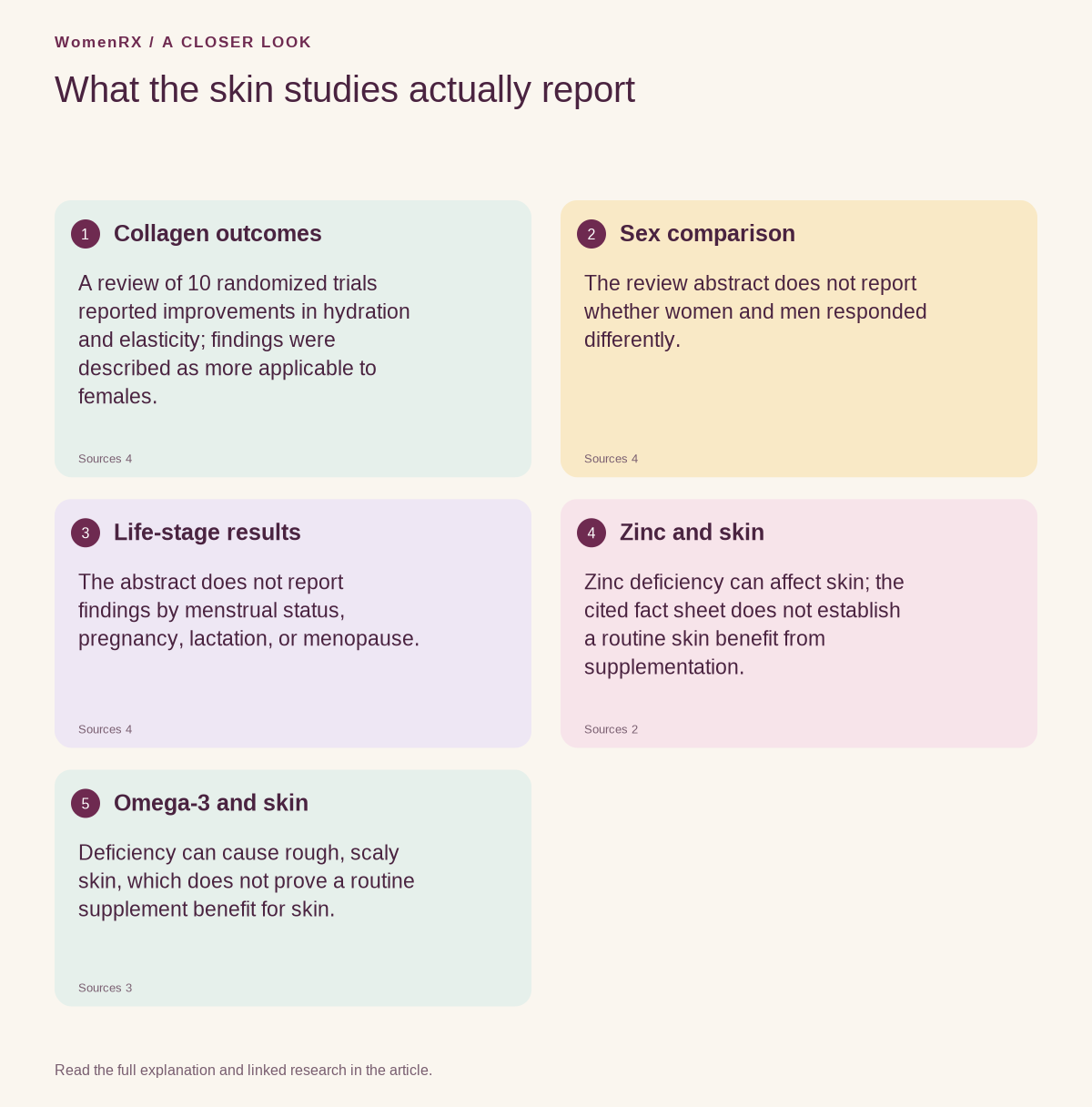
What the skin studies actually report
Collagen outcomes: A review of 10 randomized trials reported improvements in hydration and elasticity; findings were described as more applicable to females.4
Sex comparison: The review abstract does not report whether women and men responded differently.4
Life-stage results: The abstract does not report findings by menstrual status, pregnancy, lactation, or menopause.4
Zinc and skin: Zinc deficiency can affect skin; the cited fact sheet does not establish a routine skin benefit from supplementation.2
Omega-3 and skin: Deficiency can cause rough, scaly skin, which does not prove a routine supplement benefit for skin.3
Read the figure as text
This evidence map separates a reported skin outcome from a sex comparison or life-stage finding.- Collagen outcomes: A review of 10 randomized trials reported improvements in hydration and elasticity; findings were described as more applicable to females.4
- Sex comparison: The review abstract does not report whether women and men responded differently.4
- Life-stage results: The abstract does not report findings by menstrual status, pregnancy, lactation, or menopause.4
- Zinc and skin: Zinc deficiency can affect skin; the cited fact sheet does not establish a routine skin benefit from supplementation.2
- Omega-3 and skin: Deficiency can cause rough, scaly skin, which does not prove a routine supplement benefit for skin.3
More questions, answered
Does collagen work better for women?
The review says its findings are more applicable to females, but its abstract doesn’t report a direct comparison showing that women benefit more than men. It also doesn’t give results by life stage. 4
Does a nutrient deficiency mean a supplement will improve my skin?
Not necessarily. Zinc deficiency can affect skin, and essential-fatty-acid deficiency can cause rough, scaly skin, but those findings don’t establish a skin benefit from supplementation in someone who isn’t deficient. 2 3
Sources you can check
- Dietary Supplements and Life Stages: Pregnancy - Health Professional Fact SheetAccessed 2026-09-25Return to first citation
- Zinc - Health Professional Fact SheetAccessed 2026-09-25Return to first citation
- Omega-3 Fatty Acids - Health Professional Fact SheetAccessed 2026-09-25Return to first citation
- Effects of collagen-based supplements on skin's hydration and elasticity: A systematic review and meta-analysis.Danessa G, Notario D, Regina R. · Indian journal of dermatology, venereology and leprology · 2025Return to first citation