Can IBS Symptoms Change During Perimenopause?
Bowel symptoms can shift around menstrual and menopause-related changes, but the evidence doesn’t show that perimenopause explains every flare.
Yes, bowel symptoms may change alongside menstrual and menopause-related changes. Research finds that women with and without IBS often report more symptoms around menstruation, while studies of menopause are limited and don’t establish that perimenopause causes a flare. If you think you may have IBS and symptoms have lasted more than four weeks, discuss them with a clinician rather than assuming they’re IBS. 3 5 6
What the evidence says about hormones and IBS
IBS can cause abdominal pain or cramping, bloating, diarrhea, constipation, or a mix of bowel changes. Symptoms may come and go, and a flare doesn’t always have an obvious trigger. 1 2 3
Menstrual patterns offer a clearer research signal than perimenopause does. A meta-analysis found that women with IBS and women without IBS reported more IBS symptoms during menstruation than during other parts of the cycle. The review also found that there wasn’t enough evidence to determine how menopause or hormone supplementation affects IBS symptoms. 5
A review of earlier research described reports of increased gut symptoms around menstruation and perimenopause. It discussed changes in ovarian hormones as one possible explanation, but emphasized the need for more human research. That makes hormonal changes a plausible contributor, not a proven cause of any one person’s bowel symptoms. 6
Menopause findings aren’t the same as perimenopause findings
One study compared people with IBS across age and menopause groups. The 52 postmenopausal women in the study reported more severe IBS symptoms and worse physical quality of life than the 190 premenopausal women. It was a comparison of established pre- and postmenopause groups, not a study showing what happens during perimenopause or proving hormones caused the difference. 7
So if symptoms change during the transition, it’s reasonable to notice whether the timing seems to line up. But the research doesn’t support treating every new or worsening bowel problem as a hormone-driven IBS flare. Even an established IBS diagnosis doesn’t rule out another explanation for a change in symptoms. 1 5 7
Track patterns without turning them into a diagnosis
A short, practical record can help you see whether symptoms tend to cluster around a particular part of your cycle or occur independently of it. You might note:
- Bowel symptoms: pain or cramps, bloating, constipation, diarrhea, and whether symptoms come and go.
- Cycle timing: bleeding dates and any noticeable symptom changes around them.
- Other context: sleep changes, foods or drinks that seem relevant, and any recent changes in medicines or routine. Food and drink can trigger some IBS flare-ups, though triggers differ. 3
Look for a pattern over time, not a perfect explanation for every difficult day. For example, if constipation tends to appear around the same point in several cycles, that’s useful context to share. It still doesn’t confirm that hormones are the cause. Tracking sleep or other midlife changes can provide context without implying they’re established IBS triggers.
When not to assume it’s IBS
If you think you may have IBS and your symptoms have lasted more than four weeks, discuss them with a clinician. An evaluation can check for IBS and other possible causes. IBS has no single specific test, and tests may be used to rule out other conditions. 1 3
Hormone therapy shouldn’t be treated as an established IBS treatment based on this evidence. Menopause guidance describes hormone therapy for particular menopause-related symptoms and bone health, while the review of IBS research found too little evidence to determine the effect of hormone supplementation on IBS. 4 5
The useful takeaway is to keep both possibilities in view: cycle-related changes may coincide with gut symptoms, and a bowel change can have another cause. A clear record of what changed and when can help make that distinction more useful in an assessment.
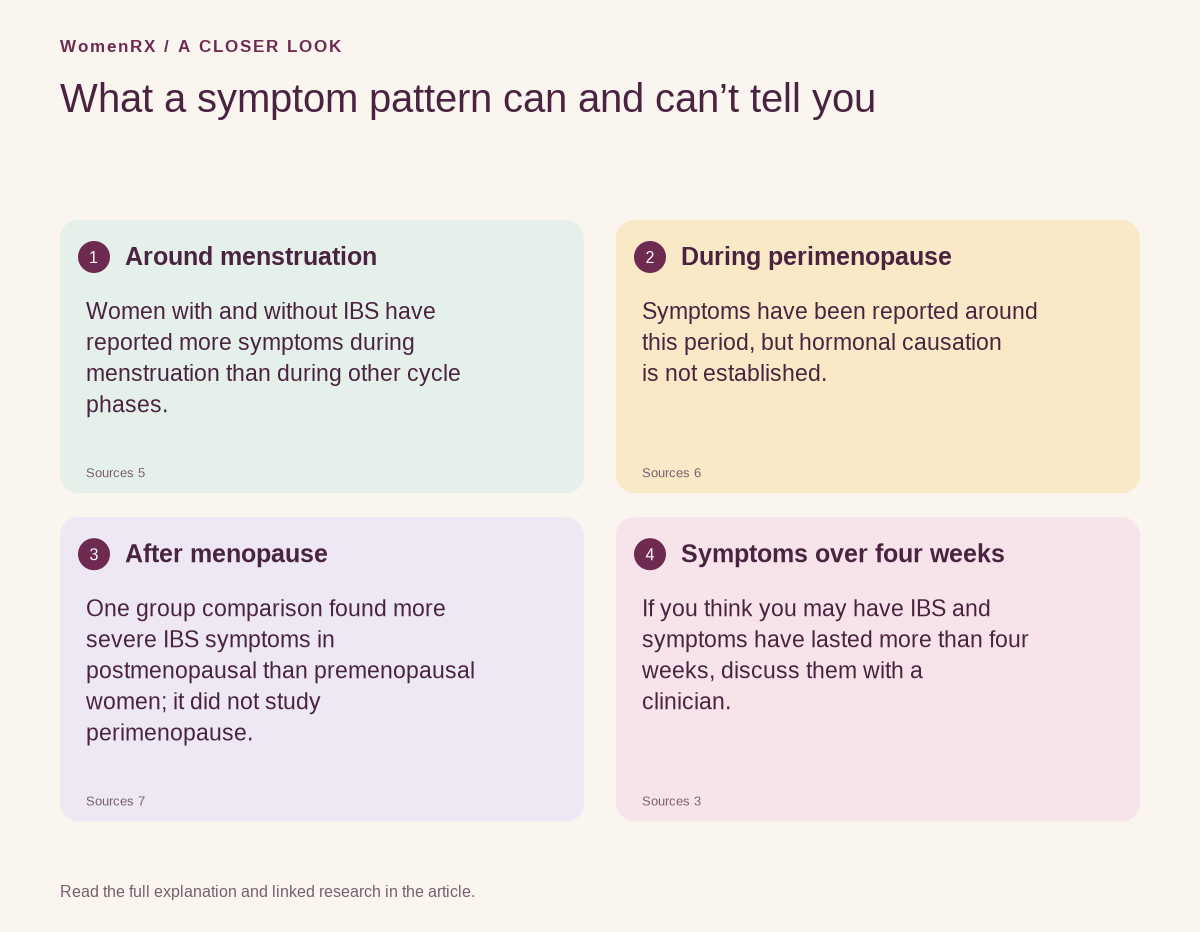
What a symptom pattern can and can’t tell you
Around menstruation: Women with and without IBS have reported more symptoms during menstruation than during other cycle phases.5
During perimenopause: Symptoms have been reported around this period, but hormonal causation is not established.6
After menopause: One group comparison found more severe IBS symptoms in postmenopausal than premenopausal women; it did not study perimenopause.7
Symptoms over four weeks: If you think you may have IBS and symptoms have lasted more than four weeks, discuss them with a clinician.3
Read the figure as text
Compare the pattern you observe with what research can support. A timing link can be useful context, but it does not establish the cause of a bowel change.- Around menstruation: Women with and without IBS have reported more symptoms during menstruation than during other cycle phases.5
- During perimenopause: Symptoms have been reported around this period, but hormonal causation is not established.6
- After menopause: One group comparison found more severe IBS symptoms in postmenopausal than premenopausal women; it did not study perimenopause.7
- Symptoms over four weeks: If you think you may have IBS and symptoms have lasted more than four weeks, discuss them with a clinician.3
More questions, answered
Does IBS usually get better after menopause?
The evidence doesn’t give a dependable answer. One study found more severe IBS symptoms among postmenopausal than premenopausal women with IBS, but it compared groups at one point rather than following the same women through the transition. 7
Can hormone therapy treat IBS?
The evidence cited here doesn’t establish hormone therapy as an IBS treatment. A review found insufficient data to determine the effect of hormone supplementation on IBS symptoms. 5
Sources you can check
- Irritable Bowel Syndrome | IBS | MedlinePlusAccessed 2026-09-25Return to first citation
- What is IBS (irritable bowel syndrome) - NHSAccessed 2026-09-25Return to first citation
- Symptoms of IBS (irritable bowel syndrome) - NHSAccessed 2026-09-25Return to first citation
- The 2022 hormone therapy position statement of The North American Menopause Society.“The 2022 Hormone Therapy Position Statement of The North American Menopause Society” Advisory Panel. · Menopause (New York, N.Y.) · 2022Return to first citation
- Meta-analysis: do irritable bowel syndrome symptoms vary between men and women?Adeyemo MA, Spiegel BM, Chang L. · Alimentary pharmacology & therapeutics · 2010Return to first citation
- Do fluctuations in ovarian hormones affect gastrointestinal symptoms in women with irritable bowel syndrome?Heitkemper MM, Chang L. · Gender medicine · 2009Return to first citation
- Postmenopausal women with irritable bowel syndrome (IBS) have more severe symptoms than premenopausal women with IBS.Lenhart A, Naliboff B, Shih W, Gupta A, Tillisch K, Liu C, Mayer EA, Chang L. · Neurogastroenterology and motility · 2020Return to first citation